
🛒 Best Price Today on Amazon
Prime members get fast, free shipping on everything above, plus member-only deals. New members get a 30-day free trial — cancel anytime.
A residential battery system has to answer three questions at once: how much energy it stores, how much power it can deliver at one moment, and how it recharges. All-in-one battery inverter systems combine those functions into a single package or a matched set, with a battery, an inverter, a solar charge controller, and outlets or a home connection in one system. That integration makes comparison easier, because the headline numbers describe the whole system rather than separate parts.
For a home, the difference between capacity and output matters. Capacity, measured in watt-hours, decides how long the system can run loads. AC output, measured in watts, decides which appliances can run at the same time.
Our top pick: EF ECOFLOW DELTA Pro Ultra 12kWh Power Station. Runner-up: BLUETTI AC300 Solar Generator with B300K Expansion Battery.
This guide compares published specifications only: battery capacity in watt-hours, continuous AC output in watts, solar input in watts, battery chemistry, expandable capacity, and output voltage.
At a Glance
| Product | Best for | Key specification |
|---|---|---|
| EF ECOFLOW DELTA Pro Ultra 12kWh Power Station | Whole-home backup with high output | 12kWh capacity, 7,200 W AC output, 120/240 V |
| BLUETTI AC300 Solar Generator with B300K Expansion Battery | Modular expansion for larger homes | 3,000 W inverter, expandable to 12,288 Wh |
| EF ECOFLOW DELTA Pro 3600Wh Portable Power Station | Portable home backup and outages | 3,600 Wh capacity, 3,600 W AC output |
| GROWATT 3500W Hybrid Solar Inverter SPF 3500TL | Fixed off-grid solar with a 48 V battery | 3,500 W inverter, MPPT charge controller |
How to Choose
1. Size capacity to your essential loads
List the appliances you need during an outage, their watt draw, and how many hours they must run. Multiply watts by hours to estimate watt-hours, then compare that figure with the published capacity of each system.
2. Check continuous AC output and voltage
Continuous AC output decides whether a system can run a refrigerator, well pump, or air conditioner alongside lights and chargers. Systems with 120/240 V output can support 240 V loads, while 120 V only systems suit smaller load lists. Check surge output as well, since motors draw extra power at startup.
3. Compare solar input and recharge options
Solar input, measured in watts, decides how fast panels can recharge the battery during daylight. Also check AC charging speed, car charging, and generator charging where listed.
4. Look at battery chemistry and cycle life
Most systems in this group use lithium iron phosphate, known as LFP, for longer cycle life and stable operation. Check the published chemistry and the number of charge cycles to the stated capacity retention, since those figures affect how long the system holds useful capacity.
5. Check expansion and parallel operation
Some systems accept extra batteries to raise total capacity, while others allow two inverters to be paired for higher output. If your load list may grow, choose a system whose published expansion path matches that plan rather than assuming a later add-on will fit.
6. Confirm transfer, app control, and outlets
Check whether the system supports a transfer switch or a smart home panel, how many AC outlets it provides, and whether an app shows state of charge, input, and output. Those details decide how the system fits into daily use and how it behaves when grid power fails.
Our Picks
EF ECOFLOW DELTA Pro Ultra 12kWh Power Station — ASIN B0CQXM3NJL

This EcoFlow system combines a DELTA Pro Ultra inverter with extra battery capacity for a listed 12kWh total, with 120/240 V output and 7,200 W of AC output. Published specifications describe expansion to 90kWh with additional batteries, LFP battery chemistry, and solar charging for home use. The package includes the inverter, two batteries, connection cables, and a portable stand.
Best for: Whole-home backup where high AC output and large expandable capacity are the main requirements.
Consideration: The system is large and heavy as a complete set, so plan floor space, ventilation, and a clear path for installation before ordering.
BLUETTI AC300 Solar Generator with B300K Expansion Battery — ASIN B0CFQ9NNQJ

The BLUETTI AC300 is a modular inverter unit with a 3,000 W pure sine wave inverter and a 6,000 W surge rating, paired here with a B300K expansion battery. Published specifications describe expansion to 12,288 Wh with up to four B300 battery modules and solar input up to 2,400 W. The AC300 unit itself has no built-in battery and must work with a B300 or B300K module.
Best for: Homes that want to start with one battery module and add capacity later without replacing the inverter.
Consideration: The inverter module cannot run on its own, so confirm that the listing includes the battery module and cables needed for the capacity you plan to use.
EF ECOFLOW DELTA Pro 3600Wh Portable Power Station — ASIN B0C1Z4GLKS

The DELTA Pro provides 3,600 Wh of capacity and 3,600 W of AC output from five 120 V AC outlets, with LFP battery chemistry and solar charging support. Published specifications describe expandable capacity to 25kWh with extra batteries and a fast AC recharge time. It is designed as a portable power station for home backup, camping, and RV use.
Best for: Essential-load backup in a portable form, including refrigerators, lights, chargers, and small appliances during an outage.
Consideration: At 3,600 Wh, total runtime is limited for heavy or continuous loads, so match the load list carefully and consider an extra battery for longer outages.
GROWATT 3500W Hybrid Solar Inverter SPF 3500TL — ASIN B0G47BTH85
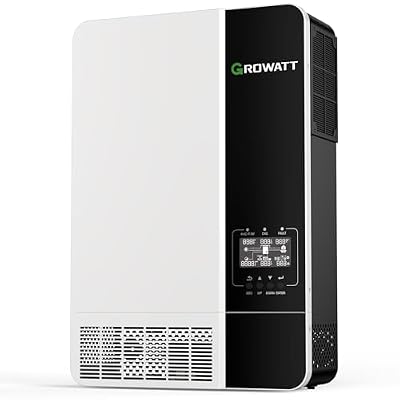
The Growatt SPF 3500TL is a 3,500 W hybrid solar inverter with a built-in MPPT charge controller, converting 48 V DC battery power to 120 V AC pure sine wave output. Published specifications describe support for 48 V lithium and AGM batteries, parallel operation, and UL1741 and IEEE1547 compliance. It is an inverter and charge controller unit rather than a system with an integrated battery.
Best for: A fixed off-grid or backup solar installation where a separate 48 V battery bank is already planned.
Consideration: A compatible 48 V battery, wiring, and protection must be added separately, so total system capacity depends on the battery bank chosen.
Which One Is Right for You?
Choose the EcoFlow DELTA Pro Ultra 12kWh system if you need 120/240 V output and the largest capacity in this group. Choose the BLUETTI AC300 with B300K battery if modular expansion matters more than a single integrated unit. Choose the EcoFlow DELTA Pro 3600Wh if you want portable backup for essential loads, and choose the Growatt SPF 3500TL if you are building a fixed solar system around a separate 48 V battery bank.
Frequently Asked Questions
What does all-in-one mean for a battery inverter system?
It means the battery, inverter, solar charge controller, and outlets or home connection are supplied as a matched system. Some systems integrate all parts in one unit, while others pair an inverter module with matched battery modules.
How much capacity do I need for home backup?
Add up the watt-hours of the loads you need to run and the hours they must run. Compare that total with the published capacity, and allow headroom for startup surges and for loads that run longer than planned.
Can these systems charge from solar panels?
Yes, each system in this group lists solar input or a built-in MPPT charge controller. Check the published maximum solar input in watts and the panel voltage range before choosing panels.
Do I need a separate battery with a hybrid inverter?
A hybrid inverter such as the Growatt SPF 3500TL needs a separate 48 V battery bank. Integrated power stations such as the EcoFlow DELTA Pro models include the battery in the listed capacity.
Bottom Line
For most homes comparing integrated systems, the EcoFlow DELTA Pro Ultra 12kWh system leads on capacity and 120/240 V output, with the modular BLUETTI AC300 system as the strongest choice for planned expansion.
Disclosure: As an Amazon Associate, this site earns from qualifying purchases.




Write Your Review
No reviews yet. Be the first to share your experience!