
🛒 Best Price Today on Amazon
Prime members get fast, free shipping on everything above, plus member-only deals. New members get a 30-day free trial — cancel anytime.
An RV trip changes what a generator has to do. At a campsite, the unit may run an air conditioner through a hot afternoon, charge batteries after dark, and power a microwave or coffee maker in the morning. At a trailhead or a dry-camping site, the same unit may need to start easily after a long drive, run on the fuel you already carry, and sit outside in dust, wind, and rain without a shelter nearby. An open-frame generator fits that kind of use because the frame is simple, the engine is exposed for airflow, and the control panel is easy to reach.
The trade-off is sound and size. Open-frame models are usually louder than enclosed inverter models, and the larger units in this group are heavy enough that wheels and a folding handle matter as much as wattage. That is why the choice should start with the loads you plan to run at the same time, not with the largest number on the box. Add the starting watts for the air conditioner, then add the running watts for the other loads, and compare that total with the running watts of each generator below.
Our top pick: Westinghouse WGen9500DF. Runner-up: Champion Power Equipment 100416.
This guide compares published specifications only: starting watts, running watts, fuel type, tank size, outlet mix, starting method, and dry weight.
At a Glance
| Product | Best for | Key specification |
|---|---|---|
| Westinghouse WGen9500DF | Large RVs with a rooftop air conditioner | 12,500 peak watts and 9,500 running watts on gasoline |
| Champion Power Equipment 100416 | Tri-fuel flexibility on long trips | 10,000 starting watts and 8,000 running watts on gasoline |
| DuroMax XP12000EH | High-demand RV setups with dual-fuel use | 12,000 starting watts and 9,500 running watts on gasoline |
| Generac GP8000E | Mid-size RVs that need electric start | 10,000 starting watts and 8,000 running watts on gasoline |
How to Choose
1. Match running watts to simultaneous loads
Start with the air conditioner, because its starting draw is the largest single load in most RVs. Then add the converter, refrigerator, and any small appliances you plan to run at the same time.
2. Choose the fuel you can carry and store
Gasoline is widely available on the road, while propane stores well and avoids stale-fuel problems during long storage. A dual-fuel or tri-fuel model lets you switch when one fuel is easier to find at a campground or a rural stop.
3. Check the RV outlet on the panel
A 30-amp RV outlet, listed as a TT-30R, connects directly to most travel-trailer shore cords with a standard adapter. Larger motorhomes may need a 50-amp outlet or a twist-lock connection.
4. Weigh starting method against weight and size
Electric start with a remote is convenient at a campsite, especially in cold mornings or after the unit has sat for a week. Recoil start keeps the design simpler and lighter, but it requires a firm pull.
5. Read tank size and run time together
A larger tank supports longer runs between refills, which matters for overnight air conditioning. Run time is always tied to load, so compare the load level stated in the listing, usually a quarter load, before you compare two models.
Our Picks
Westinghouse WGen9500DF — ASIN B07Q1DLKBG
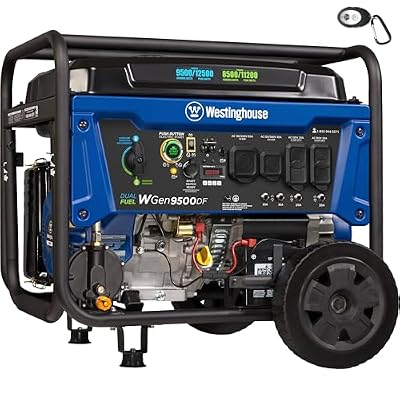
The Westinghouse WGen9500DF is listed with 12,500 peak watts and 9,500 running watts on gasoline, and 11,200 peak watts and 8,500 running watts on propane, from a 457cc engine with a 6.6-gallon fuel tank. Remote electric start, push-button start, and a transfer-switch-ready panel with a 50-amp outlet are listed in the published specifications.
Best for: Large RVs that run an air conditioner and several other loads at once.
Consideration: At 9,500 running watts on gasoline, this is a large, heavy unit, so check the weight, the wheel kit, and the space in your truck bed or storage bay before you choose it.
Champion Power Equipment 100416 — ASIN B091ZGFVNJ

The Champion 100416 is listed with 10,000 starting watts and 8,000 running watts on gasoline, 9,000 starting watts and 7,200 running watts on propane, and 8,750 starting watts and 7,000 running watts on natural gas, from a 459cc engine. Electric start, a CO Shield carbon monoxide shutoff system, and an Intelligauge digital meter are listed in the published specifications.
Best for: Long RV trips where fuel availability changes from stop to stop.
Consideration: Running watts fall on propane and natural gas, so size your loads against the fuel you plan to use most often, not only against the gasoline rating.
DuroMax XP12000EH — ASIN B01M0N8256

The DuroMax XP12000EH is listed with 12,000 starting watts and 9,500 running watts on gasoline, with dual-fuel operation on gasoline or propane, from a 458cc engine. Electric start, a transfer-switch-ready panel, and an RV-ready outlet configuration are listed in the published specifications.
Best for: High-demand RV setups that need a large margin above the air conditioner load.
Consideration: This is a full-size open-frame unit, so measure the storage space and confirm that you can move it safely on uneven ground.
Generac GP8000E — ASIN B0CDMBYFR5

The Generac GP8000E is listed with 10,000 starting watts and 8,000 running watts on gasoline, from a 420cc engine with an 8.5-gallon fuel tank and a listed run time of 11 hours at a quarter load. Electric start, a battery, COsense carbon monoxide shutoff, and PowerRush starting technology are listed in the published specifications.
Best for: Mid-size RVs that want electric start and a long run between refills.
Consideration: The running-watt ceiling is lower than the two 9,500-watt models above, so add your simultaneous loads carefully before you choose it.
Which One Is Right for You?
Choose the Westinghouse WGen9500DF or the DuroMax XP12000EH when a large air conditioner and several other loads run together. Choose the Champion 100416 when you want to switch between gasoline, propane, and natural gas across different stops. Choose the Generac GP8000E when a mid-size RV, electric start, and a long interval between refills matter more than the highest running-watt rating.
Frequently Asked Questions
Can an open-frame generator run an RV air conditioner?
Yes, when the running watts cover the air conditioner plus the other loads running at the same time. Check the air conditioner starting watts against the generator peak watts, and check the continuous draw against the running watts.
Do I need a 30-amp RV outlet?
Most travel trailers connect through a 30-amp RV outlet, listed as a TT-30R, or through an adapter from a twist-lock outlet. Confirm the outlet type on the generator panel and the plug on your shore cord before a trip, and carry the adapter that matches the pair you own.
Is propane better than gasoline for RV trips?
Propane stores for long periods without the stale-fuel problems that gasoline can develop, and many RVs already carry propane tanks. Gasoline usually gives a higher running-watt rating on the same generator and is available at almost every fuel stop.
How far from the RV should the generator sit?
Place the generator outdoors on level ground, away from doors, windows, vents, and sleeping areas, with the exhaust pointed away from the RV and from neighbouring sites. Use a cord rated for the load and the distance, and never run a portable generator inside a garage, an awning enclosure, or the RV itself.
Bottom Line
For most RV trips, the right open-frame generator is the one whose running watts, fuel options, and outlet mix match the loads you actually run together. The Westinghouse WGen9500DF leads this group on running watts and dual-fuel flexibility, while the Champion 100416 leads on fuel choice and the Generac GP8000E leads on simple electric start for a mid-size rig.
Disclosure: As an Amazon Associate, this site earns from qualifying purchases.




Write Your Review
No reviews yet. Be the first to share your experience!