
🛒 Best Price Today on Amazon
Prime members get fast, free shipping on everything above, plus member-only deals. New members get a 30-day free trial — cancel anytime.
A die grinder reaches the jobs a bench grinder and an angle grinder cannot: cleaning a weld bead inside a generator frame, opening up a cast iron exhaust port, deburring a drilled hole in a mounting bracket, or polishing a gasket face flat. It spins small mounted stones, carbide burrs and cut-off wheels on a slim spindle at speeds no drill can match, and the standard 1/4 inch collet means one bit collection fits nearly every model.
The five grinders below cover all three power choices. Two plug in, two run on battery packs, and one runs on shop air. Each was picked for engine and generator work first.
As an Amazon Associate, we earn from qualifying purchases.
Quick answer
If the tool will live on a bench, pick a corded model: the Makita GD0601 for its sealed motor and AC/DC appetite, or the DEWALT DWE4887 if a paddle switch matters more. Away from the bench, the DEWALT DCG426B and the right-angle Milwaukee 2485-20 remove the cord, and the Milwaukee head reaches ports a straight tool cannot face squarely. Shops with a healthy compressor should look at the Ingersoll Rand 3101G, the lightest tool here.
1. Makita GD0601 1/4 Inch Die Grinder

The GD0601 is the long-running bench standard in this class. Its 3.5 amp motor turns a single fixed speed of 25,000 RPM, and the slim barrel body is easy to guide one-handed. The AC/DC switch gear is the quiet headline feature: this grinder runs happily from a welder or a portable generator, which matters when the machine under repair is the one supplying it.
Makita protects the motor with labyrinth seals and a zig-zag varnish on the windings, so grinding dust stays away from the bearings, and vents aim exhaust air away from your face. The slide switch locks on for long sessions, so treat it with respect and switch off before setting the tool down. A rounded collet nut will not gouge a finished face mid-pass.
Specs
– Power: corded, 3.5 amp motor
– Speed: 25,000 RPM, fixed
– Collet: 1/4 inch (1/8 inch cone available)
– Max wheel point diameter: 1-1/2 inch
– Switch: slide switch with lock-on
– Weight: 3.7 lb
2. DEWALT DWE4887 1-1/2 Inch Die Grinder

The DWE4887 matches the Makita on headline numbers, with a 4.2 amp motor, a fixed 25,000 RPM and AC/DC capacity for generator or welder power. The big difference is control layout: a paddle switch with a lock-off button. The tool runs only while your hand holds the paddle down, and it cannot be bumped into life inside a toolbox or on a crowded bench. For work inside an engine bay, that dead-man control is a genuine safety edge.
DEWALT ships this grinder with both 1/4 inch and 1/8 inch collets, so it takes small burrs and stones for fine work as well as standard bits. The long nose reaches down into ports and recesses, and the housing shrugs off daily shop knocks.
Specs
– Power: corded, 4.2 amp motor, AC/DC capacity
– Speed: 25,000 RPM, fixed
– Collets: 1/4 inch and 1/8 inch, both included
– Max wheel diameter: 1-1/2 inch
– Switch: paddle switch with lock-off
– Weight: about 3.7 lb
3. DEWALT DCG426B 20V MAX Die Grinder

The DCG426B takes the same job cordless. A brushless motor on the 20V MAX platform drives a variable speed dial with a top speed of 25,000 RPM, and that dial is the reason to buy it: slow down for flap wheels and polishing, run flat out for carbide burrs in cast iron. An LED light at the nose helps inside dark housings and frame rails.
It is sold as a bare tool, so it needs a 20V MAX pack, and grinding drains a pack in minutes. Keep two packs in rotation. In exchange you get a grinder with no cord to drag across a wet yard, a running engine or a hot exhaust manifold.
Specs
– Power: 20V MAX battery platform, tool only
– Motor: brushless
– Speed: variable, up to 25,000 RPM
– Collet: 1/4 inch
– Light: LED at the nose
– Weight: 3.4 lb, tool only
4. Milwaukee 2485-20 M12 FUEL Right Angle Die Grinder
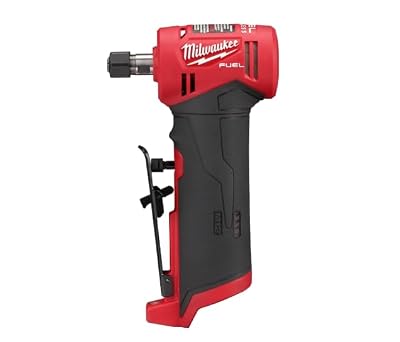
The 2485-20 puts a right-angle head on the compact M12 platform. That angled head lets the bit meet a port floor, a gasket face or a weld toe squarely, where a straight tool would work at a slant. Four speed modes top out at 25,000 RPM, and a paddle switch keeps the same dead-man safety logic as the corded DEWALT.
The brushless motor and small frame make this the easiest tool here to use overhead or deep inside an engine bay. It is a bare tool, and small M12 packs fade quickly under load, so the larger packs balance it better and keep it fed. The standard 1/4 inch collet means your existing burrs and stones carry straight over.
Specs
– Power: M12 battery platform, tool only
– Motor: brushless
– Head: right angle
– Speed: four modes, up to 25,000 RPM
– Collet: 1/4 inch
– Switch: paddle switch
5. Ingersoll Rand 3101G Edge Series Air Die Grinder

The 3101G is the air-powered option, a right-angle grinder from the Edge Series with a 0.33 HP vane motor and a 20,000 RPM free speed. It is feather-light next to the electric models, stays cool in the hand on long runs, and its rear exhaust points spent air away from the work.
The catch is supply. Air die grinders drink air: a tool in this class can pull roughly 18 cfm under load at 90 PSI even though its average consumption figure reads far lower, so a small pancake compressor will run nonstop and still fall behind. A workshop compressor with a decent tank and a regulator set at 90 PSI is the honest match. A safety throttle lever has to be flipped before the throttle will open.
Specs
– Power: pneumatic vane motor, 0.33 HP
– Free speed: 20,000 RPM
– Collet: 1/4 inch
– Head: right angle
– Air inlet: 1/4 inch NPT, 90 PSI working pressure
– Exhaust: rear
How to choose the right die grinder
Power source first. Corded tools give unlimited run time, and AC/DC models keep working from a generator when the grid is down. Cordless tools trade run time for freedom and shine on outdoor or in-bay work. Air tools are the lightest of all, but only make sense behind a compressor that can feed them.
Head shape. A straight body reaches down bores and ports and suits bench work. A right-angle head meets flat faces squarely and fits into bays where a long straight body would foul on hoses.
Speed control. Carbide burrs want full speed. Flap wheels, wire brushes and polishing points behave better turned down, so a speed dial earns its keep if you swap accessory types often.
Bits and collets. Nearly every die grinder uses a 1/4 inch collet; a second 1/8 inch collet widens the choice of fine accessories. Every accessory carries a maximum speed figure: never fit a wheel or brush whose limit sits below the speed of your tool.
Switch safety. A paddle switch stops the tool the moment your grip loosens. A lock-on slide switch is handy for long bench sessions but demands more care.
FAQ
Can I run a corded die grinder from a portable generator?
Yes. AC/DC models such as the two corded picks here are built for it, and run from generator or welder output as happily as from a wall socket.
How big a compressor does an air die grinder need?
Judge by consumption under load, not the small average figure in the headline specs. A die grinder can demand around 18 cfm at 90 PSI while cutting, so look for a compressor that can deliver close to that, or accept pauses while a smaller tank refills.
Do all die grinders take the same bits?
Nearly all use a 1/4 inch collet, so carbide burrs, mounted stones and cut-off wheels swap freely between brands. Some tools include or accept a 1/8 inch collet for finer accessories. Always match the accessory speed limit to the tool.
Straight or right-angle for engine work?
Straight tools reach deeper and suit porting and bench jobs. Right-angle heads meet gasket faces and weld toes squarely and fit tighter bays. Many busy shops end up owning one of each.
Verdict
For daily bench grinding, the Makita GD0601 remains the default pick, with the DEWALT DWE4887 close behind for paddle switch fans. The DCG426B and Milwaukee 2485-20 cover cordless work, straight and right-angle alike. If your shop air is up to the job, the Ingersoll Rand 3101G is the lightest, simplest tool here.

Write Your Review
No reviews yet. Be the first to share your experience!