Best Generator Surge Protectors for RV and Home Power
Compare the best generator surge protectors for RV and backup power: 30A and 50A inline units that guard against surges, low voltage, and faulty wiring.
A generator or a campground pedestal can deliver power that looks fine on the surface and still damage the electronics inside an RV or a home backup setup. Voltage can sag under load, spike after a storm, or arrive through a miswired outlet, and the air conditioner, refrigerator, and control boards are the parts that pay for it. An inline surge protector sits between the power source and the rig, watches the incoming line, and either absorbs the spike or cuts the power before the fault reaches anything expensive.
This guide compares five inline surge protectors that plug in at the pedestal or at the generator outlet, covering both common RV service sizes, 30 amp and 50 amp. Every pick is a portable unit that moves from site to site without tools, and every pick carries a real Amazon ASIN confirmed from the product information section of its Amazon listing. Two are full electrical management systems that disconnect on low voltage, high voltage, open ground, open neutral, and reverse polarity, two are smart Bluetooth and WiFi units that report voltage and current to a phone, and one is a simple surge and diagnostics unit for owners who want basic protection.
As an Amazon Associate, we earn from qualifying purchases.
The EMS-PT50X is the full-protection pick for 50 amp rigs, and it earns that place by doing more than absorbing spikes. It is a portable electrical management system rated for 50 amp service at 120 and 240 volts with a 12,000 watt capacity, and it watches the line continuously for low voltage, high voltage, open ground, open neutral, reverse polarity, and AC frequency outside the safe range. When it finds one, it disconnects the rig from the pedestal instead of passing the bad power through. A scrolling digital display shows voltage, current, and error codes, so the owner can see exactly why power was cut.
Surge absorption is rated at 3,580 joules across five modes with a maximum current spike rating of 88,000 amps, and the response time is under one nanosecond. A 50 amp coach usually carries two air conditioners, a residential refrigerator, and an inverter charger, so the value of what sits behind the protector is higher. The housing is tough Lexan plastic with an all-weather shield, a rugged pull handle, and a locking bracket, and it operates from minus 40 degrees Celsius to plus 105 degrees Celsius.
Two limits are worth noting. The unit is large and heavy at 18 by 6.25 by 5 inches and 4.94 pounds, and it hangs from the pedestal outlet, so owners with low or crowded pedestals should check clearance and consider a short adapter cord to take the weight off the receptacle. The surge module can also be used up by repeated spikes: an E 10 error code means the surge protection module is depleted, and the unit keeps passing power in that state, so the display has to be checked now and then. The listing states that the manufacturer does not consider the unit discontinued, and the warranty is a lifetime warranty that excludes the cover.
Specs
Amperage: 50 amps
Voltage: 120 and 240 volts
Maximum power: 12,000 watts
Surge protection: 3,580 joules, 5-mode, 88,000 amp maximum current spike
Response time: under 1 nanosecond
Operating temperature: minus 40 degrees Celsius to plus 105 degrees Celsius
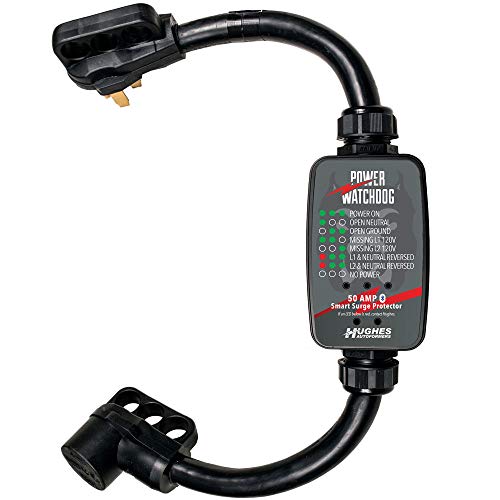
The Power Watchdog PWD50 takes a different approach from the Progressive units: instead of a display on the box, it sends voltage, amperage, and wattage readings to a phone over Bluetooth, so the owner can watch pedestal conditions from inside the RV. It is a 50 amp portable unit for 120 volt service, and it pairs that monitoring with emergency power off, which cuts the power when voltage moves outside the safe range and restores it once conditions stabilize. The enclosure is rated IP65 for dust and rain, which matters for a device that lives outdoors at the pedestal.
The surge rating needs a careful note because the listing itself gives two figures. The product information field lists 6,100 joules, while the product description states 6,000 joules. Both figures come from the same Amazon listing, and the article uses the product information figure of 6,100 joules. Either way, the rating is the highest in this roundup by a clear margin. The surge module is replaceable, which is a real advantage over sealed units: when the module is used up by a large spike, the owner swaps the module instead of replacing the whole protector.
The unit is compact at 8.5 by 3.75 by 2.75 inches with 8 to 10 inches of attached cable, and it weighs 3 pounds. That small footprint is a genuine benefit at crowded pedestals, where a long rigid unit can foul the cover or hang awkwardly. The trade is that there is no screen on the unit itself, so everything runs through the phone app, and an owner who does not want to rely on a phone for pedestal readings should weigh that before choosing it over a display model. It was first available on January 16, 2018, and the listing names Power Watchdog as the brand and Hughes Autoformers as the manufacturer.
Specs
Amperage: 50 amps
Voltage: 120 volts
Surge protection: 6,100 joules per product information (product description states 6,000 joules)
Connectivity: Bluetooth app monitoring of voltage, amperage, and wattage
Weather resistance: IP65
Dimensions: 8.5 x 3.75 x 2.75 inches, with 8 to 10 inches of attached cable
The EMS-PT30X is the 30 amp version of the full-protection Progressive unit, and it is the pick for travel trailers and smaller motorhomes that run on 30 amp service. It carries the same fault logic as its 50 amp sibling: it disconnects on low voltage, high voltage, open ground, open neutral, reverse polarity, and AC frequency outside the safe range, and a scrolling digital display shows voltage, current, and error codes. Surge absorption is rated at 1,790 joules across three modes with a maximum current spike rating of 44,000 amps, which matches the smaller service size.
A 30 amp rig has one air conditioner and a smaller inverter charger, but the same pedestal faults can damage them, and a single low-voltage afternoon can shorten an air conditioner compressor life. The PT30X cuts power before the damage happens, then restores it when the line is safe again. The housing is the same tough Lexan design with an all-weather shield, a rugged pull handle, and a locking bracket, and it operates from minus 40 degrees Celsius to plus 105 degrees Celsius. The display is the feature that separates it from cheaper surge-only units: when the power goes out at the pedestal, the error code tells the owner whether the problem is low voltage, an open neutral, or a surge module that has been used up.
One catalog quirk is worth flagging. The product information field for item weight reads 0.01 ounces, which is clearly a catalog figure rather than the real weight of a unit this size, so the article treats weight as not stated. The dimensions are listed as 18 by 6.25 by 5 inches, the same as the 50 amp model, so owners should plan for a long unit hanging from the pedestal and check cover clearance. The listing states that the manufacturer does not consider the unit discontinued, and the warranty is a lifetime warranty that excludes the cover.
Specs
Amperage: 30 amps
Voltage: 120 volts
Maximum power: 3,600 watts
Surge protection: 1,790 joules, 3-mode, 44,000 amp maximum current spike
Response time: under 1 nanosecond
Operating temperature: minus 40 degrees Celsius to plus 105 degrees Celsius
Dimensions: 18 x 6.25 x 5 inches
Weight: not stated (product information weight field reads 0.01 ounces, a catalog figure)
The Power Watchdog PWD30W is the newest unit in this roundup, a second-generation 30 amp model that adds WiFi to the Bluetooth monitoring of the original Power Watchdog line. It is a portable 30 amp unit that reports voltage, amperage, and wattage to a phone, and it carries emergency power off, which cuts the power when voltage moves outside the safe range and restores it once conditions stabilize. The surge rating is 3,000 joules, the highest of the 30 amp picks here, and the enclosure is rated IP65 for dust and rain.
WiFi is the feature that sets this unit apart from its Bluetooth-only sibling. With WiFi, the owner can check pedestal conditions without staying within Bluetooth range of the unit, which is useful when the rig is parked and the owner is away from the campsite for the day. The replaceable surge module design carries over, so a spent module can be swapped instead of replacing the whole unit. The model number is PWD30W, and the listing names Power Watchdog as the brand.
The limits are the ones that come with any phone-first device. There is no screen on the unit itself, so pedestal conditions are only visible through the app, and an owner who prefers a physical display should look at the Progressive or Southwire display models instead. The product information excerpt does not list dimensions or weight, so those figures are not stated here, and buyers should confirm the physical size on the listing before ordering if pedestal clearance is tight.
Specs
Amperage: 30 amps
Surge protection: 3,000 joules
Connectivity: WiFi and Bluetooth app monitoring of voltage, amperage, and wattage
The Southwire Surge Guard 44261 is the simple pick in this group, for owners who want surge protection and wiring-fault detection without paying for a full electrical management system or a smart app. It is a portable 30 amp unit rated for 120 volts with 2,100 joules of surge protection, and it plugs in at the pedestal with a single outlet and a Type B plug. Diagnostic LEDs indicate wiring faults, and an LED voltage monitor gives a basic read on pedestal conditions, which is enough to catch a miswired outlet before the rig is connected.
The honest trade is that this is a surge and diagnostics unit, not a full management system. It does not carry the automatic low-voltage and high-voltage disconnect logic of the Progressive EMS models, and it has no digital display, no Bluetooth or WiFi monitoring, and no replaceable surge module. Owners who camp at older parks with sagging voltage, or who run an air conditioner that is sensitive to low voltage, should understand that difference and consider one of the EMS picks instead. For owners who mostly stay at well-maintained parks, the simpler design is a reasonable fit, and the lower joule rating still covers the most common pedestal surges.
The unit weighs 0.73 kilograms and carries the Southwire brand with model number 44261 and part number 44261. It is the lightest and most compact pick in this roundup, which makes it easy to carry as a second unit or to keep in a storage bay. Buyers should confirm the plug style matches their service, since this is a 30 amp unit only and will not fit a 50 amp pedestal without an adapter, and an adapter does not turn a 30 amp protector into 50 amp protection.
Specs
Amperage: 30 amps
Voltage: 120 volts
Surge protection: 2,100 joules
Outlets: 1
Plug type: Type B, 3 pin (North American)
Features: diagnostic LEDs for wiring faults, LED voltage monitor
Weight: 0.73 kilograms
Model: 44261
UPC: 032886298080
How to Choose
Begin with the service size, because it decides everything else. A 30 amp RV uses a single 120 volt leg, while a 50 amp RV uses two 120 volt legs for 120 and 240 volt service, and the two plugs are physically different. A 30 amp protector cannot be plugged into a 50 amp pedestal without an adapter, and an adapter does not give 30 amp protection to a 50 amp rig. Check the pedestal plug on the rig first, then buy the matching amperage.
Next, decide how much fault logic is wanted. A full electrical management system disconnects the rig on low voltage, high voltage, open ground, open neutral, reverse polarity, and frequency faults, and it is the right choice for owners who run air conditioners, residential refrigerators, or inverter chargers. A surge-only unit with diagnostics absorbs spikes and flags wiring faults but does not disconnect on low voltage, so it suits owners who stay at well-maintained parks and want basic protection. The joule rating is the third factor: higher joules absorb larger spikes, and the ratings here run from 1,790 joules on the 30 amp Progressive to 6,100 joules on the 50 amp Hughes. Higher is better, but it is not the only factor, and a lower-joule unit with full fault logic can protect better overall than a higher-joule unit without it.
Then consider how the owner wants to see what is happening. A display on the unit, as on the two Progressive models, shows voltage and error codes at the pedestal without a phone. A Bluetooth or WiFi app, as on the two Hughes models, shows the same readings inside the rig, but it needs a charged phone and a working app. A simple LED unit, as on the Southwire 44261, shows only fault lights and needs no phone or display at all. Weather resistance matters as well: the Hughes units are rated IP65 for dust and rain, while the Progressive units rely on an all-weather shield and Lexan housing.
Finally, think about size and security. The Progressive units are long, at 18 inches, and hang from the outlet, so low pedestals and tight covers can be a problem, and a short adapter cord can take the weight off the receptacle. The Hughes units are compact, at about 8.5 inches for the 50 amp model, and fit crowded pedestals more easily. A locking bracket or lock ring helps keep a portable unit from walking away, and both Progressive models include one. Hardwired units exist for owners who never want to plug in a portable device, including hardwired versions from the same brands, but they need installation inside the rig and are a different purchase from the portable units in this guide.
Frequently Asked Questions
Do I need a 30 amp or a 50 amp surge protector?
Match the protector to the RV service, not to the generator. A 30 amp RV uses a TT-30 plug at 120 volts, and a 50 amp RV uses a 14-50 plug at 120 and 240 volts. The plugs are physically different, so the wrong size will not fit without an adapter, and an adapter does not change the protection rating. Check the shore power cord plug on the rig, then buy the same amperage. Owners who sometimes run on a generator should also check the generator outlet size, since a 30 amp generator outlet needs a 30 amp protector even if the rig is 50 amp.
What is the difference between a surge protector and an EMS?
A surge protector absorbs voltage spikes, while an electrical management system does that and also watches for wiring and voltage faults. An EMS disconnects the rig on low voltage, high voltage, open ground, open neutral, reverse polarity, and frequency faults, and it restores power once the line is safe again. A surge-only unit with diagnostics flags wiring faults with lights but does not disconnect on low voltage. The two Progressive picks here are full EMS units, the two Hughes picks combine surge protection with emergency power off and app monitoring, and the Southwire 44261 is a surge and diagnostics unit without full EMS disconnect logic.
Can a surge protector wear out?
Yes, and this is the detail most owners miss. The surge module inside the unit absorbs spikes, and each large spike uses up some of its capacity. On the Progressive EMS models, an E 10 error code means the surge module is depleted, and the unit keeps passing power in that state, so the display has to be checked. On the Hughes models, the surge module is replaceable, so a spent module can be swapped instead of replacing the whole unit. On sealed units without a replaceable module, the whole unit has to be replaced once the module is used up. A unit that has taken a direct lightning strike should be treated as spent.
Will a surge protector work with a generator?
Yes, provided the amperage matches and the generator output is stable. Portable inverter generators generally produce clean power that works well with these units, while older conventional generators can vary in voltage and frequency under load, which can cause an EMS to disconnect more often. That disconnect is the unit doing its job, not a fault in the unit. Owners running on generator power should size the protector to the generator outlet, keep the unit dry, and confirm that the generator ground and neutral arrangement matches what the protector expects, since an open ground reading on a floating-neutral generator can trigger a fault code.
Final Verdict
For 50 amp rigs, the Progressive Industries EMS-PT50X is the most complete portable pick, with full fault logic, a readable display, and 3,580 joules of surge absorption, while the Hughes Power Watchdog PWD50 suits owners who want phone monitoring, the highest joule rating here, and a replaceable surge module. For 30 amp rigs, the Progressive EMS-PT30X gives the same full fault logic with a display, the Hughes PWD30W adds WiFi monitoring with the strongest 30 amp joule rating in the group, and the Southwire 44261 covers basic surge and wiring-fault detection. Match the amperage first, choose full fault logic for air conditioners and sensitive electronics, and check the display or the app now and then.
Compare 5 jet ski covers for outdoor storage, from 600D universal covers to a model-specific 1000D cover, with sizing, vents, straps and waterproofing explained.

 Progressive Industries EMS-PT50X
 Hughes Power Watchdog PWD50
 Progressive Industries EMS-PT30X
 Hughes Power Watchdog PWD30W
 Southwire Surge Guard 44261



Write Your Review
No reviews yet. Be the first to share your experience!