
Our Short List of 3
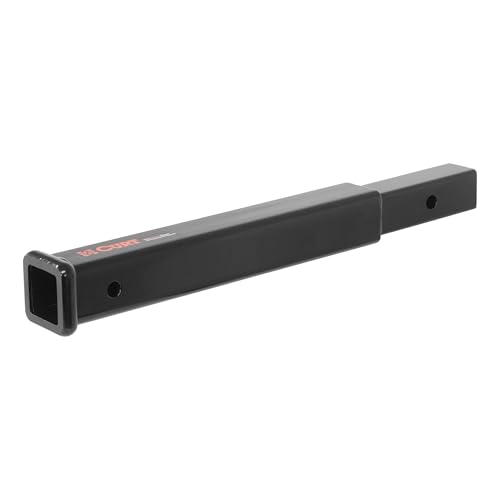
- Receiver size: 2 inch shank into 2 inch opening
- Extension length: 18 inches
- Gross trailer weight capacity: 3,500 lb
- Tongue weight capacity: 350 lb

- Receiver size: 2 inch shank, two 2 inch receiver tubes
- Tube spacing: about 5-13/16 inch rise to the upper tube
- Gross trailer weight capacity: 3,500 lb
- Tongue weight capacity: 350 lb

- Shank: 1-1/4 inch; opening: 2 inch receiver
- Extension length: 6-1/4 inches
- Tongue weight capacity: 350 lb
- Use: accessories only, not for towing
All 4 Picks at a Glance
| Product | Specs | Action |
|---|---|---|
| CURT 45796 18-Inch Receiver Tube Extender |
| Check price on Amazon |
| CURT 45792 Dual Receiver Extender |
| Check price on Amazon |
| CURT 45785 1-1/4 to 2 Inch Receiver Adapter Extender |
| Check price on Amazon |
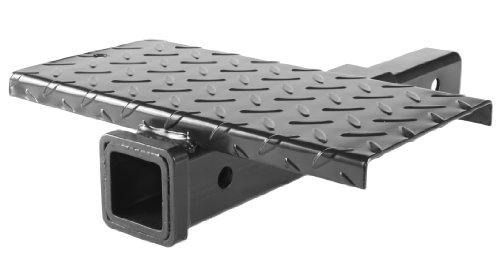 MaxxHaul 70069 Hitch Extender with Step |
| Check price on Amazon |
🛒 Best Price Today on Amazon
Prime members get fast, free shipping on everything above, plus member-only deals. New members get a 30-day free trial — cancel anytime.
A hitch extender is a short steel tube that slides into your receiver and moves the mounting point farther back. That extra space solves common headaches: a bike rack that dug into a rear spare tire suddenly fits, a cargo carrier stops blocking the tailgate, and a coupler gains room to swing on tight turns.
Extenders come in a few forms: plain extensions from about 7 to 18 inches, adapters that also change receiver size, dual-receiver models with a second tube, and step models that double as a foothold.
As an Amazon Associate, we earn from qualifying purchases.
Quick answer
The CURT 45791 is the safe default: 8 inches of extra room, a solid shank, and enough capacity for racks and light towing. For maximum reach, look at the 18-inch CURT 45796; for a bike rack above and a trailer below, pick the CURT 45792 dual receiver. Owners of small cars with 1-1/4 inch hitches need the CURT 45785 adapter, and truck owners will like the MaxxHaul 70069 with its built-in step.
CURT 45791 8-Inch Receiver Tube Extender
The 45791 is the extender most people picture: a one-piece steel tube with a solid 2-inch shank on one end and a fresh 2-inch receiver opening on the other. It adds 8 inches of length, the sweet spot for clearing a rear spare tire on a Wrangler or SUV while keeping a rack tucked close to the vehicle.
The gloss black powder coat holds up well against road salt and gravel spray. Gross trailer weight capacity is 3,500 pounds with 350 pounds of tongue weight, so light towing with a ball mount in the extender remains possible for small utility trailers. Treat that tongue figure as a ceiling, though: moving any load back increases leverage.
Specs
- Receiver size: 2 inch shank into 2 inch opening
- Extension length: 8 inches
- Gross trailer weight capacity: 3,500 lb
- Tongue weight capacity: 350 lb
- Construction: solid steel shank, gloss black powder coat
CURT 45796 18-Inch Receiver Tube Extender
- Receiver size: 2 inch shank into 2 inch opening
- Extension length: 18 inches
- Gross trailer weight capacity: 3,500 lb
- Tongue weight capacity: 350 lb
When 8 inches is not enough, the 45796 more than doubles it. At 18 inches, this is the longest extender in the CURT line, built for truck campers that overhang the bed, tailgates that must fold flat with a carrier installed, and couplers sitting close behind a spare tire or storage box.
The build mirrors the shorter model: solid 2-inch shank, 2-inch receiver tube, 3,500 pound gross trailer weight and 350 pound tongue weight capacities. That last point deserves care, because a longer tube multiplies leverage — a loaded carrier pushes down and twists harder than the same carrier near the bumper. Use it for light racks and clearance jobs rather than heavy towing, and pair it with an anti-rattle collar.
CURT 45792 Dual Receiver Extender
- Receiver size: 2 inch shank, two 2 inch receiver tubes
- Tube spacing: about 5-13/16 inch rise to the upper tube
- Gross trailer weight capacity: 3,500 lb
- Tongue weight capacity: 350 lb
The 45792 answers a different question: what if one receiver could do two jobs at once? Its 2-inch shank slides into the vehicle, and the far end carries two stacked 2-inch receiver tubes. The lower tube takes a ball mount for towing, while the upper tube holds an accessory such as a bike rack or cargo carrier.
The upper tube sits about 5-13/16 inches above the lower one, lifting a bike rack clear of the trailer tongue and coupler on most setups. The top tube is for accessories only — towing happens on the bottom tube — and the unit carries 3,500 pounds gross trailer weight capacity with 350 pounds of tongue weight. The trade-off is bulk: this is a chunk of steel you will notice at every install.
CURT 45785 1-1/4 to 2 Inch Receiver Adapter Extender
- Shank: 1-1/4 inch; opening: 2 inch receiver
- Extension length: 6-1/4 inches
- Tongue weight capacity: 350 lb
- Use: accessories only, not for towing
Plenty of sedans and small crossovers wear a 1-1/4 inch Class I or Class II hitch, while nearly every bike rack and cargo carrier on the shelf is built for a 2-inch tube. The 45785 bridges that gap: its 1-1/4 inch shank slides into the small receiver and presents a 2-inch opening, adding 6-1/4 inches of length in the process.
That length is a genuine bonus, moving the rack back far enough to open the hatch on many vehicles and keeping pedals away from the bumper. Limits matter, though. The adapter carries a 350 pound tongue weight capacity and is meant for accessories, not towing — no ball mount, no trailer. A four-bike rack plus bikes can approach that ceiling faster than you expect.
MaxxHaul 70069 Hitch Extender with Step
- Receiver size: fits 2 inch receiver
- Gross trailer weight capacity: 4,000 lb
- Tongue weight capacity: 400 lb
- Step plate: 7 x 14 inch, anti-slip diamond pattern
The 70069 adds a second job to the extender brief: it is also a step. A 7 by 14 inch diamond-pattern plate sits on top of the tube, giving a secure foothold for reaching a roof rack, tying down kayaks, or climbing into a truck bed.
As an extender, it fits a standard 2-inch receiver and moves the mounting point back far enough to clear most tailgates and rear spares. Capacity steps up as well, at 4,000 pounds gross trailer weight and 400 pounds of tongue weight, and the double powder coat finish shrugs off rust.
How to choose
Measure the clearance problem first. Mount your rack directly in the receiver and measure the gap you need — spare tire to rack, or tailgate arc to carrier rail. Then pick the shortest extender that clears it with an inch or two to spare, because every added inch multiplies the leverage on the receiver.
Understand the capacity cut. An extender does not change what your hitch can hold, but it changes how the load pushes on it: the farther back the weight sits, the harder it twists and presses down. That is why extender makers publish their own tongue weight limits, and why a common rule of thumb says an extension can cut usable tongue weight roughly in half. Use the lowest number among vehicle, hitch, and extender, and keep margin in hand.
Match the receiver size, and silence the rattle. Most extenders are 2 inch to 2 inch; a 1-1/4 inch hitch needs an adapter extender, and dual receivers solve a two-load problem rather than a size problem. Finally, two tubes and a pin always have some play, so fit an anti-rattle collar or hitch tightener — a U-bolt plate that clamps shank to receiver — to remove the clunking and the wear it causes.
FAQ
Can I tow a trailer with a hitch extender?
Yes, with the right model and modest loads. Straight extenders like the CURT 45791 and 45796 and the MaxxHaul 70069 carry published towing capacities, while adapter extenders such as the CURT 45785 are for accessories only.
Will an extender clear my rear spare tire?
Usually, yes. A rear-mounted spare typically eats 6 to 9 inches behind the receiver, so an 8-inch extender handles most Wrangler and SUV setups. Measure from the pin hole to the outer face of the tire, then choose an extender at least that long, plus a small margin.
Does a dual receiver extender let me tow and carry bikes together?
That is exactly its purpose. The trailer rides on the lower tube and the bike rack sits in the upper tube, reserved for accessories. Keep the combined tongue weight — trailer tongue plus rack and bikes — within the 350 pound limit.
How do I stop the clunking noise?
Fit an anti-rattle collar or hitch tightener at the vehicle receiver joint, and use a threaded or locking pin at the accessory joint if your rack supports one. Tightening both joints removes nearly all play.
Verdict
For most drivers, the CURT 45791 hits the balance of length, strength, and simplicity, and it earns the top spot here. Step up to the 45796 only when the tape measure says you truly need 18 inches, choose the 45792 when a trailer and a bike rack travel together, and reach for the 45785 when a small car needs to speak 2-inch. The MaxxHaul 70069 rounds out the list for truck owners who will use the step daily.





Write Your Review
No reviews yet. Be the first to share your experience!