
Our Short List of 3
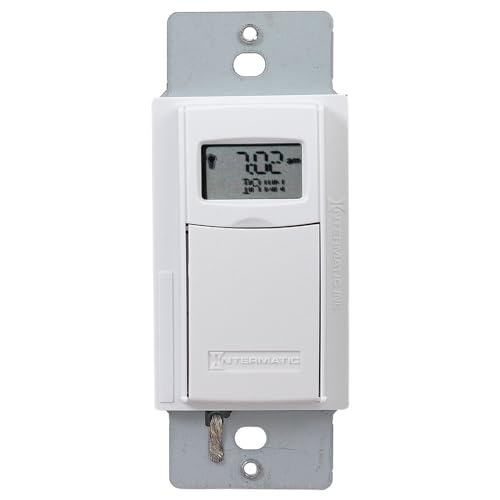
- Best for: Older homes without a neutral wire at the switch, and outdoor lights that should follow sunset.
- Backup: Replaceable CR2 lithium battery, up to 3 years
- Programs: Up to 40 ON/OFF events, 7-day, astronomic sunrise/sunset
- Wiring: No neutral connection required; single-pole or 3-way
- Rating: 15A, 120-277 VAC; LED ballast 5A at 120 VAC

- Best for: Households that want a different schedule for different days, plus a vacation mode for security lighting.
- Backup: Built-in rechargeable battery keeps settings during outages
- Programs: Up to 18 ON/OFF programs, 7-day scheduling, random and DST modes
- Wiring: Neutral wire required; single-pole or 3-way
- Rating: 15A/1875W resistive, 10A/1250W tungsten, 1/2 HP, 125 VAC

- Best for: A single light or fan on a simple, identical daily routine.
- Backup: Battery backup maintains settings during a power outage
- Programs: 4 programmable on/off buttons, 24-hour daily cycles
- Wiring: Neutral wire required; screw terminal installation
- Rating: 120 VAC, 15A general/resistive, 1200W tungsten, 1/2 HP, UL listed
All 3 Picks at a Glance
| Product | Specs | Action |
|---|---|---|
| Intermatic ST01 In-Wall Timer |
| Check price on Amazon |
| BN-LINK 7-Day Programmable In-Wall Timer Switch |
| Check price on Amazon |
| myTouchSmart In-Wall Digital Timer (26893) |
| Check price on Amazon |
🛒 Best Price Today on Amazon
Prime members get fast, free shipping on everything above, plus member-only deals. New members get a 30-day free trial — cancel anytime.
A light switch timer only earns its place if the schedule survives a power cut. When the grid drops and comes back, a timer without backup can lose its clock and its programs, leaving porch and hallway lights dark until someone reprograms it. A timer with a battery backup keeps time through the outage and resumes the schedule on its own.
Every pick in this guide is an in-wall timer switch whose listing states a battery backup in so many words. The three models split by how that backup works: a replaceable lithium cell rated in years, a built-in rechargeable battery, and a backup paired with simple preset buttons instead of a programming menu.
Quick Picks
As an Amazon Associate we earn from qualifying purchases.
| Product | Best for | Key spec from title |
|---|---|---|
| Intermatic ST01 In-Wall Timer | Older homes without a neutral wire | Replaceable CR2 battery backup, up to 3 years |
| BN-LINK 7-Day Programmable In-Wall Timer | Detailed weekly schedules | Built-in rechargeable battery, 18 ON/OFF programs |
| myTouchSmart In-Wall Digital Timer (26893) | Simple daily routines | Battery backup with 4 programmable buttons |
How to Choose
What the backup actually protects
Battery backup on a timer switch protects the clock and the stored programs, not the light itself: the load still goes dark while the power is out. The difference shows up when power returns. A backed-up timer knows what time it is and which program should be running, so the lights resume their pattern without a visit to the switch. Listings phrase this differently, from a stated backup protection time to a rechargeable cell that keeps settings intact, so read the exact wording. If a listing never mentions a battery or memory backup, assume the schedule is lost in an outage.
Replaceable cell versus built-in rechargeable
The Intermatic ST01 uses a replaceable CR2 lithium battery that the maker rates for up to three years of backup, and the battery also lets the timer run without a neutral wire. Built-in rechargeable designs, like the BN-LINK and myTouchSmart below, draw a small charge from the line while power is on and spend it during outages, so there is nothing to swap but also nothing to replace when the cell ages. Neither approach is automatically better. A replaceable cell suits a timer you expect to keep for many years; a rechargeable cell suits a set-and-forget install where opening the switch to change a battery is a chore.
Check the wiring your wall box offers
Wiring decides which timers you can install at all. The ST01 needs no neutral connection, which makes it the realistic option in older homes where the switch box holds only a hot and a load wire. The BN-LINK and myTouchSmart both require a neutral wire, stated plainly in their listings, so open the box and confirm a neutral bundle is present before ordering either. Also confirm the load rating covers what the switch controls: all three picks here are rated 15A resistive, but LED and motor ratings are lower, and fan loads should be checked against the listing’s stated ballast and horsepower figures.
Match the programming style to the routine
Scheduling depth varies more than the marketing suggests. A 7-day timer with many on/off programs, like the BN-LINK’s 18, can run a different pattern every day and add a random vacation mode. An astronomic timer, like the ST01, tracks sunrise and sunset and shifts with the seasons, which suits outdoor lights that should follow dusk. The myTouchSmart reduces programming to four preset on/off buttons on a repeating 24-hour cycle, which is easier to set but cannot vary by weekday. Pick the style that matches how your household actually lives, not the longest feature list.
The 3 Best Options
Intermatic ST01 In-Wall Timer
- Best for: Older homes without a neutral wire at the switch, and outdoor lights that should follow sunset.
- Backup: Replaceable CR2 lithium battery, up to 3 years
- Programs: Up to 40 ON/OFF events, 7-day, astronomic sunrise/sunset
- Wiring: No neutral connection required; single-pole or 3-way
- Rating: 15A, 120-277 VAC; LED ballast 5A at 120 VAC
Older homes without a neutral wire at the switch, and outdoor lights that should follow sunset.
The decorator wall plate is not included, and the timer is not for use with sunlamps or saunas.
The ST01 is the heavy-duty option, built around an astronomic clock that switches at sunrise and sunset and a 7-day schedule holding up to 40 ON/OFF events. Its backup is a replaceable CR2 lithium battery, and Intermatic’s technical data lists the backup type as battery backup with a protection time of three years, so a long outage does not erase the program. It is also the only pick here that needs no neutral wire, and its ratings reach beyond lighting to motor loads, with a 15A resistive rating across 120 to 277 volts.
BN-LINK 7-Day Programmable In-Wall Timer Switch
- Best for: Households that want a different schedule for different days, plus a vacation mode for security lighting.
- Backup: Built-in rechargeable battery keeps settings during outages
- Programs: Up to 18 ON/OFF programs, 7-day scheduling, random and DST modes
- Wiring: Neutral wire required; single-pole or 3-way
- Rating: 15A/1875W resistive, 10A/1250W tungsten, 1/2 HP, 125 VAC
Households that want a different schedule for different days, plus a vacation mode for security lighting.
The neutral wire is mandatory, so older switch boxes without one cannot use it.
BN-LINK’s timer is the scheduling maximalist of the three: up to 18 ON/OFF programs across a 7-day week, a random vacation mode that varies the pattern while you are away, and a daylight saving mode that shifts the clock without reprogramming. The listing states a built-in rechargeable battery that keeps settings intact during power outages, which is the feature this guide is built around. A blue backlit display makes the small screen readable in a dark hallway. It requires a neutral wire, works in single-pole and 3-way setups, and is ETL listed with a 15A, 1875W resistive rating.
myTouchSmart In-Wall Digital Timer (26893)
- Best for: A single light or fan on a simple, identical daily routine.
- Backup: Battery backup maintains settings during a power outage
- Programs: 4 programmable on/off buttons, 24-hour daily cycles
- Wiring: Neutral wire required; screw terminal installation
- Rating: 120 VAC, 15A general/resistive, 1200W tungsten, 1/2 HP, UL listed
A single light or fan on a simple, identical daily routine.
The daily cycle cannot give weekends a different schedule, and the wall plate is not included.
The myTouchSmart 26893 replaces menus with buttons: four programmable on/off buttons, two easy override buttons, and blue LED indicators that show which programs are active at a glance. Its listing states a battery backup that maintains settings in the event of a power outage, and the schedule repeats on a 24-hour daily cycle rather than a 7-day calendar. That simplicity is the point for a porch light or a fan that should do the same thing every day. It requires a neutral wire, installs with screw terminals, and is UL listed with ratings of 15A general and resistive, 1200W tungsten, and 1/2 HP.
Which One Fits Your Situation
Your switch box has no neutral wire
The Intermatic ST01 is the only realistic choice of the three, because it is designed to install without a neutral connection. Its CR2 battery carries the clock through outages for up to three years, and the astronomic mode means porch lights follow the seasons without reprogramming. Confirm the load is within its ratings, especially the lower limit for electronic ballast and LED loads, and remember to buy a decorator plate since one is not in the box.
You want lights that make the house look occupied on holiday
Take the BN-LINK. Its random vacation mode varies the on and off times so the pattern does not look mechanical, and the rechargeable backup keeps the whole program alive through any outage that happens while you are away. The 18-program capacity also lets you layer a normal weekday schedule under the vacation pattern. Just verify the neutral wire first; without it this timer cannot be installed, and the ST01 becomes the fallback.
You keep forgetting schedules and want buttons, not menus
The myTouchSmart 26893 suits you. Four labeled buttons carry the programs, the LEDs show what is active, and the override buttons let anyone switch the light manually without disturbing the schedule. The trade is flexibility: the same cycle repeats every day. For a porch light, a bathroom fan, or a shop light on a fixed routine, that trade is usually worth it, and the battery backup means a storm outage does not wipe the setup.
You are automating several different circuits
Mix the picks by circuit rather than standardizing on one. Use the ST01 where the wiring is old or the load follows dusk, the BN-LINK where the weekly pattern is complex, and the myTouchSmart where the routine never changes. All three are rated 15A resistive, but check each listing’s LED, ballast, and motor figures against the actual load on that circuit, because those secondary ratings differ more than the headline number suggests.
Common Mistakes
- Assuming battery backup keeps the lights on during an outage; it protects the clock and programs, not the load.
- Ordering a timer that needs a neutral wire before checking whether the switch box actually has one.
- Ignoring the lower LED, ballast, and motor ratings and judging the timer only by its 15A headline figure.
- Choosing a 24-hour daily timer for a routine that needs different weekday and weekend patterns.
- Forgetting that a replaceable backup battery, like the ST01’s CR2 cell, eventually needs changing.
Frequently Asked Questions
Does battery backup mean my lights stay on in a blackout?
No. The battery is far too small to power a light fixture; it keeps the timer’s clock running and its programs stored while the mains are down. When power returns, the timer resumes the correct schedule instead of sitting at a flashing default time. If you need actual light during an outage, that is a separate product category, such as a rechargeable emergency light, not a feature any in-wall timer switch provides.
How long does the backup in these timers last?
It depends on the design. Intermatic rates the ST01’s replaceable CR2 lithium battery at up to three years of backup protection. The BN-LINK and myTouchSmart use built-in rechargeable batteries that sip power from the line while it is live; their listings state that settings are preserved through outages without quoting a year figure. In practice, any of the three will carry a schedule through the short outages most homes see, and the replaceable cell is the one to plan around for multi-year life.
What if my switch box has no neutral wire?
Your options narrow quickly, because most digital timers draw operating power through a neutral. The Intermatic ST01 is built for exactly this case and needs no neutral connection, which is why it appears in this guide. If your heart is set on a neutral-required model like the BN-LINK, an electrician can sometimes pull a neutral into the box, but that is a wiring job, not a switch swap. Check the box before ordering anything.
Can one of these timers control a ceiling fan or a motor load?
Yes, within the stated ratings. The BN-LINK lists a 1/2 HP motor rating and names fans among its uses, the myTouchSmart also carries a 1/2 HP rating, and the ST01 lists motor loads up to 1 HP at 120 VAC. Compare the fan’s draw against the listing’s figures rather than the resistive headline, and avoid putting a heater or other high-draw appliance on a timer unless its rating explicitly covers that load type.





Write Your Review
No reviews yet. Be the first to share your experience!