🛒 Best Price Today on Amazon
Prime members get fast, free shipping on everything above, plus member-only deals. New members get a 30-day free trial — cancel anytime.
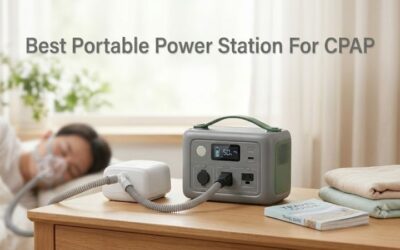
A portable power station is suitable for CPAP only when its output, connection method and usable energy meet the requirements of the exact CPAP setup. A large battery label, an AC outlet or a seller’s CPAP keyword is not enough to establish compatibility. This guide explains how to compare a proposed setup with its manufacturer’s instructions; it does not rank tested devices or promise overnight therapy coverage.
Start with the CPAP model and approved power path
Record the exact machine model, its original power supply and any heated humidifier or heated tubing used with it. Ask the equipment provider or manufacturer which external battery, inverter or DC converter arrangements are supported. A connector that fits physically may have the wrong voltage, polarity or power requirements.
ResMed’s travel guidance directs users to discuss portable power options with their CPAP equipment provider. Its battery and converter products are model-specific. Do not infer that a third-party cable listing establishes approval for every AirSense, AirMini or other machine.
A power station and a DC adapter are different products
A power station stores energy in a battery and provides one or more outputs. A DC adapter or converter changes a compatible source’s output into the form required by a particular machine; it does not supply its own overnight battery capacity. Compare adapters separately from power stations and verify the complete source–converter–machine combination.
When using AC power, confirm the station’s output requirements against the CPAP manufacturer’s instructions and use the approved machine power supply. When using a DC route, use the specified converter and supported input source. Neither route should be chosen from plug shape alone.
Read watts and watt-hours separately
- Rated output, in watts: the continuous load an output supports within the manufacturer’s conditions.
- Battery capacity, in watt-hours: stored energy before conversion losses, reserve limits and other operating effects.
- Surge or boost claims: separate operating modes or limits; these are not interchangeable with rated continuous output.
For one specification example, EcoFlow lists the RIVER 2 at 300W rated output and up to 600W with X-Boost. The higher number must not be presented as its normal continuous rating. This is a specification clarification, not an endorsement of X-Boost for CPAP or proof that the station is compatible with your machine.
Estimate runtime, then verify the actual setup
A planning calculation is usable battery energy divided by the setup’s average power consumption. For illustration only, 240Wh of usable energy divided by a measured 30W average load equals 8 hours. Those numbers are hypothetical; they are not a runtime claim for any listed product or CPAP model.
Actual consumption depends on the machine, prescribed operation and accessories. Heated accessories can materially increase energy use. Do not change prescribed therapy or comfort settings simply to match an advertised battery runtime; discuss an appropriate outage or travel plan with the equipment provider. Include reserve rather than planning to exhaust the battery at the exact end of a night.
Follow manufacturer instructions for checking the intended combination before relying on it. Confirm that low-load shutoff, timers, output settings and charging behavior will not interrupt operation. A claimed UPS or pass-through feature does not by itself establish uninterrupted operation for a medical device.
What to compare before purchase
- Documented compatibility with the exact CPAP model and approved adapter.
- Usable energy and verified runtime under the intended configuration.
- Rated output and supported AC or DC connection requirements.
- Output shutoff behavior and whether unattended operation is supported.
- Manufacturer temperature, ventilation, charging and storage instructions.
- Warranty, return terms and a realistic backup plan if the battery is unavailable or depleted.
FAQ
Does a higher watt rating mean a longer night of use?
No. Output capability and energy capacity describe different limits. Runtime also depends on conversion losses and the actual CPAP setup.
Can a DC adapter replace a power station?
No. An adapter needs a suitable power source; it does not create stored battery energy.
Is there one best power station for every CPAP?
No universal winner is established here. Start with manufacturer-supported compatibility, then verify runtime and operating behavior for the exact setup.
Sources and review basis
Prepared as a compatibility and specification guide using ResMed travel guidance, ResMed battery and converter information, and the EcoFlow RIVER 2 specification page, checked September 20, 2026. No original runtime measurements or numerical review scores are claimed.