
🛒 Best Price Today on Amazon
Prime members get fast, free shipping on everything above, plus member-only deals. New members get a 30-day free trial — cancel anytime.
Overlanding means self-reliant travel in a vehicle across remote terrain, often for days or weeks, camping wherever the track ends. Every accessory competes for payload, space, and fuel, and the vehicle itself is already a capable generator in the form of its alternator. That context makes the power question very different from backyard or home backup. This comparison looks at how overlanders typically power their rigs and whether a generator ever earns a place.
Typical overlanding loads
| Load | Running watts | Daily energy (approx.) |
|---|---|---|
| 12V compressor fridge | 40–60W cycling | 400–900Wh |
| Camp lights and lighting strips | 10–40W | 50–200Wh |
| Phones, GPS, radios, headlamps | 20–60W | 100–250Wh |
| Camera and drone batteries | 50–150W | 100–400Wh |
| Laptop | 45–90W | 150–400Wh |
| Air compressor for tires | 150–400W (12V) | 30–100Wh per use |
| Rooftop tent heater (diesel, electric parts) | 10–40W | 100–400Wh |
| Induction cooktop or kettle | 1,000–1,800W | 300–700Wh |
A typical overland rig without electric cooking uses 800 to 2,000Wh per day. The fridge is the constant load; everything else is small or intermittent.

EF ECOFLOW Portable Power Bank Station TRAIL 300 DC, 288Wh 300W DC
Included for 'Best Power Solution for Overlanding Trips: Generator or Power Station?' because the listing specifies 288Wh 300W DC, details this guide uses to compare options.
View on Amazon
ENOFLO Portable Power Station, 97.68Wh Solar Generator
Included for 'Best Power Solution for Overlanding Trips: Generator or Power Station?' because the listing specifies 97.68Wh Solar Generator, details this guide uses to compare options.
View on Amazon
HOWEASY Portable Power Station 300W,Solar Generator 222Wh
Included for 'Best Power Solution for Overlanding Trips: Generator or Power Station?' as a relevant option in this category; details come from the product listing.
View on Amazon
Takki Solar Generator Peak 450W Portable Power Station with 60W Solar Panels 222Wh Pure Sine Wave Camping Lithium Battery Power Pack with AC 110V Outlet for Camping CPAP Home Use Emergency Outdoor
Included for 'Best Power Solution for Overlanding Trips: Generator or Power Station?' as a relevant option in this category; details come from the product listing.
View on Amazon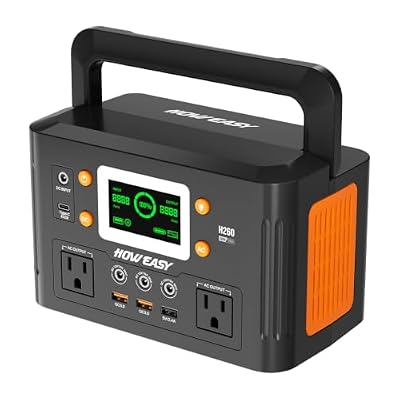
HOWEASY Portable Power Station,260W(500W peak) Solar Generator with PD 65W
Included for 'Best Power Solution for Overlanding Trips: Generator or Power Station?' because the listing specifies 260W(500W peak) Solar Generator with PD 65W, details this guide uses to compare options.
View on Amazon
EF ECOFLOW TRAIL 300 DC Portable Power Station with Waterproof Travel Bag
Included for 'Best Power Solution for Overlanding Trips: Generator or Power Station?' as a relevant option in this category; details come from the product listing.
View on Amazon
P5000 Plus 5120Wh Portable Power Station, 3600W Solar Generator
Included for 'Best Power Solution for Overlanding Trips: Generator or Power Station?' because the listing specifies 3600W Solar Generator, details this guide uses to compare options.
View on AmazonThe dual-battery and power station approach
Most overlanders use either a dual-battery system in the vehicle, often a 100 to 200Ah lithium auxiliary battery, or a portable power station of 1,000 to 2,000Wh. Both charge from the alternator while driving and from solar at camp.
Charging from the vehicle
A DC-DC charger of 25 to 50A adds roughly 300 to 700W while driving. Two to three hours on the trail can replace a full day of fridge and electronics use. This is the key reason generators are rarely needed on overland trips that move daily.
Solar at camp
A 100 to 400W roof-mounted or folding panel adds 300 to 1,500Wh on sunny days, covering stationary days at camp.
Where a generator can make sense
Long stationary basecamps
If you set up a basecamp for several days without driving, in forest shade or during winter, solar and alternator charging fall short. A small generator can recharge the batteries in an hour or two.
Group expeditions
A group with several vehicles sometimes carries one shared inverter generator for camp lighting, cooking, and recharging multiple power stations, splitting the weight and fuel.
Electric cooking or heavy charging
Induction cooking or charging e-bikes and drones heavily can exceed what the alternator and solar deliver. A generator handles high-draw loads without draining the auxiliary battery.
The drawbacks of a generator on the trail
Weight and space are significant: a 2,000W-class inverter adds 40 to 55 lb plus fuel. Gasoline storage in jerry cans already carries vehicle range fuel, and devoting some to a generator reduces range. Engine noise disrupts the solitude that draws people to remote camps, and many public lands require spark arrestors and set quiet hours.
Comparison for a 10-day overland trip
| Factor | Dual battery or station + DC-DC + solar | Small inverter generator |
|---|---|---|
| Charges while driving | Yes | No |
| Silent at camp | Yes | No |
| Weight and space | 20–60 lb, mostly built in | 40–55 lb plus fuel |
| Works in shade or winter basecamp | Limited without driving | Yes |
| Fuel needed | None beyond driving | 0.5–1 gal per charge session |
| Maintenance | Minimal | Oil, fuel, air filter in dust |
Setup recommendations by trip style
- Moving daily, fridge and electronics: 100 to 200Ah auxiliary lithium or 1,000 to 1,500Wh station, 40A DC-DC charger, 200W solar.
- Mixed moving and 2 to 3 day camps: same plus 200 to 400W of solar.
- Long basecamps or winter trips: add a small inverter generator or a larger battery bank.
- Group expeditions: one shared generator, individual stations per vehicle.
FAQ
Do overlanders need a generator?
Most do not. A dual battery system or power station charged by the alternator while driving and by solar at camp covers typical overlanding loads. Generators help mainly for long stationary basecamps, winter trips, or heavy electric cooking.
How big a power station do I need for overlanding?
A 1,000 to 1,500Wh station runs a 12V fridge, lights, and electronics for one to two days without charging, and much longer when paired with DC-DC charging and solar.
Bottom line
For overlanding, the vehicle’s alternator is your generator. A dual battery system or 1,000 to 1,500Wh power station, charged by a DC-DC charger and 200 to 400W of solar, is the best primary solution. Carry a small inverter generator only for long basecamps in shade or winter, or share one across a group.
Write Your Review
No reviews yet. Be the first to share your experience!