
🛒 Best Price Today on Amazon
Prime members get fast, free shipping on everything above, plus member-only deals. New members get a 30-day free trial — cancel anytime.
- Quick picks
- How we chose
- The threshold that matters: 1,000 watts or 2,000 watts
- Comparison table
- The 1,000-watt class: ultralight picks
- The 1,700 to 1,800 running-watt class
- Worked example: sizing a kit for CPAP, phones, laptop and a small fridge
- Buying checklist
- Safety for small generators
- Care that keeps a small generator ready
- FAQ
The Honda EU2200i is the best small inverter generator in the sub-2,000-running-watt class for quiet and long-term support, the Honda EU1000i is the lightest pick for phones, laptops and a CPAP, and the Westinghouse iGen2200 and Champion 100692 deliver the most runtime and value per tier. For true ultralight loads under 900 watts, the 1,000-watt class is enough and saves 15 to 25 pounds of carrying weight.
“Under 2,000 watts” covers two very different buying decisions. The first is the 1,000-watt class: roughly 900 running watts, around 30 pounds, built to charge devices, run a CPAP and power lights. The second is the 1,700 to 1,800 running-watt class: around 40 to 55 pounds, able to run a small fridge, a microwave on low settings or a window fan alongside electronics. This guide separates them clearly, because buying the bigger class for a phone-and-CPAP job wastes fuel and back strength, while buying the smaller class for a fridge leads to tripped overloads.

Honda EU1000i 1000 Watt Inverter Generator, Super Quiet 120V Gas Powered Portable Generator for Camping or Home Backup Power Supply, Up to 6.8 Hour Run Time (EU1000T1AN)
Included for 'Best Small Inverter Generators Under 2000 Watts' because the listing specifies Up to 6.8 Hour Run Time (EU1000T1AN), details this guide uses to compare options.
View on Amazon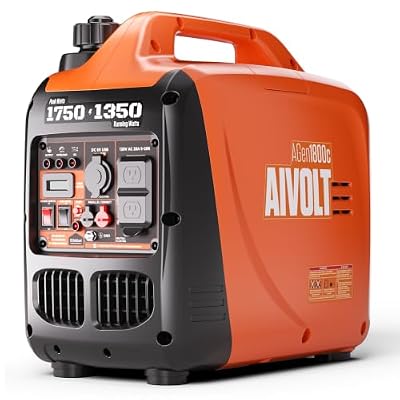
AIVOLT 1750W Inverter Generator Portable Gas Generator for Camping Home | Ultra-Light 26.5lbs, One-Hand Carry. Super Quiet 52dBA. Clean <3% THD Power. CO Auto-Shutoff. 7hr ECO Mode. EPA Compliant.
Included for 'Best Small Inverter Generators Under 2000 Watts' because the listing specifies Ultra-Light 26.5lbs, details this guide uses to compare options.
View on Amazon
AIVOLT 1600W Super Quiet Inverter Generator 28lbs Portable for Camping | Gas Generator. 1260W Running. Super Quiet 57dBA. <3% THD Pure Sine Wave. CO Auto-Shutoff. 8hr ECO Mode. EPA Compliant.
Included for 'Best Small Inverter Generators Under 2000 Watts' as a relevant option in this category; details come from the product listing.
View on Amazon
Westinghouse 1500 Peak Watt Super Quiet & Lightweight Portable Inverter Generator, Gas Powered, CO Sensor, Parallel Capable, Long Run Time,Blue
Included for 'Best Small Inverter Generators Under 2000 Watts' because the listing specifies Gas Powered and CO Sensor, details this guide uses to compare options.
View on AmazonQuick picks
- Best ultralight (1,000-watt class): Honda EU1000i
- Best overall small inverter generator: Honda EU2200i
- Best for longest runtime per tank: Yamaha EF2200iS and Westinghouse iGen2200
- Best light 2,000-watt-class unit: Champion 100692
- Best budget-conscious light unit: WEN 56203i
- Best mainstream retail option with parallel capability: Generac GP2200i
- Best low-cost 1,000-watt class alternative: GENMAX GM1200i
How we chose
This is a research-based guide built from manufacturer specification sheets, technical releases and the spec tables of major buyer guides. Where sources disagree (weights and decibel ratings vary by test standard and by year), we use ranges or class descriptions. We ranked units on five criteria:
- Running watts against typical small loads. A CPAP draws roughly 30 to 60 watts without a heated humidifier, a laptop about 45 to 100 watts, phones 10 to 20 watts each, and a small fridge roughly 100 to 150 watts while running, with a brief startup surge several times higher.
- Carry weight. Under 30 pounds is a one-hand carry, 38 to 50 pounds is a two-hand carry, and above that a hand truck helps.
- Runtime at quarter load. Small loads run at low output, so quarter-load runtime predicts refuel frequency better than rated-load runtime.
- Noise at light load. Quarter-load decibel rating matters for campsites and for running overnight near sleeping areas.
- Parallel kit option. Pairing two small units doubles capacity without giving up portability.
The threshold that matters: 1,000 watts or 2,000 watts
| Load | Typical running watts | Typical surge | 1,000-watt class OK? | 2,000-watt class OK? |
|---|---|---|---|---|
| Smartphone charging (two phones) | 20 to 40 | None | Yes | Yes |
| CPAP without heated humidifier | 30 to 60 | Low | Yes | Yes |
| CPAP with heated humidifier and tubing | Up to roughly 90 to 120 | Low | Yes | Yes |
| Laptop and monitor | 60 to 150 | Low | Yes | Yes |
| LED lighting for a campsite | 20 to 60 | None | Yes | Yes |
| Small compact refrigerator | 100 to 150 | Several times running watts for a moment | Usually, if little else is running | Yes |
| Full-size refrigerator | 150 to 250 | Often 3 to 4 times running watts at start | Not recommended | Yes, with other loads limited |
| Microwave oven (compact) | 700 to 1,000 input | Low | Marginal | Yes, alone on the circuit |
| Coffee maker | 600 to 1,200 | Low | No | Yes, alone on the circuit |
| Window air conditioner (small) | 500 to 900 | Several times running watts | No | Sometimes, check the label |
Treat the figures in this table as planning ranges, not guarantees. Always read the label on your own appliance for its running and starting wattage.
Comparison table
| Model | Running / peak watts | Approx. weight | Noise class | Runtime note | Parallel |
|---|---|---|---|---|---|
| Honda EU1000i | About 900 / 1,000 | Under 30 lb | Low 40s to mid 50s dB(A) by load | Small tank, long at light load | Yes |
| GENMAX GM1200i | 1,000 class | Around 30 lb class | Low-to-mid 50s dB(A) class | Check current spec sheet | Check model |
| Honda EU2200i | 1,800 / 2,200 | 46.5 to 47.4 lb dry | 48 to 57 dB(A) by load | 3.2 h rated, 8.1 h quarter | Yes |
| Yamaha EF2200iS | 1,800 / 2,200 | About 55 lb | Low-to-mid 50s dB(A) class | About 10.5 h on 1.24 gal (manufacturer-class figure) | Yes |
| Westinghouse iGen2200 | 1,800 / 2,200 | Around 50 lb class | Low 50s dB(A) | Roughly 12 h at quarter load | Yes |
| Champion 100692 | 1,700 / 2,000 | Light, around 40 lb class | Low 50s dB(A) | Roughly 11 h at quarter load | Yes |
| WEN 56203i | 1,700 / 2,000 | About 39 lb | About 51 dB(A) | Check current spec sheet | Check model |
| Generac GP2200i | 1,700 / 2,200 | Around 50 lb class | Low 50s dB(A) | Roughly 10 h at quarter load | Yes |
The 1,000-watt class: ultralight picks
Honda EU1000i
Spec line: about 900 running W · 1,000 max W · under 30 lb · carry handle · parallel-ready · very quiet at light load
Best for: CPAP, phones, tablets, laptops, camp lights and small fans on camping, van and boat trips.
Skip if: you want to run a fridge with other loads, a coffee maker or a microwave.
- Pros: the lightest and quietest option in this guide, easy one-hand carry, parallel option for doubling capacity, a long record for reliability.
- Cons: small fuel tank means frequent refueling on multi-day use; premium cost for the watts delivered; a starting compressor can overload it.
GENMAX GM1200i
Spec line: 1,000-watt class · around 30 lb class · pure-sine inverter output · low-to-mid 50s dB(A) class
Best for: shoppers who want an ultralight inverter at a lower price tier than the Honda for phones, CPAP and laptop work.
Skip if: you need the lowest noise or the strongest service network.
- Pros: light, small footprint, lower entry cost than the Honda EU1000i.
- Cons: exact weight, noise and runtime figures vary between sources, so verify the current spec sheet; service and parts support is less established.
The 1,700 to 1,800 running-watt class
Honda EU2200i
Spec line: 1,800 running W · 2,200 max W · about 47 lb · 121 cc engine · 0.95 US gal tank · 3.2 h at rated load · 8.1 h at quarter load · parallel-ready
Best for: campers and outage users who want the quietest operation in the class and strong long-term support.
Skip if: you want the longest runtime per tank or the lowest purchase cost.
- Pros: very low noise at light load, solid dealer and parts network, parallel capability with a Companion unit, compact for the output.
- Cons: quarter-load runtime is shorter than several rivals; premium pricing tier.
Yamaha EF2200iS
Spec line: 1,800 running W · 2,200 max W · about 55 lb · about 1.24 gal tank · longer runtime than the Honda (published figure about 10.5 h) · parallel-capable
Best for: users who want the Honda’s output class with a longer tank, such as overnight fridge backup.
Skip if: weight is a priority; it is roughly eight pounds heavier than the EU2200i.
- Pros: long runtime for a unit this size, premium build, parallel capability.
- Cons: heavier, a premium pricing tier, and the dealer network is thinner than Honda’s in some areas.
Westinghouse iGen2200
Spec line: 1,800 running W · 2,200 peak W · low-50s dB(A) class · roughly 12 h at quarter load · parallel-ready
Best for: value-driven buyers who want the longest published runtime in the class.
Skip if: you need the lowest noise or the deepest service network.
- Pros: long runtime, same output class as the Honda at a lower price tier, parallel option.
- Cons: a few decibels louder than the Honda at light load; weight sits in the 50-pound class.
Champion 100692
Spec line: 1,700 running W · 2,000 peak W · light, around 40 lb class · roughly 11 h at quarter load · low-50s dB(A) class · parallel-ready
Best for: campers who want a lighter 2,000-watt-class unit with long runtime at a lower price tier.
Skip if: you need a full 1,800 running watts or the quietest operation.
- Pros: light for its class, long runtime, parallel capability, low entry cost.
- Cons: published weight varies by source, so confirm before a long carry; a few decibels louder than the Honda at light load.
WEN 56203i
Spec line: 1,700 running W · 2,000 peak W · about 39 lb · about 51 dB(A) · low total harmonic distortion inverter output
Best for: shoppers who want the lightest and lowest-cost unit in the 2,000-watt class.
Skip if: you need confirmed parallel capability or a deep service network.
- Pros: light for the output class, quiet for its price tier, low harmonic distortion for electronics.
- Cons: runtime and parallel details vary between sources; confirm on the current spec sheet; limited dealer support compared with Honda or Yamaha.
Generac GP2200i
Spec line: 1,700 running W · 2,200 max W · low-50s dB(A) class · roughly 10 h at quarter load · parallel-ready
Best for: buyers who want a widely stocked mainstream brand with competitive runtime.
Skip if: weight is your top concern; it sits in the 50-pound class.
- Pros: broad retail availability, solid runtime, parallel option, simple controls.
- Cons: heavier than the Champion and WEN; a bit louder than the Honda at light load.
Worked example: sizing a kit for CPAP, phones, laptop and a small fridge
Follow these steps to decide whether the 1,000-watt class is enough, using planning figures you can replace with the numbers on your own labels.
- List running watts. CPAP with heated humidifier 90 W, two phones 30 W, laptop 70 W, LED lights 30 W, compact fridge 120 W. The total is 340 W.
- Add the largest starting surge. A compact fridge compressor may briefly draw three to four times its running watts, call it 480 W, so peak demand is about 340 + (480 – 120) = 700 W.
- Compare with the generator. A 900-running-watt unit has headroom of 560 W continuous and handles the 700 W peak, but only barely if you add a kettle or a hair dryer. A 1,800-running-watt unit has more than 1,400 W of headroom.
- Estimate the quarter-load runtime. A 340 W load is under 20 percent of an 1,800-watt generator’s rating, so it will run near its best quarter-load runtime (about 8 hours for the Honda EU2200i, 10 to 12 hours for the Champion or Westinghouse class).
- Pick. If the fridge is not in the list, choose the 1,000-watt class. If it is, choose the 1,800-watt class for the margin, or the 1,000-watt class and run the fridge only when nothing else is drawing power.
The Honda EU2200i fuel numbers tell the same story. Its published tank is 0.95 gallons and 8.1 hours at quarter load, which is about 0.12 gallons per hour at around 450 watts. At 340 watts the burn is a little lower, so a single tank covers a full night with some left over.
Buying checklist
- Choose the class before the brand. Under 900 watts of real load: 1,000-watt class. Anything with a compressor or a heating element: 1,800-watt class.
- Look for pure-sine output. Low total harmonic distortion protects laptops, CPAPs and chargers.
- Check parallel kit availability. Two 1,000-watt units paralleled can match one 2,000-watt unit while staying much lighter to carry.
- Confirm the handle. A built-in carry handle matters more than the spec sheet suggests; test the grip position against your own height.
- Check for eco or economy mode. Throttling the engine to match the load cuts fuel burn and noise at low load.
- Look for low-oil shutoff and overload protection, and a carbon monoxide shutdown feature if the model offers one.
Safety for small generators
- Carbon monoxide: small units still produce lethal carbon monoxide. Run them outdoors only, at least 20 feet from doors, windows and vents, with exhaust pointing away from sleeping areas. Never run one in a tent, vehicle, garage or camper. Keep a battery-powered carbon monoxide alarm where you sleep.
- CPAP and medical devices: a generator is not a substitute for a medical power plan. If a device is essential for your health, talk to your equipment provider about backup options and keep a battery backup in addition.
- Refueling: shut the engine off and let it cool before adding fuel; store fuel in approved containers away from living space.
- Cords: use outdoor-rated, grounded extension cords sized for the load, and keep connections off wet ground.
- Backfeeding: never plug a generator into a wall outlet; use a licensed electrician for any home connection.
Care that keeps a small generator ready
Small inverter generators are easier to neglect because they are easy to store. Run the engine for 10 to 15 minutes every month or two under a light load, replace the oil on schedule, keep the air filter clean and use ethanol-free fuel or a stabilizer when storing for months. Follow the manual on draining the carburetor for long storage. A well-kept budget unit will outlast a neglected premium one.
FAQ
What size inverter generator do I need for a CPAP?
A CPAP usually draws 30 to 120 watts depending on the humidifier, so a 1,000-watt-class inverter generator is enough. Check the power label on your own device.
Use pure-sine inverter output and keep the generator outdoors and downwind of where you sleep. Ask your provider about a battery backup too.
Can a 1,000-watt inverter generator run a refrigerator?
Often a compact fridge, yes, if little else is running. A full-size fridge is better served by a 1,800-watt-class unit because of its startup surge.
Check the starting wattage on the appliance label and compare it with the generator’s peak rating, not just the running rating.
Which is quieter, the Honda EU1000i or the EU2200i?
Both are among the quietest in their classes. The EU1000i is quieter in absolute terms at light load, while the EU2200i is rated roughly 48 to 57 dB(A) depending on load.
Honda has published different noise figures for the EU2200i over the years, so compare the same test standard when you read specs.
How long will a small inverter generator run on one tank?
At quarter load, the 1,800-watt-class units run roughly 8 to 12 hours per tank. The Honda EU2200i is rated at about 8.1 hours on a 0.95-gallon tank.
At rated load the runtime drops to about 3 hours for the Honda, so plan fuel from your real load, not the maximum rating.
Is a 2,000-watt inverter generator enough for camping?
For most tent and small-camper use, yes. It runs lights, chargers, a small fridge, a fan and a microwave one at a time.
It will not reliably start a large RV air conditioner on its own. Two units in parallel are the usual route for that.
Can I parallel two small inverter generators?
Many can. The Honda EU1000i and EU2200i, Westinghouse iGen2200, Champion 100692 and Generac GP2200i are described as parallel-capable, but each needs the maker’s parallel cable or kit.
Only pair compatible models, keep both outdoors, and never exceed the rating of the cord or outlet you are using.
What is the lightest inverter generator for backpacking-style trips?
The Honda EU1000i at under 30 pounds is the lightest option in this guide, with the GENMAX GM1200i in the same weight class.
If you only need to charge phones and a headlamp, a battery power station may be an even lighter option; this guide focuses on fuel-powered units.
Do inverter generators need special fuel?
No. They run on regular unleaded gasoline with a recommended minimum octane in the manual. Ethanol-free fuel or a stabilizer helps during storage.
Use fresh fuel, never mix oil and gasoline unless the manual calls for it, and refuel only when the engine is cool.

Write Your Review
No reviews yet. Be the first to share your experience!