
🛒 Best Price Today on Amazon
Prime members get fast, free shipping on everything above, plus member-only deals. New members get a 30-day free trial — cancel anytime.
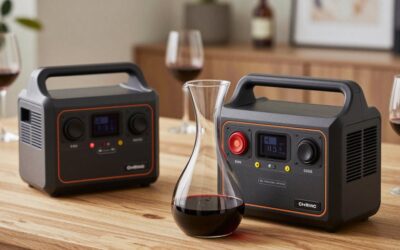
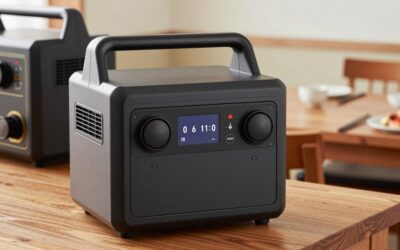
The Bluetti AC180 sits in a useful spot for summer backup: its roughly 1,800W inverter can start most window air conditioners, and its roughly 1,152Wh battery can run a small one for a couple of hours. Whether that translates into a cool night or a short burst depends heavily on one thing: whether your window unit is a traditional fixed-speed model or a newer inverter model. This guide compares the two, estimates runtimes and explains how to use solar to cool a room in the evening during a multi-day outage.
Fixed-speed versus inverter window units
A traditional fixed-speed window AC runs its compressor at full power, shuts off, then restarts with a hard current spike. Each restart can briefly draw two to three times the running load. An inverter window unit uses a variable-speed compressor that ramps up gently and then slows down once the room is cool, often drawing a third to half as much power as a fixed-speed unit of the same size.
The AC180’s continuous output in the 1,800W class (confirm with Bluetti’s current spec sheet; its Power Lifting mode applies only to resistive loads) handles most fixed-speed startups up to about 10,000 BTU. But the inverter type is where the battery goes much further.
Runtime comparison
Assume about 950Wh usable after inverter losses and self-consumption.
| Unit | Typical draw once room is cool | Estimated AC180 runtime | With B80-class expansion |
|---|---|---|---|
| 6,000 BTU fixed-speed (cycling ~60%) | ~330W average | ~2.9 hours | ~5.3 hours |
| 8,000 BTU inverter (low speed) | ~250-350W | ~2.7-3.8 hours | ~5-7 hours |
| 10,000 BTU fixed-speed (cycling ~65%) | ~600W average | ~1.6 hours | ~2.9 hours |
| 12,000 BTU fixed-speed (cycling ~70%) | ~800W average | ~1.2 hours | ~2.2 hours |
Real duty cycles depend on outdoor temperature, insulation and thermostat setting. A room that gets full afternoon sun can keep a compressor running nonstop.
A solar-assisted cooling routine
Daytime: refill
The AC180 accepts roughly 500W of solar. On a long summer day, 400 to 500W of panels can produce 2 to 3kWh, enough to refill the battery completely. Keep the unit indoors in a shaded spot while charging; heat can slow charging and shorten battery life.
Late afternoon: pre-cool
Close blinds on sun-facing windows early. Start the AC around the hottest indoor hour, often 5 to 7 p.m., to bring one bedroom down to around 78°F.
Night: coast with fans
Once the room is cool, switch to a fan or let an inverter unit idle at low speed. On a mild night, the room may stay comfortable for hours with only a 30 to 50W fan.
Repeated daily, this routine can keep one room livable through a multi-day summer outage without any fuel.
Safety checklist
- Plug the AC directly into the AC180; avoid lightweight extension cords, which can overheat at 5 to 10 amps.
- If you recharge with a gas generator, place it outdoors at least 20 feet from the house, away from the window unit’s air intake. Never run it in a garage or on a porch, and keep CO alarms inside.
- To power a hardwired mini-split or house circuits, have a licensed electrician install an inlet and transfer switch or interlock. Never backfeed through a wall outlet.
- Watch vulnerable household members for heat illness and have a cooling-center plan.
How to check your window unit’s real draw
Nameplate ratings rarely match real-world draw. Before summer, plug the window AC into a plug-in watt meter for an evening and note three numbers: startup spike (if the meter captures it), running watts once the compressor settles and total kWh over four hours. Most 6,000 BTU fixed-speed units read 450 to 550W running; inverter units often drop to 200 to 350W once the room cools. Those measured numbers let you plan exact AC180 runtimes rather than relying on estimates.
FAQ
Can the AC180 run a 15,000 BTU window unit?
Large units draw 1,300 to 1,500W running and surge higher. The AC180 may start one, but runtime would be well under an hour, and startup failures are likely on hot days.
Is it worth buying an inverter window AC just for outages?
If summer outages are common where you live, yes. Inverter units are also quieter and cheaper to run on grid power, so the benefit carries over to everyday use.
Bottom line
The Bluetti AC180 can run most small to mid-size window air conditioners for about one to four hours, with inverter models lasting longest. Paired with solar recharging and a room-cooling routine, it can keep one bedroom tolerable through a multi-day summer outage.

Write Your Review
No reviews yet. Be the first to share your experience!