
🛒 Best Price Today on Amazon
Prime members get fast, free shipping on everything above, plus member-only deals. New members get a 30-day free trial — cancel anytime.
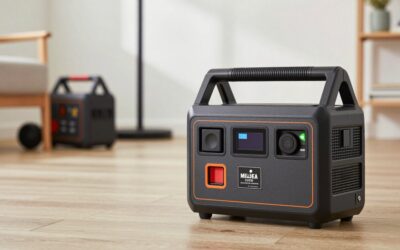
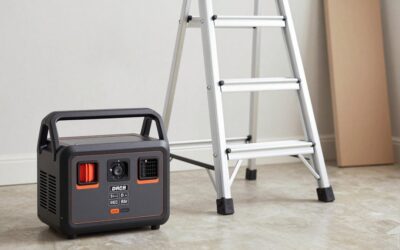
Short answer: a 1,000Wh portable power station will typically run a modern full-size refrigerator for about 10 to 20 hours. The spread is wide because refrigerators don’t draw a constant load. The compressor cycles on and off, and how long it runs each hour depends on the fridge’s age, size, kitchen temperature, and how often the door opens. This guide shows how to estimate your own number, and how to stretch a 1,000Wh battery through a long outage.
Why the label wattage misleads
A refrigerator’s nameplate might say 6 amps (about 720W), but that includes the defrost heater and a worst-case rating. In normal operation the compressor draws roughly 100-200W while running, for about 30-50% of each hour, plus a brief startup surge of 800-1,500W. Averaged over a day, most Energy Star refrigerators use 1.0-1.8 kWh. The yellow EnergyGuide label lists annual kWh; divide by 365 for a daily figure.
Estimated runtime on a 1,000Wh station
| Refrigerator type | Daily use (typical) | Average draw | Estimated runtime (~850Wh usable) |
|---|---|---|---|
| Compact 10-12 cu ft top-freezer | 0.8-1.0 kWh | 33-42W | ~20-26 hrs |
| 18-21 cu ft top-freezer (Energy Star) | 1.0-1.3 kWh | 42-54W | ~16-20 hrs |
| 25 cu ft French door | 1.4-1.8 kWh | 58-75W | ~11-15 hrs |
| Side-by-side with ice/water | 1.6-2.0 kWh | 67-83W | ~10-13 hrs |
| Older fridge (15+ years) | 2.0-3.0 kWh | 83-125W | ~7-10 hrs |
“Usable” assumes about 85% of the rated capacity reaches the fridge after inverter conversion losses and the station’s own idle draw. Check your station’s current spec sheet. Some list higher inverter efficiency, and some carry a larger internal reserve.
Can the station start the compressor?
Runtime means nothing if the inverter can’t handle the compressor’s inrush. Most 1,000Wh-class stations offer 1,200-2,000W continuous with a 2,000-3,000W surge, which comfortably starts a household refrigerator. Older units with smaller inverters, or fridges with worn compressors, occasionally trip on start. If you hear a click and the station’s overload light comes on, that’s a surge problem, not a capacity problem.
Measure instead of guessing
A plug-in energy monitor costs about $15-$30. Plug the fridge into it for 24 hours during normal use, and you’ll have your real daily kWh. Many power stations also display live output watts. Watching it for an hour shows the compressor’s running draw and how long it stays on. Divide the station’s usable Wh by your measured average watts for a realistic runtime.
Five ways to stretch the battery
Keep the doors shut
Each opening lets cold air spill out, and the compressor runs longer to recover. Plan what you need before opening the door.
Turn off the ice maker and door dispenser heaters
Ice makers can add 0.2-0.4 kWh a day on some models.
Raise the setpoint slightly
Running at 38-40°F instead of 34-36°F trims compressor time while staying within the food-safety limit of 40°F.
Cycle the power
A closed full fridge holds safe temperatures for about 4 hours. Powering it for 2 hours and leaving it off for 2 hours roughly halves energy use. Use a fridge thermometer to verify.
Add thermal mass
Fill empty shelves with jugs of water. A fuller fridge holds cold longer between compressor cycles.
Recharging to go beyond one day
A 200W solar panel in good sun delivers roughly 0.8-1.0 kWh per day, about one day of fridge use for an efficient model. Two panels make a 1,000Wh station and a fridge close to self-sustaining in sunny weather. You can also recharge from a gas generator in about 1-1.5 hours of wall-speed charging. That generator must run outdoors, at least 20 feet from the house, with the exhaust pointed away from windows and doors, and the home needs working CO alarms.
Battery care
LiFePO4 stations are rated for thousands of cycles, but temperature still matters. Don’t charge below 32°F unless the unit has self-heating, and keep it out of hot garages in summer. For storage between outages, keep the battery at about 50-60% and top it up every few months. Plugging the fridge straight into the station is fine. Connecting a station to household wiring requires a transfer switch or manufacturer hub installed by a licensed electrician.
FAQ
Will a 1,000Wh power station run a refrigerator overnight?
Yes. Most modern refrigerators will run 10-20 hours on a 1,000Wh station, which comfortably covers a night.
Does running the fridge through the station damage the battery?
No. Normal cycling is what these batteries are designed for. Avoid storing the station at 0% or 100% for long periods, and keep it within its temperature range.
Bottom line
Plan on 10-20 hours from a 1,000Wh station for a typical modern refrigerator, or less for older and larger units. Measure your fridge’s real daily kWh, cycle the power if the outage runs long, and add solar or a safely placed generator to refill the battery each day.



Write Your Review
No reviews yet. Be the first to share your experience!