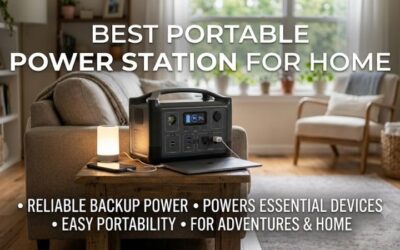
A power station for home is the simplest way to keep the lights on, the fridge cold, and your phone charged when the grid goes down. Unlike a gas generator, it needs no fuel, no outdoor placement, and no noise complaints from neighbors. But the gap between a unit that can run a refrigerator for six hours and one that can barely handle a space heater for twenty minutes is enormous — and prices range from under two hundred dollars to well over fifteen hundred.
What separates the strong options from the mediocre ones comes down to three things: real inverter wattage versus peak rating games, battery chemistry that survives hundreds of cycles, and whether the output ports actually match how you use electricity at home. Below, we compare eight current models on their published specs and owner-reported experience to help you pick the right one for your situation.
As an Amazon Associate we earn from qualifying purchases at no extra cost to you. Product prices and availability are accurate as of the date shown and are subject to change.
Quick Picks
| Product | Best For | Price |
|---|---|---|
| Anker SOLIX S2000 | Best overall home backup on a budget | $649.99 |
| Jackery Explorer 300 | Camping and light emergency loads | $259 |
| Jackery HomePower 3600 Plus | Whole-home backup at scale | $1709 |
| Jackery Explorer 1000 v2 | Best mid-range portable | $499 |
| LIBRIDS 640Wh | Value light home backup | $245.99 |
| ABOK Ark3600 | High-capacity value pick | $1199 |
| ALLWEI 300W | Ultra-budget entry point | $149 |
| BLUETTI Elite 30 V2 | Solar beginners wanting quality | $449 |
How We Picked
We evaluated each unit on four criteria that matter most when you are choosing a power station for home use rather than casual tailgating: usable inverter output (not inflated peak numbers), energy capacity relative to price, battery chemistry and expected cycle life, and port configuration — specifically whether you get enough AC outlets to run multiple appliances simultaneously without a power strip. Owner feedback on long-term reliability and real-world runtime rounded out the picture.
The 8 Best Power Station For Home in 2026
Anker SOLIX S2000 Portable Power Station
The S2000 hits the sweet spot for anyone who wants genuine home backup without spending four figures. Its 2,010Wh capacity and 3,000W peak output mean a refrigerator, a few lights, and a laptop can all run from one unit during an outage lasting several hours. Owners consistently praise the quiet operation and the fact that Anker’s app lets you monitor load and battery level remotely.
- Pro: 3,000W peak output handles heavy-draw appliances like microwaves and space heaters.
- Pro: Large capacity-to-price ratio compared to most home backup units in this range.
- Con: Not rated for continuous 3,000W draw; sustained heavy loads will throttle output.
Skip it if you need to run a full HVAC system or multiple large appliances simultaneously for an entire day.
Jackery Explorer 300 Portable Power Station
With just 292Wh of stored energy, this is not a home backup in any meaningful sense for most households. It earns its place on this list because it excels as a grab-and-go emergency kit for a single device — a CPAP machine for one night, a phone and lamp during a brief storm outage. Jackery’s build quality and support remain the brand’s strongest asset at this price.
- Pro: Compact and light enough to grab during an evacuation or take camping.
- Pro: Reliable brand support and a wide ecosystem of compatible solar panels.
- Con: Capacity runs dry quickly with anything that draws more than 100W.
Skip it entirely if your goal is to keep a refrigerator or well pump running through a multi-hour outage.
Jackery HomePower 3600 Plus Power Station
This is the most capable unit on our list, and it is priced accordingly at $1,709. The 3,584Wh capacity and 3,600W continuous AC output put it in territory where you can genuinely ride through a day-long outage running a refrigerator, a furnace blower, lights, and electronics together. It is a power station for home use that approaches what a small gas generator delivers, without the fuel storage headache.
- Pro: 3,600W continuous output supports nearly every household appliance simultaneously.
- Pro: Expandable with additional battery packs for multi-day scenarios.
- Con: High price makes it a hard sell for people in regions with rare outages.
Skip it if your needs are limited to keeping a few devices alive for a couple of hours — the Anker S2000 handles that at less than half the cost.
Jackery Explorer 1000 v2 Portable Power Station
The 1,070Wh capacity and 1,500W inverter make the Explorer 1000 v2 a legitimate mid-range option for people who want a portable backup that doubles as a camping unit and an emergency home source. It will run a refrigerator for roughly six to eight hours depending on compressor duty cycle. The v2 revision brought a faster charging speed over wall power, which owners have highlighted as a real quality-of-life improvement.
- Pro: Versatile size — small enough to move room-to-room, large enough for serious use.
- Pro: Jackery’s app monitoring and solar input compatibility are mature and well-documented.
- Con: 1,500W output means no heavy electric tools or full-size microwaves at their rated draw.
Skip it if you need sustained output above 1,500W; the Anker S2000 offers double the peak wattage for a modest price bump.
LIBRIDS Portable Power Station 640Wh
At $245.99, this unit undercuts almost every competitor offering comparable capacity. The 640Wh battery and 1,200W surge output make it workable for a short outage involving a router, a few lights, a laptop, and a small fan. The four AC outlets are a notable advantage at this price — many rivals in this tier give you only two.
- Pro: Four AC outlets provide flexible plug coverage without a power strip.
- Pro: Best capacity-per-dollar ratio in the under-$300 bracket.
- Con: Brand support network is thinner than Jackery or Anker, and long-term reliability data is limited.
Skip it if you value established brand ecosystem and warranty responsiveness over raw specification value.
ABOK Ark3600 Portable Power Station
The Ark3600 packs 3,840Wh into a LiFePO4 battery and delivers 3,600W of output, rivaling the Jackery HomePower 3600 Plus in headline specs while costing $500 less. LiFePO4 chemistry means you get thousands of charge cycles before meaningful capacity loss. For a power station for home use on a tighter budget, this is the value play in the high-capacity tier.
- Pro: LiFePO4 battery promises exceptional cycle life and thermal safety.
- Pro: 3,840Wh is the highest capacity on this list, ideal for multi-day outage preparedness.
- Con: ABOK is a newer brand with a less-proven track record in software and app stability.
Skip it if you are uncomfortable relying on a lesser-known brand for your primary home backup system.
ALLWEI Portable Power Station 300W
Priced at $149, the ALLWEI 300W is the cheapest way to get LiFePO4 chemistry on this list. With 256Wh of capacity, it handles a single phone-and-lamp emergency or a night of CPAP use. The LiFePO4 cell means it will outlast the lead-acid or NMC alternatives you will find at similar prices. It is a genuine budget entry point, not a toy.
- Pro: LiFePO4 battery at this price point is rare and gives you long-term durability.
- Pro: Solar generator compatibility makes it useful in off-grid settings.
- Con: 300W output caps you at small electronics and lighting; no kitchen appliances.
Skip it if you need more than a couple of low-draw devices running at once — the LIBRIDS 640Wh is only $97 more and doubles your capacity.
BLUETTI Elite 30 V2 Portable Power Station
BLUETTI has built a reputation for premium build quality and thoughtful design, and the Elite 30 V2 continues that tradition. At 288Wh and 600W output with LFP chemistry, it occupies a similar role to the Jackery Explorer 300 but with the safety and longevity advantages of lithium iron phosphate. Owners highlight the compact form factor and quiet inverter as standout traits.
- Pro: LFP battery chemistry offers superior safety and far longer cycle life than NMC alternatives.
- Pro: BLUETTI’s ecosystem, including solar panels and expansion options, is well-supported.
- Con: The $449 price is nearly double what similar-capacity competitors charge.
Skip it if you only need a small unit for occasional emergencies and do not want to pay a premium for brand and chemistry.
Buying Guide
Matching Inverter Wattage to Your Real Load
Look at the continuous wattage rating, not the peak or surge number. Your refrigerator compressor might surge to 1,200W for a few seconds but runs at 150-200W steady state. A space heater draws its rated wattage continuously. Add up the units you actually need during an outage — typically a fridge, a furnace blower, a few lights, and electronics — and buy a unit whose continuous rating exceeds that total with at least twenty percent headroom.
Battery Chemistry and Cycle Life
LiFePO4 cells now dominate the mid-range and above, and for good reason. They tolerate deep discharge cycles far better than older NMC lithium-ion chemistry, often delivering 2,000 to 4,000 full cycles versus 500 to 800. If you plan to use your power station for home backup several times a year, the chemistry choice determines whether the unit is still useful in three years or already degraded. The ALLWEI and ABOK models in this list both use LiFePO4 at prices that make the chemistry upgrade easy to justify.
AC Outlet Count and Configuration
During an outage, you do not want to be juggling extension cords or daisy-chaining power strips to reach every device. A minimum of two AC outlets is practical for a small unit, and four or more is a genuine convenience. The LIBRIDS model gives you four AC outlets at a price where most competitors offer two, making it a smart choice if you run multiple devices simultaneously from one power station for home use.
Our Verdict
For most homeowners, the Anker SOLIX S2000 is the best power station for home backup because it balances 2,010Wh of capacity, 3,000W peak output, and a $649.99 price into a package that covers realistic outage scenarios without forcing a four-figure commitment. If your budget is tight and you only need to ride out a few hours with essential electronics, the ALLWEI 300W at $149 is the best money-you-can-spend entry point thanks to its LiFePO4 cell.
One condition flips the recommendation: if outages in your region routinely last more than twelve hours and you need to run HVAC-level equipment, the ABOK Ark3600 delivers the most capacity and highest continuous output on this list at $1,199 — roughly $500 less than the Jackery HomePower 3600 Plus with comparable specs.
FAQ
Can a portable power station replace a gas generator for home use?
For shorter outages involving refrigeration, lights, electronics, and a furnace blower, yes. For running heavy loads like a well pump, a central air conditioner, or a full kitchen simultaneously for more than a few hours, a gas generator still wins on energy density and refill speed.
How long does a power station take to recharge from a wall outlet?
Most units in this list recharge from zero to full in four to seven hours via AC input, depending on capacity and the model’s maximum input wattage. Higher-end units like the Anker S2000 and Jackery HomePower 3600 Plus support faster charging, which matters if you are cycling through repeated storms.
Do I need a power station with LiFePO4 chemistry specifically?
Not strictly, but you should prefer it if the unit will see regular use. LiFePO4 cells last several times longer in charge cycles, run cooler, and carry less fire risk than NMC lithium-ion. At the budget tier, the ALLWEI and ABOK both include it at no penalty over older chemistry alternatives.
Will a power station work during a blackout if my home is wired to the panel?
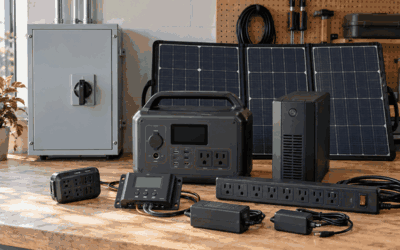
Not unless you add a transfer switch or use a dedicated home integration kit designed for the specific unit. The portable power stations on this list plug into wall outlets directly. They are not whole-home transfer systems, but some models like the Jackery HomePower 3600 Plus offer accessory kits that bridge into your electrical panel for that purpose.


Write Your Review
No reviews yet. Be the first to share your experience!