
🛒 Best Price Today on Amazon
Prime members get fast, free shipping on everything above, plus member-only deals. New members get a 30-day free trial — cancel anytime.
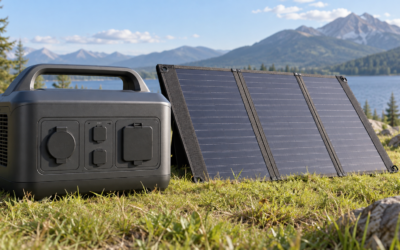
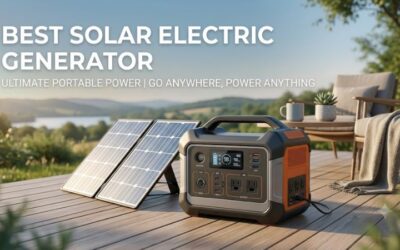
A solar powered generator is usually a battery power station paired with compatible solar panels. The battery stores energy, the outputs supply devices, and the panels recharge the battery when conditions permit. A useful system needs those three parts to match your load and available sunlight.
This guide combines the buying checks that matter for a station-only purchase or a panel bundle: capacity, output, charging limits, compatibility and realistic replenishment. Manufacturer sources were checked on September 20, 2026.
Separate three different ratings
| Rating | What it tells you | What it does not establish |
|---|---|---|
| Battery capacity in Wh | Rated stored energy. | A guaranteed overnight runtime for any appliance. |
| Continuous output in W | The sustained load the inverter is rated to supply. | That every motor will start or that all outlets can supply their maximum together. |
| Panel rating and solar-input limit in W | Nominal panel output and the station’s allowed charging power. | How much energy a shaded panel will deliver in a real day. |
Check startup requirements, voltage and the station’s documented surge behavior for motor-driven loads. Match actual equipment rather than assuming that a model described as a solar generator can power an entire home.
Check the exact bundle contents
A product name may cover a station alone, a station with one panel or several panel options. Confirm the battery model, panel model and quantity, charging cable, adapters and any separate expansion battery. Compare complete systems on the same basis.
The Explorer 1000 v2 manufacturer specification lists 1,070Wh and 1,500W rated AC output. A bundle description does not change those base ratings. Verify its panel option and the station’s input specifications on the exact listing and manual rather than transferring details from a similarly named bundle.
Panel compatibility includes electrical limits
The connector must fit, but electrical compatibility matters too. Check voltage, current, power limits, polarity and the approved cable arrangement. When more than one panel is proposed, verify the combined electrical values against the station manufacturer’s instructions.
EcoFlow’s panel manual requires the panel’s electrical output parameters to fall within the receiving device’s input range and directs users to the device instructions for other connections. An adapter changes the physical connection; it does not prove that an otherwise incompatible panel is safe to use. Avoid assuming that a shared connector makes every panel interchangeable.
Estimate recharge time as a scenario
A starting calculation is energy to replace divided by average charging power. Replacing 800Wh at a steady 160W would take five hours before additional losses and charging taper. Both figures are assumptions for the example, not a prediction for a named kit.
Panel nameplate output is not the same as average input throughout the day. Shade, orientation, weather, temperature and the station’s own charging limits affect the result. Running equipment while charging also reduces the net energy available to replenish the battery. A small panel can be adequate for occasional top-ups while being a poor match for frequent deep discharges.
For recurring use, compare daily device energy demand with a conservative estimate of daily solar replenishment and plan for low-sun periods. Avoid a fixed panel-to-battery ratio or a guaranteed same-day recharge claim without local conditions and model-specific evidence.
Compare the remaining ownership details
- Outputs: required AC voltage and waveform, USB-C profiles, DC connectors, and individual/shared limits.
- Battery: chemistry, documented cycle conditions, storage instructions and warranty coverage.
- Alternative charging: supported wall or vehicle charging and the actual included accessories.
- Portability: station weight plus the weight and folded size of panels and cables.
- Support: manuals, replacement cables, service arrangements and any model-specific expansion support.
Choose a system around the use case
For low-energy electronics, prioritize compatible ports and a system you can realistically carry and replenish. For refrigeration or other appliances, first check starting and running requirements, then work out energy demand. Heating loads can consume stored energy quickly even when the inverter can supply their wattage.
For house wiring, use only supported integration equipment installed by a qualified professional; see our home backup planning guide. A solar kit’s battery capacity or included panel does not establish that it can be connected to household circuits.
Buying decision: choose the combination whose documented output and charging limits fit your equipment, then verify the exact items in the box. Current manufacturer documentation is more useful than a generic top-pick badge.
Write Your Review
No reviews yet. Be the first to share your experience!