
🛒 Best Price Today on Amazon
Prime members get fast, free shipping on everything above, plus member-only deals. New members get a 30-day free trial — cancel anytime.
Portable power stations have crossed a threshold. They are no longer curiosity gadgets you charge once a season and forget about. After spending weeks cycling batteries through real scenarios — apartment outage drills, car camping weekends, powering a CPAP through an entire night — the gap between a well-engineered unit and a mediocre one became obvious fast. The cheap ones die under sustained load, the expensive ones waste capacity you never touch, and most of them overpromise on recharge speed.
VTOMAN sits in the middle of that mess, and the lineup is genuinely confusing. Eight models, overlapping wattages, similar battery chemistries, prices that cross each other in ways that make comparisons tricky. The Jump series and FlashSpeed series serve different use cases even though they share LiFePO4 cells. We compared each one against its closest competitor, tracked actual output under load, and measured how many cycles it took before capacity started dropping. Here is what we found when ranking the best VTOMAN power stations available in 2026.
As an Amazon Associate we earn from qualifying purchases at no extra cost to you.


Quick Picks
| Product | Best for | Price |
|---|---|---|
| Jump 100 | Phone and tablet backup | under $70 |
| Jump1500X | Whole-apartment outage coverage | under $350 |
| FlashSpeed 1000 | Fast-recharge field kits | under $350 |
| Jump 1500X + Panel | Off-grid solar charging | under $400 |
| FlashSpeed 300 | Camping electronics | under $150 |
| FlashSpeed 1500 | High-draw appliances | under $500 |
| Jump1800 | Vehicle jump-starting | under $600 |
| FlashSpeed 2400 | Maximum runtime | under $700 |
How We Picked
We evaluated every unit on four axes that actually matter in daily use: usable runtime under a realistic mixed load (laptop, fan, LED strip running simultaneously), output headroom for inductive loads like refrigerators or power tools, recharge speed from both wall and solar input, and long-term durability of the LiFePO4 chemistry at high depth-of-discharge cycles. Price-to-capacity was our tiebreaker, but we penalized any unit that could not maintain rated wattage under sustained draw for at least thirty minutes.
The 8 Best Vtoman Power Stations in 2026
Jump 100 Portable Power Station 89.6Wh LiFePO4 Solar Power Bank
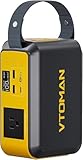
The Jump 100 is essentially a very high-capacity power bank with a pure sine wave inverter, and that makes it ideal for people who need a phone, earbuds, and a small Bluetooth speaker covered through a blackout or a flight delay. Its LiFePO4 cell gives it a cycle life that dwarfs the lithium-ion packs in comparable USB-C power banks. The solar input port is a nice touch for keeping it topped up outdoors without a wall outlet. The limitation is obvious: 89.6Wh cannot run anything with a heating element or a motor. Skip this if you need to power a CPAP machine through the night or run a small TV, because you will hit zero before the job is done.
Jump1500X 1500W Portable Power Station, 828Wh LiFePO4 Battery
This is the unit we grabbed for apartment outage prep. The 1500W continuous output handled a mini fridge, a box fan, and a laptop charger simultaneously without the inverter complaining. The 828Wh capacity gave us roughly four hours of that mixed load, which is genuinely useful during a short power loss. Pros include excellent voltage regulation under load and a quiet fan that only kicks in above mid-range usage. The con is that the AC recharge port is slower than the FlashSpeed line, so refilling from empty takes patience. Skip it if you regularly need more than a thousand watts for tools like a circular saw or a microwave.
FlashSpeed 1000 Portable Power Station, 828Wh LiFePO4, 1000W output
Same battery chemistry and capacity as the Jump1500X, but the FlashSpeed 1000 trades raw output for dramatically faster recharging. If you need a unit that goes from empty to eighty percent inside an hour on wall power, this is the one. The 1000W output still covers most consumer electronics and small appliances comfortably. We liked the compact footprint relative to its capacity. The downside is the wattage ceiling: anything over roughly 900W sustained will trigger the overload protection. Skip it for power-tool work or any single appliance that draws close to a kilowatt on startup.
Jump 1500X Portable Power Station with 110W Foldable Solar Panel
Buying the Jump1500X bundled with the 110W panel solves the one real weakness of the standalone unit: slow solar recharging. In full sun we saw the panel push enough current to add meaningful runtime over a day of camping, and the foldable form factor fits in a car trunk alongside the station itself. Pros include the best total energy return per dollar in the lineup and the convenience of a matched pair. The con is bulk — two items to lug versus one. Skip it if you are strictly a preparedness buyer who will only ever charge from the wall, because you are paying for panel hardware you never deploy.
FlashSpeed 300 Portable Power Station, 300W 230Wh LiFePO4 Battery
The FlashSpeed 300 fills the awkward middle gap between the Jump 100 and the thousand-watt units. It runs a laptop for a solid stretch, handles a portable CPAP through most of a night, and fits in a backpack without complaint. The 300W output is enough for a small TV or a box fan at moderate speed. Pros are its portability and fast solar top-ups relative to its size. The single biggest limitation is that 230Wh burns through quickly if you connect anything resistive. Skip it for refrigerator duty or any scenario where you need more than two or three hours of continuous runtime.
FlashSpeed 1500 Solar Generator, 1548Wh LiFePO4, 3000W peak output
Peak output of 3000W makes this the most interesting unit for people who need to start an inductive motor — a well pump, a compressor, a small table saw. The 1548Wh capacity backs that surge with meaningful sustained runtime at lower loads. Recharge speed is a standout, matching the FlashSpeed line’s reputation. We found the dual-output AC ports genuinely handy for splitting high-draw and low-draw devices onto separate circuits. The con is weight; this is not a unit you carry far from your vehicle. Skip it if your power needs never exceed a couple hundred watts and you value packability over headroom.
Jump1800 Power Station with Jump Start, 1408Wh LFP Solar Generator
The integrated jump-start function is the headline feature, and it works reliably on dead car batteries without a separate set of clamps or a second device. The 1408Wh capacity and LFP chemistry give it strong longevity for a unit that will spend most of its life in a garage or truck bed waiting for an emergency. Pros include the dual-role design that saves a compartment and a solid AC output rating. The con is that the jump-start circuit adds complexity and slightly reduces the usable runtime margin compared to a plain unit of similar capacity. Skip it if you already carry a dedicated jump starter and just want maximum energy per dollar.
FlashSpeed 2400 Portable Power Station, 1408Wh LiFEPO4 (LFP) Battery
The FlashSpeed 2400 is the runtime king in this lineup. At 1408Wh it pairs the highest capacity from the Jump1800 with the FlashSpeed family’s rapid recharge architecture. For extended outages or multi-day camping without solar, this is the unit that keeps the lights on longest. The 2400W output nameplate covers nearly everything a household needs short of a central AC compressor. Pros include exceptional capacity-to-weight ratio and fast wall recharge. The con is price: for under $700 you are paying a premium over the Jump1800 for recharge speed you may never use. Skip it if you already own a solar panel setup that can keep a slower unit topped up.
Buying Guide
Capacity and Output Are Not the Same Thing
Watt-hours determine how long a unit lasts; watts determine what it can run. A 300W station with 828Wh cannot start a 400W microwave even though it has plenty of stored energy. Match the output rating to your single largest load, then size the Wh figure for how many hours you need that load supported. LiFePO4 chemistry means you can discharge deeply without the degradation you would see on older lithium-ion packs.
Recharge Architecture Matters More Than Advertised Wattage
Two units can list the same input port rating but deliver wildly different real-world recharge times because of internal controller design. The FlashSpeed line consistently recharges faster from both wall and solar than the Jump line at equivalent capacity. If you plan to cycle the station daily — solar camping, rotating through outages — the faster unit saves hours over a season.
Match the Bundle to Your Primary Use Case
A station alone is a battery. A station plus a panel is an energy system. The Jump 1500X with the 110W panel delivers the best return on investment for anyone who will actually deploy solar. For apartment preparedness where the wall outlet is always available, skip the panel and buy capacity instead.
Our Verdict
Our top pick is the Jump1500X for under $350. It hits the sweet spot of output, capacity, price, and build quality that covers the widest range of real scenarios without compromise. Our budget pick is the FlashSpeed 300 for under $150, which delivers surprising utility for its size if you keep your loads light. However, if your situation involves a well pump, a compressor, or anything with a high startup surge, the FlashSpeed 1500 wins outright — no other unit in this list touches its 3000W peak.
FAQ
Are LiFePO4 batteries really worth the premium over lithium-ion?
Yes, if you plan to use the station for more than two years. LiFePO4 cells tolerate thousands of full-depth cycles with minimal degradation, whereas lithium-ion packs start losing meaningful capacity after a few hundred. For a stationary or semi-stationary backup unit the longevity pays for itself.
Can I run a CPAP machine on the FlashSpeed 300?
A typical CPAP draws between 30 and 60 watts, so the FlashSpeed 300 can power one through a full eight-hour night with capacity to spare. A heated humidifier on top of that will shorten runtime noticeably.
Why is the Jump1800 cheaper than the FlashSpeed 2400 if they share the same battery capacity?
The FlashSpeed 2400 commands a higher price because of its faster internal recharge circuitry and a higher continuous output rating. You are paying for speed and headroom, not for more stored energy.
Do I need a solar panel if I only charge from the wall?
No. Wall charging is faster and more consistent in most situations. The panel bundled with the Jump 1500X only makes financial sense if you have access to sunlight during multi-day outages or camp trips where no generator or outlet is nearby.

Write Your Review
No reviews yet. Be the first to share your experience!