
🛒 Best Price Today on Amazon
Prime members get fast, free shipping on everything above, plus member-only deals. New members get a 30-day free trial — cancel anytime.
Space heaters are among the most power-hungry plug-in appliances in any home. Nearly all electric resistance heaters in the U.S. are capped at 1,500W on high to stay within the limits of a standard 15-amp, 120V circuit. That makes the wattage question simple at first glance — but real consumption depends on heat settings, thermostat cycling, heater type and room conditions. This guide explains typical wattage, daily energy use and what those numbers mean for generators and batteries.
Typical space heater wattage
| Heater type | Low setting | High setting | Notes |
|---|---|---|---|
| Ceramic fan heater | 600–900W | 1,500W | Fast heat, fan noise |
| Oil-filled radiator | 600–900W | 1,500W | Slow, steady, retains heat |
| Infrared / quartz | 500–750W | 1,000–1,500W | Heats objects and people directly |
| Micathermic panel | 700–800W | 1,500W | Quiet convection + radiant |
| Small personal heater | 200–400W | 400–750W | Desk or under-desk use |
| 240V garage/shop heater | — | 4,000–10,000W | Hardwired, 240V |
Running watts versus starting watts
Resistive heaters have no motor surge worth worrying about — starting watts equal running watts. A small fan adds perhaps 20–50W. That makes sizing straightforward but demanding: a 1,500W heater draws 1,500W for as long as it runs on high.
Thermostat cycling and real consumption
Most space heaters have thermostats that cycle the elements on and off to maintain temperature. In a well-insulated room, a heater might run 40–60% of the time once the room reaches its set point. In a drafty room during very cold weather, it may run nearly continuously.
| Scenario | Duty cycle | Average watts (1,500W heater) | kWh per 8 hours |
|---|---|---|---|
| Insulated room, mild weather | ~30–40% | ~450–600W | ~3.6–4.8 kWh |
| Average room, cold weather | ~50–70% | ~750–1,050W | ~6–8.4 kWh |
| Drafty room, freezing weather | ~85–100% | ~1,275–1,500W | ~10–12 kWh |
Heat output and wattage
Every watt of electric resistance heat produces about 3.41 BTU per hour. A 1,500W heater produces about 5,100 BTU/hr, regardless of type. Differences between heater types lie in how heat is delivered — fan-forced, radiant or convective — not in efficiency. Claims of dramatically more heat from the same wattage are misleading; the real advantage is comfort and distribution.
Rule of thumb
Plan on roughly 10 watts per square foot for a room with average insulation and standard ceilings. A 150 sq ft bedroom needs about 1,500W to stay warm in cold weather, while a 75 sq ft office might need 750W.
Why space heaters strain backup power
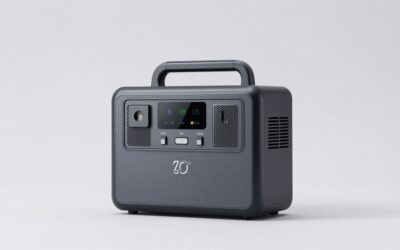
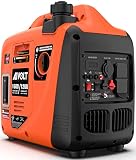
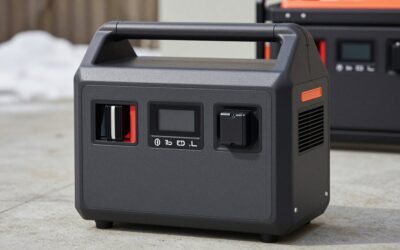
A single space heater on high is equivalent to running a refrigerator, a TV, a laptop, lights and a CPAP combined — several times over. On battery power, a 2,000Wh power station runs a 1,500W heater for barely over an hour. On generator power, it consumes a large share of a small unit’s capacity and increases fuel burn.
| Backup source | Runtime on 750W low setting | Runtime on 1,500W high |
|---|---|---|
| 1,000Wh power station | ~1.1 hours | ~0.55 hours |
| 2,000Wh power station | ~2.3 hours | ~1.1 hours |
| 5,000Wh home battery | ~5.5 hours | ~2.8 hours |
Safer, more efficient alternatives during outages
- Heat one small room and close doors to concentrate warmth.
- Use a 400–750W setting and add blankets or heated mattress pads (50–100W).
- Keep a gas furnace running on generator power; its blower typically draws only 300–800W while burning gas for heat.
- Use propane indoor-safe heaters only if rated for indoor use, with ventilation and CO alarms.
Operating cost at grid prices
At an electricity price of $0.16 per kWh, a 1,500W heater running on high for 8 hours costs about $1.92 per night, or roughly $58 per month. At 50% duty cycle, those figures drop to about $0.96 per night and $29 per month. In regions paying $0.30 per kWh, costs nearly double. Comparing these numbers with your furnace’s cost can show whether zone heating a single room saves money, which it often does when you lower the whole-house thermostat by several degrees and heat only occupied rooms.
Safety reminders
Plug heaters directly into wall outlets, never into power strips, keep three feet of clearance from fabrics and furniture, and choose models with tip-over and overheat protection.
FAQ
How many watts does a space heater use per hour?
A heater on high uses up to 1,500W, or 1.5 kWh per hour of continuous operation. With thermostat cycling, average consumption is often 0.6–1.2 kWh per hour.
Is an oil-filled heater more efficient than a ceramic heater?
Both convert electricity to heat at nearly 100% efficiency. Oil-filled heaters feel steadier and retain warmth after cycling off, while ceramic heaters warm a room faster.
Bottom line
Most portable space heaters use up to 1,500W on high and 600–900W on low, with no starting surge. Their continuous draw makes them tough for batteries and fuel budgets, so use them sparingly during outages and favor lower settings or furnace blower power where possible.

Write Your Review
No reviews yet. Be the first to share your experience!