
🛒 Best Price Today on Amazon
Prime members get fast, free shipping on everything above, plus member-only deals. New members get a 30-day free trial — cancel anytime.
- Best double wall ovens by cooking situation
- What separates the best double wall ovens
- Rack flexibility: the overlooked multi-dish feature
- Installation dimensions: measure the opening, not the old oven face
- Controls that make two-oven cooking easier
- Ownership realities: cleaning, repairs, and common mistakes
- How to choose in five minutes
The best double wall ovens for most households are 30-inch electric models with roughly 10 cubic feet of combined capacity, true convection in at least the upper oven, independently controlled temperatures, and rack systems that can support several heavy dishes. The right choice depends less on the biggest headline capacity than on whether both cavities heat evenly, fit your cookware, and can be installed in your existing cabinet opening.
Best double wall ovens by cooking situation
| Best for | Recommended type or example | Why it fits | Typical market range |
|---|---|---|---|
| Most family kitchens | 30-inch electric double oven with true convection in both cavities | Balanced capacity, flexible temperatures, and enough room for simultaneous roasting and baking | $2,500–$4,500 |
| Frequent holiday and batch cooking | 30-inch model with about 10.0–10.2 cubic feet combined capacity | Accommodates large roasting pans, multiple sheet pans, and separate cooking temperatures | $3,000–$5,500 |
| Connected cooking and guided controls | GE Profile PTD9000-series or a comparable smart double wall oven | App connectivity, guided settings, temperature probes, and more detailed electronic controls | $3,000–$5,000 |
| Premium fit and finish | Bosch 800-series, Wolf, or comparable premium double wall oven | Strong insulation, substantial hardware, refined controls, and more consistent cabinet integration | $4,000–$8,000+ |
| Replacing an older built-in oven | A model selected by cutout dimensions rather than brand alone | Reduces the risk of cabinet modification, filler panels, or an unsuccessful installation | $2,000–$5,000 |
What separates the best double wall ovens
Capacity is more than the advertised cubic feet
A typical 30-inch double wall oven provides approximately 10 cubic feet combined, often divided into two cavities of about 5 cubic feet each. That sounds generous, but usable capacity depends on the shape of each oven. A tall cavity may accept a turkey or standing rib roast, while a broad cavity may be more convenient for four sheet pans.
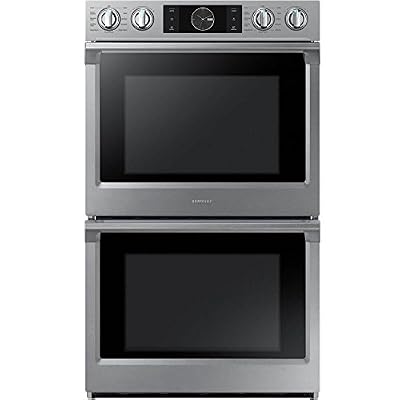
Samsung Appliance NV51K7770DS 30" 10.2 cu. ft. Total Capacity Electric Double Wall Oven with Top Broiler, in Stainless Steel
Included for 'Best Double Wall Ovens' because the listing specifies in Stainless Steel, details this guide uses to compare options.
View on Amazon
SAMSUNG 30" Smart Double Wall Oven w/Steam Cook, Wi-Fi, Large Oven Capacity, NV51K6650DG/AA, Fingerprint Resistant Stainless Steel, Black
Included for 'Best Double Wall Ovens' because the listing specifies Wi-Fi and Large Oven Capacity, details this guide uses to compare options.
View on Amazon
Rangaire RWOD301GS 30" Electric Double Wall Oven, Stainless Steel
Included for 'Best Double Wall Ovens' because the listing specifies Stainless Steel, details this guide uses to compare options.
View on Amazon
SAMSUNG 30" Smart Double Wall Oven w/Flex Duo, Steam Cook, Wi-Fi, Large Oven Capacity, NV51K7770DG/AA, Fingerprint Resistant Stainless Steel, Black
Included for 'Best Double Wall Ovens' because the listing specifies Steam Cook and Wi-Fi, details this guide uses to compare options.
View on AmazonBefore buying, measure your largest cookware. A 16-inch roasting pan, a half-sheet pan measuring about 13 by 18 inches, and a Dutch oven are more useful reference points than the total cubic-foot number. Check whether the pan can sit in the center of the rack without touching the door, convection fan cover, or side walls.
Two equal ovens are convenient when both dishes need similar space. A larger lower oven and smaller upper oven can be more efficient if you commonly roast large items in one cavity and reheat or bake side dishes in the other.
Convection performance affects timing and browning
“Convection” is not a single performance level. Fan-assisted ovens move heated air, but the best double wall ovens add a dedicated heating element around the fan. This is usually called true convection, European convection, or third-element convection.
- True convection in both ovens: the most useful arrangement for cooking two temperature-sensitive dishes simultaneously.
- Convection in one oven only: acceptable for occasional baking, but less flexible during large meals.
- Air-fry modes: useful for crisping small batches, though the supplied basket may occupy substantial rack space.
- Convection roast: helpful for browning meat, but it can dry lean foods if the temperature and cooking time are not adjusted.
Convection does not automatically mean a recipe should be shortened by exactly 25 degrees or 25 percent. Start with the manufacturer’s recommendation, then use an independent oven thermometer or probe to learn how your particular cavity behaves. Fan placement, pan color, rack position, and load size all affect results.
Temperature accuracy matters more than a fast preheat claim
Most modern wall ovens offer electronic temperature control in 5-degree increments, but the displayed temperature is not the same as the temperature at every point around the food. Ovens cycle their heating elements, and the temperature can swing above and below the target while averaging correctly over time.
Look for adjustable temperature calibration, a preheat signal that indicates when the oven is actually ready, and a temperature probe on models intended for frequent roasting. A probe is especially valuable in a double oven because it prevents repeated door opening while another dish is cooking.
Fast preheat is useful when schedules are tight, but it should not outweigh stable low-temperature performance. For bread, custards, cakes, and slow roasting, even heating and reliable recovery after the door opens are more important.
Rack flexibility: the overlooked multi-dish feature
Rack design determines whether the advertised capacity is practical. A good double wall oven should have several rack positions, smooth gliding racks, and at least one rack that can be moved without excessive force when hot.
- Standard flat racks: light, inexpensive, and easy to reposition.
- Gliding or telescoping racks: safer for heavy roasting pans, but they are heavier and can be harder to clean.
- Split racks: allow different heights on each side, useful for tall cookware.
- Temperature-sensitive cooking: benefits from clear rack-position markings and a fan cover that does not consume excessive rear space.
For simultaneous cooking, leave space around each pan so air can circulate. Two tightly packed sheet pans may cook less evenly than one pan on each rack with room between them. A model with six or seven rack positions gives you more usable combinations than one with only five, even when the internal volume is similar.
Installation dimensions: measure the opening, not the old oven face
Most 30-inch double wall ovens are designed for a cabinet cutout roughly 28 1/2 to 29 inches wide and about 50 to 52 inches high, but the exact requirements vary substantially by model. The exterior trim can be close to 30 inches while the required opening is smaller. Depth, electrical clearance, and door projection also matter.
Use the installation manual for the exact model before ordering. Record these measurements:
- Cutout width at the top, middle, and bottom.
- Cutout height from the cabinet floor to the top of the opening.
- Available cutout depth, including any obstruction behind the cabinet.
- Distance from the front trim to adjacent cabinet doors and handles.
- Electrical supply, breaker size, and junction-box location.
As a practical example, if an existing opening is 51 inches high and a replacement requires 51 1/8 inches, the oven is not a drop-in fit. A small mismatch can require cabinet alteration, a platform, or filler work. Electrical installation should follow local code and the manufacturer’s instructions; many full-size double ovens require a dedicated 208- or 240-volt circuit.
Controls that make two-oven cooking easier
Prioritize controls that reduce mistakes rather than controls that simply add more menus. Each cavity should have clearly separate temperature, mode, timer, and start controls. A single shared display is workable only if it makes the active upper and lower settings unmistakable.
- Useful: independent timers, audible completion alerts, control lock, Sabbath mode when needed, temperature probe support, and a bright display visible from across the kitchen.
- Convenient but optional: Wi-Fi notifications, voice control, recipe guidance, and remote preheating.
- Potentially frustrating: touch panels that do not respond with wet hands, deep menus for basic bake settings, or controls that cancel one oven when the other is adjusted.
Smart features cannot compensate for an unsuitable cavity layout. Treat connectivity as a bonus after confirming heating modes, rack design, installation fit, and service availability.
Ownership realities: cleaning, repairs, and common mistakes
Self-cleaning is convenient but produces intense heat. Remove racks unless the manual specifically permits leaving them inside, wipe loose spills first, and ventilate the room. Steam-clean cycles are gentler but are better for light residue than for baked-on grease.
The parts most likely to create ownership problems are door hinges, rack glides, control panels, door gaskets, and heating elements. Heavy racks can wear their glides, while abrasive cleaners can damage enamel or stainless-steel finishes. Do not line the oven floor with foil: it can interfere with heat circulation and damage the cavity or heating elements.
Double ovens also require more careful scheduling. Running both cavities at high heat can increase kitchen heat and electrical demand. Avoid blocking the cooling vents, and allow the oven to complete its fan-cooling cycle before switching off power at the breaker.
How to choose in five minutes
- Choose a standard 30-inch true-convection model if you cook family dinners, bake regularly, and want the best balance of price and flexibility.
- Choose the largest-capacity model that fits if you host holidays or frequently cook several sheet pans and roasting dishes at once.
- Choose premium hardware if smooth racks, quiet operation, design integration, and long-term daily use justify the added cost.
- Choose simple controls if multiple household members use the oven or you dislike app-dependent appliances.
- Choose based on the installation manual first when replacing an existing wall oven; an excellent oven that does not fit is not a practical purchase.
For most buyers, the strongest specification target is two independently controlled 5-cubic-foot-class electric cavities, true convection in both, at least six rack positions per cavity, one gliding rack, adjustable temperature calibration, and controls that remain usable without an app. That combination delivers the capacity and control needed for genuine multi-dish cooking without paying primarily for features that rarely affect the food.






Write Your Review
No reviews yet. Be the first to share your experience!