
🛒 Best Price Today on Amazon
Prime members get fast, free shipping on everything above, plus member-only deals. New members get a 30-day free trial — cancel anytime.
Keeping a laptop running during an outage is less about raw power than about getting clean, steady electricity into a charger designed for grid power. A typical ultrabook charger draws 30-65W, a workstation brick might pull 100-150W, and a gaming laptop under load can demand 230-330W. Nearly any generator can supply that. Choosing the right setup comes down to power quality, noise, fuel efficiency, and whether you need a generator at all.
What different laptops draw
| Laptop type | Charger rating | Typical draw while working | Draw while charging + working | Energy for an 8-hr workday |
|---|---|---|---|---|
| Ultrabook / Chromebook | 30-65W USB-C | 8-20W | 35-60W | ~0.1-0.25 kWh |
| Mainstream 14-16 in. | 65-100W | 15-35W | 50-90W | ~0.15-0.35 kWh |
| Creator / workstation | 100-180W | 30-90W | 90-160W | ~0.4-0.9 kWh |
| Gaming laptop (gaming) | 230-330W | 150-280W | 200-300W | ~1.2-2.2 kWh |
| Add: Wi-Fi router + modem | – | 10-25W | – | ~0.1-0.2 kWh |
Power quality: why inverter generators are the default
Laptop chargers are switching power supplies, and most tolerate a wide input range. Even so, feeding a $1,500-$3,000 computer from an open-frame generator with high harmonic distortion is an unnecessary risk. Inverter generators produce a clean sine wave, typically under 3% THD. That’s comparable to grid power, and it’s what manufacturers mean by “safe for sensitive electronics.” Surge protection between the generator and your chargers adds another layer.
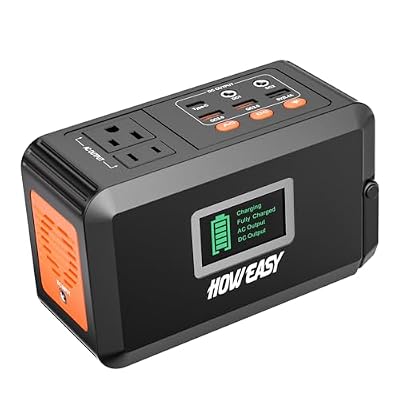
HOWEASY Portable Power Station,120W(240W Peak) Solar Generator
Included for 'Best Generator for Running a Laptop' because the listing specifies 120W(240W Peak) Solar Generator, details this guide uses to compare options.
View on Amazon
Westinghouse iGen400s 400 Watt, 183Wh Portable Power Station and Solar Generator with LED Display and DC Outlet for Camping, Home, Travel, Indoor/Outdoor Use (Solar Panel Not Included)
Included for 'Best Generator for Running a Laptop' because the listing specifies Home and Travel, details this guide uses to compare options.
View on Amazon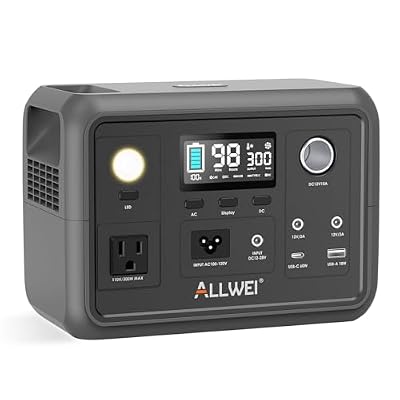
ALLWEI Portable Power Station 300W, 256Wh Solar Generator LiFePO4 Battery
Included for 'Best Generator for Running a Laptop' because the listing specifies 256Wh Solar Generator LiFePO4 Battery, details this guide uses to compare options.
View on Amazon
MARBERO 200W Portable Power Station 148Wh Camping Solar Generator Laptop Power Bank with AC Outlet 110V, DC, USB QC3.0, LED Flashlights for CPAP Home Outdoor Trip Emergency Backup
Included for 'Best Generator for Running a Laptop' because the listing specifies USB QC3.0 and LED Flashlights for CPAP Home Outdoor Trip Emergency Backup, details this guide uses to compare options.
View on AmazonGenerator picks for remote work
Best fuel-burning choice: 1,000-2,300W inverter
A small inverter in eco mode runs a couple of laptops, a router, and a monitor on roughly 0.07-0.12 gallons per hour. That can mean a full workday on about a gallon. Units in the 1,000W class weigh around 28-35 lb, and 2,000W-class units about 45-55 lb. The larger size is worth it if the same generator will also carry a refrigerator.
Best overall for laptops: 300-1,000Wh power station
For computing alone, a battery station usually beats a generator outright. A 500Wh class unit with a 100W or 140W USB-C PD port can charge an ultrabook directly, skipping the AC inverter and its 10-15% loss, and runs silently at your desk. A 1,000Wh station can often cover a mainstream laptop and router for two or three workdays.
Best for gaming or rendering: 2,000W+ inverter or a large station
A gaming laptop at 250W plus an external monitor at 30-40W adds up to around 2-2.5 kWh a day. That’s a job for a 2,000W-class inverter, or a 2,000Wh+ battery station recharged by the generator or solar.
Charge from DC whenever you can
Every conversion loses energy. Generator AC to laptop brick to battery loses about 10-15%. Power station battery to AC inverter to brick to laptop loses 15-25%. Station battery straight to USB-C PD to laptop loses only a few percent. If your laptop charges over USB-C, a station’s high-watt PD port is the most efficient path. It also avoids the station’s AC inverter idle draw, often 10-25W on its own.
Protect your data, not just your hardware
Generators run out of fuel and breakers trip. Keep your laptop’s battery as the buffer. Don’t remove it or run on a nearly empty battery. Enable autosave and cloud sync, and treat any generator hiccup as a non-event, because the laptop simply switches to its internal battery. If you run a desktop PC too, a small UPS between it and the generator smooths short interruptions.
Where the generator goes
People who work from home often set the generator by a home-office window for a short cord run. Keep it at least 20 feet from the house, with the exhaust pointing away from windows, doors, and HVAC intakes. Don’t run it in a garage or under a deck. CO alarms belong on every floor and near the office. For a clean connection to home circuits, have a licensed electrician install a transfer switch or interlock. Never backfeed through a wall outlet.
FAQ
Can I charge a laptop directly from a generator?
Yes. Plug the laptop’s normal charger into the generator’s AC outlet. Use an inverter generator, or a unit rated for low distortion, and ideally a surge protector.
How long will a 500Wh power station run a laptop?
For a mainstream laptop averaging 25-40W, roughly 10-16 hours through USB-C PD, and somewhat less through the AC outlet. A gaming laptop under load may get only 2-3 hours.
Bottom line
Laptops need clean power more than big power. For most remote workers, a 300-1,000Wh power station with USB-C PD is the best outage tool. When a fuel generator is part of the plan, a 1,000-2,300W inverter is the right class. It also keeps the router and the fridge running.










Write Your Review
No reviews yet. Be the first to share your experience!