
🛒 Best Price Today on Amazon
Prime members get fast, free shipping on everything above, plus member-only deals. New members get a 30-day free trial — cancel anytime.
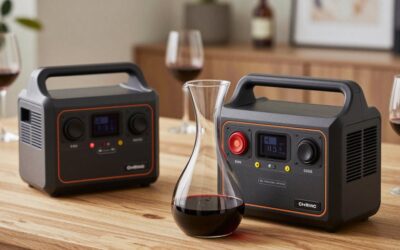
Losing power at 6 a.m. is survivable. Losing coffee at 6 a.m. is, for a lot of households, the moment the outage becomes personal. The good news is that coffee is a short, predictable load, which makes it easy to plan for. The catch is that coffee makers are heating appliances that spike close to the limit of small generators and power stations, so the machine you own decides whether a compact backup can handle it.
Match the source to your brewer’s heating element
Drip brewers draw 600 to 1,200 watts, pod machines 1,200 to 1,500 watts, espresso machines 1,000 to 1,800 watts and electric kettles 1,200 to 1,500 watts. There is no motor surge worth mentioning, so the sizing rule is simple: the source’s continuous (running) output must exceed the brewer’s rating, preferably by 20 percent or more, especially if anything else is running.
| Power source (continuous output) | 5-cup drip | 12-cup drip | Pod brewer | Espresso | Brewer + fridge |
|---|---|---|---|---|---|
| Power station 300 – 600 W | Some models | No | No | No | No |
| Power station 1,000 – 1,200 W | Yes | Borderline | No | No | No |
| Power station 1,800 – 2,400 W | Yes | Yes | Yes | Most | Yes, if fridge is not starting |
| Inverter generator 900 – 1,000 W | Yes | Borderline | No | No | No |
| Inverter generator 1,600 – 1,800 W | Yes | Yes | Yes, alone | Some | Stagger |
| Generator 2,800 W and up | Yes | Yes | Yes | Yes | Yes |
Planning ranges only; check the current spec sheet for your brewer’s rated watts and the source’s continuous output before relying on it.
Battery energy per cup
For power stations, capacity matters as much as output. A 12-cup pot uses about 0.12 to 0.2 kWh including a short warm period. A 1,000 Wh station could brew four or five full pots before needing recharge, but every pot comes at the expense of fridge runtime. A pod machine uses around 0.03 to 0.06 kWh per cup, yet needs 1,500 watts of output, which many 1,000 Wh stations cannot supply. This mismatch, enough energy but not enough output, is the most common reason a station “cannot run” a coffee maker.
Skip the warming plate
Brew into a thermal carafe or pour into an insulated flask immediately. A warming plate that cycles at 50 to 100 watts for two hours can use as much energy as brewing the pot, which is a poor trade when battery capacity is precious.
Generator strategy for the morning routine
If you run a generator during an outage, the morning is when loads stack: fridge compressor, furnace blower in winter, lights, phone chargers and the coffee maker. On a 2,000-watt inverter, starting a 1,200-watt drip brew while the refrigerator compressor kicks on can trigger an overload. Brew first, or wait for the fridge to cycle off. On a 3,000 to 4,000 watt generator you can mostly ignore sequencing.
Fuel cost of coffee on a generator
A 12-cup brew takes around 10 minutes. On a 2,000 to 3,000 watt inverter carrying a 1,000-watt load, that is roughly 0.03 to 0.05 gallons of gasoline for the brew itself. The expensive part is keeping the generator running afterward, so time coffee for when the generator is already on for the fridge or freezer.
Non-electric backup is worth considering
A manual pour-over cone, French press or stovetop percolator combined with a camp stove, gas range or even a grill side burner removes coffee from your electrical budget entirely. Many gas ranges can be lit with a match during an outage; check your range manual, since some models have safety interlocks that prevent it. That can free a small power station to focus on refrigeration, CPAP or medical devices.
FAQ
Can a 1,000-watt power station run a Keurig-style pod machine?
Usually not, because most pod brewers use 1,200 to 1,500 watt heaters. Some stations offer a power-lifting mode that lowers voltage to run resistive loads; it may work but brews slowly.
Is it safe to run an espresso machine on a generator?
Yes, if the generator has clean inverter power and enough continuous output. Espresso machines have electronic controllers and PID thermostats that prefer the low distortion of an inverter generator.
Bottom line
A drip coffee maker needs about 1,000 to 1,500 watts of continuous capacity, and pod or espresso machines need 1,800 watts or more, so a 1,600 to 3,000 watt inverter generator or an 1,800-watt-output power station is the practical minimum. Brew into a thermal carafe, avoid overlapping with the fridge start, or go non-electric to keep precious backup power for refrigeration.
Write Your Review
No reviews yet. Be the first to share your experience!