
🛒 Best Price Today on Amazon
Prime members get fast, free shipping on everything above, plus member-only deals. New members get a 30-day free trial — cancel anytime.
Van life makes every cubic foot and pound matter. There is no trailer tongue to mount a generator on, no bay to store gas cans, and often no desire to draw attention while parked on a quiet street or trailhead. That context tilts the generator-versus-power-station decision heavily, but not completely, toward batteries. This comparison covers how vans are typically powered, what a realistic daily budget looks like, and the few situations where a generator still earns a spot.
Van power sources at a glance
| Source | Typical output | Daily energy (approx.) |
|---|---|---|
| Roof solar, 200–600W | 200–600W peak | 0.6–2.5 kWh depending on sun |
| Alternator via DC-DC charger, 20–60A | 250–800W while driving | 0.5–2.5 kWh per 2–3 hours of driving |
| Shore power at campgrounds | up to 1,800W+ | Unlimited while plugged in |
| Small inverter generator | 1,000–2,200W | As much as fuel allows |
Most full-time van dwellers rely on solar and alternator charging. Driving two hours a day with a 40A DC-DC charger adds roughly 1 kWh, which is enough to cover a cloudy day.

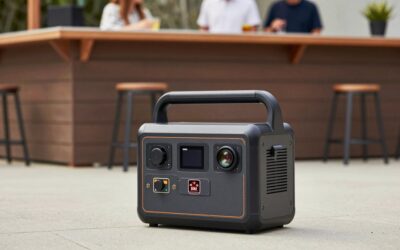
Jackery Explorer 300 Portable Power Station,292Wh
Included for 'Best Power Solution for Van Life: Generator or Power Station?' because the listing specifies 292Wh, details this guide uses to compare options.
View on Amazon
STARYLINE 1000W Portable Power Station 1024Wh LiFePO4 for Outdoor & Home
Included for 'Best Power Solution for Van Life: Generator or Power Station?' as a relevant option in this category; details come from the product listing.
View on Amazon
BLUETTI Solar Generator Elite 300 & Charger 2 Alternator Charger 3014.4Wh
Included for 'Best Power Solution for Van Life: Generator or Power Station?' as a relevant option in this category; details come from the product listing.
View on Amazon
Champion Power Equipment 100593 3276-Wh Power Station 3200/1600-Watt Portable Lithium-Ion Battery Solar Generator
Included for 'Best Power Solution for Van Life: Generator or Power Station?' as a relevant option in this category; details come from the product listing.
View on AmazonTypical daily van loads
| Load | Running watts | Daily energy |
|---|---|---|
| 12V compressor fridge | 40–60W cycling | 0.4–0.8 kWh |
| Roof vent fan | 10–40W | 0.1–0.3 kWh |
| LED lights | 10–30W | 0.05–0.15 kWh |
| Laptop and phone | 40–100W | 0.3–0.7 kWh |
| Diesel heater (fan and pump) | 10–40W after start | 0.1–0.4 kWh |
| Induction cooktop, 30 min | 1,200–1,800W | 0.6–0.9 kWh |
| Rooftop or under-bench AC | 500–1,200W | 2–8 kWh |
Without air conditioning or induction cooking, most vans use 1 to 2.5 kWh per day, easily covered by a 1.5 to 3 kWh battery system with solar and alternator charging.
The power station and built-in battery case
A portable power station of 1,000 to 3,000Wh or a built-in lithium bank of 200 to 400Ah at 12V is the standard van setup. It is silent, so it works when stealth parking in towns. It runs the fridge, fans, and laptop through the night. It charges from three sources, sun, driving, and shore power, and needs no fuel.
Portable station or built-in system?
A power station is fast to install and moves between vehicles, which suits weekend vans and renters. A built-in system with a separate inverter, DC-DC charger, and battery scales higher and integrates cleanly with roof solar and 12V wiring. Many builds start with a station and later move to a built-in system.
Where a generator still makes sense
Hot climates and air conditioning
Vans with air conditioning can burn through 5 kWh in an afternoon. A small inverter generator can run the AC and recharge the battery at the same time. This is most relevant for desert travel in summer or for vans carrying pets that need cooling while owners are away.
Long stationary stays in shade or winter
If you park for a week in a forest or during short winter days without driving, solar and alternator charging fall short. A 1,000 to 2,000W generator used for an hour or two refills the bank.
The practical drawbacks
Storing a generator and gasoline inside a van is unpleasant and potentially dangerous, since fuel vapors and a living space do not mix. Many vans mount a small generator on a rear hitch carrier or skip it entirely. Running one in towns or stealth spots attracts attention.
Comparison for full-time van living
| Factor | Battery + solar + alternator | Generator added |
|---|---|---|
| Noise | Silent | 50–60 dBA when running |
| Stealth parking | Excellent | Poor while running |
| Runs AC for hours | Only with very large bank | Yes |
| Storage burden | Battery inside, panels on roof | Generator plus fuel on carrier |
| Works when parked in shade for a week | Limited | Yes |
FAQ
How big a power station do I need for van life?
A 1,500 to 2,000Wh station, or a 200 to 300Ah 12V lithium bank, covers most vans without AC. Add more capacity if you run induction cooking or work long hours on a desktop setup.
Can I charge a power station while driving?
Yes. Use the station’s car charging input, typically 100 to 120W, or install a DC-DC charger for much faster charging of 300 to 800W from the alternator.
Bottom line
For van life, a battery system charged by solar and the alternator is the best primary power: quiet, stealthy, and fuel-free. Add a small inverter generator on a hitch carrier only if you need air conditioning in the heat or regularly park for long stretches without sun or driving.









Write Your Review
No reviews yet. Be the first to share your experience!