
🛒 Best Price Today on Amazon
Prime members get fast, free shipping on everything above, plus member-only deals. New members get a 30-day free trial — cancel anytime.
EcoFlow and Jackery are the two names most shoppers see first when they look for a portable power station or a solar generator bundle. Both now build around LiFePO4 batteries and both sell everything from small camping units to home-backup machines. The difference is in philosophy: EcoFlow chases speed and features, Jackery focuses on simplicity and ease of use. This comparison looks at how that plays out when you actually own one.
The brands at a glance
EcoFlow
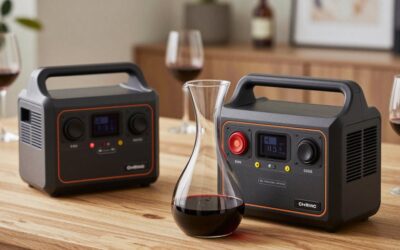
EcoFlow built its reputation on very fast AC charging and one of the widest lineups in the category, from palm-sized River units to the Delta Pro home-backup series, plus smart generators, alternator chargers and home panels. Its app is feature-rich, and the brand is often first to market with new capabilities such as 240V output or whole-home integration.

EF ECOFLOW Delta 3 Portable Power Station, 1024Wh 1800W
Included for 'EcoFlow vs Jackery: Full Comparison' because the listing specifies 1024Wh 1800W, details this guide uses to compare options.
View on Amazon
EF ECOFLOW DELTA 3 Max Portable Power Station, 2048Wh LFP Battery, 2400W
Included for 'EcoFlow vs Jackery: Full Comparison' because the listing specifies 2048Wh LFP Battery and 2400W, details this guide uses to compare options.
View on Amazon
EF ECOFLOW Portable Power Station RIVER 2, 256Wh 300W
Included for 'EcoFlow vs Jackery: Full Comparison' because the listing specifies 256Wh 300W, details this guide uses to compare options.
View on Amazon
Jackery Explorer 300 Portable Power Station,292Wh
Included for 'EcoFlow vs Jackery: Full Comparison' because the listing specifies 292Wh, details this guide uses to compare options.
View on AmazonJackery
Jackery is known for approachable, easy-to-use power stations, the Explorer line and its bundled ‘Solar Generator’ kits that pair a station with SolarSaga folding panels. It has moved its lineup from NMC to LiFePO4 and added HomePower units aimed at home backup. The emphasis is simplicity: clear displays, few settings and a strong retail presence.
Head-to-head comparison
| Factor | EcoFlow | Jackery |
|---|---|---|
| Lineup | River (small), Delta (mid), Delta Pro (home backup) | Explorer (portable), Solar Generator bundles, HomePower (home backup) |
| Charging | Very fast AC charging is a signature; strong solar and multi-source options | Solid AC charging on newer models; bundle-friendly solar |
| Controls / app | Full-featured app, Wi-Fi and Bluetooth | App on newer models; simple on-device controls |
| Typical warranty | Typically around 5 years on current LiFePO4 models (check listing) | Typically around 5 years on newer LiFePO4 models (check listing) |
| Price position | Mid to premium list price, frequent deep sales | Mid to premium, bundles common |
In practice, EcoFlow tends to win on charging speed and ecosystem depth, while Jackery wins on straightforward operation and bundled solar kits that are easy to set up for first-time buyers.
How sizes and prices line up
Both brands sell across the same broad size classes, so it is more useful to compare within a class than across whole brands. Typical street prices shift a lot with sales, but the price-per-watt-hour ranges below are a good sanity check for any deal.
| Size class | Typical street price range | Price per Wh | Typical use |
|---|---|---|---|
| 250-500Wh | $200-500 | ~$0.60-1.20 | Phones, laptops, CPAP, camping |
| 1-2kWh | $500-1,600 | ~$0.40-0.80 | Fridge, outages, RV, job site |
| 3-4kWh+ | $1,800-4,000+ | ~$0.35-0.70 | Home backup, 240V loads |
Ownership experience
Setup and daily use
EcoFlow’s app unlocks charge limits, charge speed, schedules and detailed monitoring, which power users love. Jackery’s displays and controls are simpler, so there is less to learn but also less to tweak.
Accessories
EcoFlow offers a wider range of accessories, including alternator chargers, smart generators and home panels. Jackery’s accessory list is narrower but covers the essentials, especially its SolarSaga panels.
Support
Both brands are large and well established in North America. Buying from an authorised retailer makes warranty claims easiest with either.
Sizing: how much battery do you need?
Brand matters less than size. Add up the watt-hours your devices use in a day (watts x hours), divide by 0.85 for inverter losses, and pick the size class that covers it with some headroom. Then check that the inverter’s continuous rating covers everything that runs at the same moment, with extra surge capacity for motors.
| Device | Typical draw | Hours | Energy per day |
|---|---|---|---|
| Refrigerator (compressor cycling) | 100-150W average | 24 | ~1,200-1,800Wh |
| CPAP (no humidifier) | 30-50W | 8 | 240-400Wh |
| Wi-Fi router + modem | 15-25W | 12 | 180-300Wh |
| Laptop | 45-70W | 6 | 270-420Wh |
| LED lights (x4) | 40W total | 5 | 200Wh |
A household running all five of those through a day needs roughly 2.5-3.5kWh of rated capacity once losses are included. Campers who skip the fridge can usually get by with 500Wh-1kWh.
Safety and placement
Battery power stations produce no exhaust, so they are safe to run indoors, which is their biggest advantage over gas generators. LiFePO4 chemistry is also highly resistant to thermal runaway. Give the unit a few inches of clearance around its vents, keep it off wet floors, and avoid storing it in hot cars or garages where temperatures climb above about 95°F. Most units will not charge below freezing unless they have self-heating, so bring them inside in winter.
Scenario picks
Camping weekend
Either brand’s 1kWh-class unit works. Jackery’s bundle kits are the simpler route; EcoFlow’s fast charging helps if you can top up at a campground outlet.
Home outage kit
EcoFlow’s fast AC charging means you can refill quickly when a storm warning arrives; Jackery’s HomePower units keep things simple for 120V essentials.
RV or van
EcoFlow’s alternator charger and wide accessory range give it the edge for vehicle builds.
Who should choose which
Choose EcoFlow if…
you want the fastest recharge, the widest accessory ecosystem and advanced app control, and you are comfortable with a feature-dense product.
Choose Jackery if…
you want a simple, dependable station or an all-in-one solar bundle without learning a complex app.
FAQ
Is EcoFlow or Jackery better for beginners?
Jackery is usually easier for first-time buyers thanks to its simple controls and bundle kits. EcoFlow suits people who want more control and faster charging.
Do EcoFlow and Jackery use the same battery type?
Current models from both brands use LiFePO4, but older Jackery Explorer units used NMC. Check the chemistry before buying used or discounted stock.
Bottom line
Choose EcoFlow if you want the fastest charging, deepest app control and the broadest accessory ecosystem. Choose Jackery if you want a simple, dependable station or an easy solar bundle. Both are safe, established choices when you pick the right size for your loads.

Write Your Review
No reviews yet. Be the first to share your experience!