
🛒 Best Price Today on Amazon
Prime members get fast, free shipping on everything above, plus member-only deals. New members get a 30-day free trial — cancel anytime.
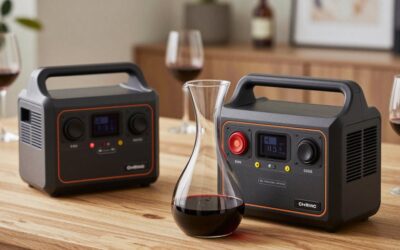
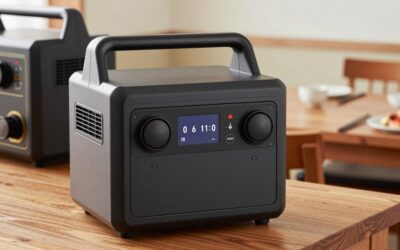
Can a 2,000Wh portable power station keep a bedroom cool through a hot night? Sometimes, but it depends on the air conditioner more than the battery. A typical fixed-speed 8,000 BTU window unit will drain a 2,000Wh station in about 2.5 to 3.5 hours. A modern inverter window AC in a small, shaded room can stretch that to 4-7 hours. Here’s how to work out your number, and a practical plan for sleeping cool on battery power.
Runtime by AC type and size
| Window AC | Fixed-speed running watts | Inverter AC avg (after cool-down) | Fixed-speed runtime (~1,700Wh usable) | Inverter AC runtime |
|---|---|---|---|---|
| 5,000-6,000 BTU | 400-600W | 200-350W | ~3-4.5 hrs | ~5-8.5 hrs |
| 8,000 BTU | 650-750W | 300-450W | ~2.3-2.6 hrs nonstop; ~3-3.5 hrs with cycling | ~3.8-5.7 hrs |
| 10,000 BTU | 850-1,000W | 400-600W | ~1.7-2 hrs | ~2.8-4.3 hrs |
| 12,000 BTU | 1,050-1,250W | 500-750W | ~1.4-1.6 hrs | ~2.3-3.4 hrs |
Fixed-speed figures assume the compressor runs continuously, which is typical in hot weather. When the room reaches setpoint and the compressor cycles off, runtime improves. Check your AC’s nameplate watts and its CEER rating. Higher CEER means more cooling per watt.
Surge headroom is rarely a problem at 2,000Wh
Most 2,000Wh-class stations offer 2,000-3,000W continuous and 3,500W+ surge, enough to start any 120V window unit up to about 12,000 BTU. That’s a real advantage over the 1,000Wh class, where larger units can trip the inverter on compressor start. Inverter ACs start gently and are the easiest match of all.
A realistic overnight plan
Evening: pull the heat out
From 9 to 11 p.m., run the AC at a moderate setpoint (76-78°F) in a closed bedroom. This removes the stored heat and humidity that make the room miserable. Expect to use 600-1,200Wh depending on the unit and room.
Night: switch to fans and a timer
Set the AC’s built-in timer to shut off after you fall asleep, or cycle it with the eco setting. Leave a fan running at 30-50W. Around 500-900Wh remains, enough for 10+ hours of fan plus a CPAP if needed.
Pre-dawn: optional boost
If the room heats up again, a 30-45 minute AC run at 3-4 a.m. can restore comfort. Leave some battery for the morning refrigerator and phones.
Reduce the cooling load
Choose the smallest room that fits the sleepers. Close interior doors, draw blackout curtains on sunny sides during the day, and seal gaps around the window unit with foam panels. Every degree of heat you keep out is battery you don’t spend. In dry climates, opening windows for night air may beat the AC entirely.
Portable AC vs window AC on battery
If you’re choosing a unit for outage use, a window AC beats a single-hose portable air conditioner by a wide margin. Portable units sit inside the room, and single-hose models pull conditioned air out through the exhaust hose, drawing hot outdoor air in through every gap. Their real-world efficiency can be 30-50% lower than a window unit of the same BTU rating. On a 2,000Wh battery, that can mean an hour or more of lost cooling. Dual-hose portables do better. A window-mounted inverter unit, or a U-shaped window AC that seals the opening well, gives the most cooling per watt-hour.
Refilling the battery the next day
Heat-wave outages tend to be sunny. With 600-1,000W of solar panels and 5 peak sun hours, a 2,000Wh station can refill almost completely, setting up another cool evening. A fuel generator can refill the station in about 1.5-2 hours. Run it outdoors, at least 20 feet from the house, with the exhaust pointed away from the bedroom window where the AC draws in air. CO alarms in sleeping areas are essential.
Heat and the station itself
Discharging at 600-1,000W warms the battery, and a hot room adds to it. Place the station on a hard surface in the cooled room, not outside by the AC’s hot exhaust, with its vents clear. Most LiFePO4 stations operate to about 104-113°F before throttling. For long-term health, store at about 50-60% charge and avoid leaving the unit in a hot car or attic.
FAQ
Will a 2,000Wh power station run an 8,000 BTU AC all night?
A fixed-speed unit usually lasts about 2.5-3.5 hours. An efficient inverter AC with a closed, shaded room can reach 4-6+ hours. A full night usually requires pre-cooling, fans, and a timer.
Is it better to buy a bigger station or a more efficient AC?
Often the AC. An inverter window unit can add hours of runtime for a few hundred dollars, which is cheaper than doubling battery capacity.
Bottom line
A 2,000Wh station runs an 8,000 BTU window AC for roughly 2.5-3.5 hours, and an inverter AC for about 4-6. Pre-cool the bedroom, finish the night on a fan and timer, and recharge from solar or a safely placed generator the next day.
Write Your Review
No reviews yet. Be the first to share your experience!