
A portable power station solves a straightforward problem: you need to run electronics somewhere there is no wall outlet, or you need a few hours of backup when the grid drops out. The confusion comes from how manufacturers label capacity and output. Two units might both claim “500W,” but one delivers it continuously while the other only handles a brief surge, meaning your coffee maker trips the breaker the moment it kicks on. Capacity, measured in watt-hours, tells you roughly how long a device can run before the battery drains, and that single number is the most reliable way to compare options across brands.
What separates a good buy from a regret is whether the published specifications match the experience owners describe. Some budget units arrive with plastic housings that flex under transport weight, AC outlets that overheat, or charge controllers that throttle input from solar panels to a trickle. Established brands tend to publish clearer surge ratings and offer firmware updates that fix early bugs. Owner forums and review threads are where you catch the mismatch between spec sheet and reality.
As an Amazon Associate we earn from qualifying purchases at no extra cost to you. Product prices and availability are accurate as of the date shown and are subject to change.





Quick Picks
| Product | Best for | Price |
|---|---|---|
| Jackery Explorer 300 | Casual camping and small electronics | $259 |
| Anker SOLIX S2000 | Home backup during outages | $649.99 |
| Daran 89.6Wh | Phone and laptop charging on a budget | $79.99 |
| Portable Power Station 500W | Mid-range runtime for mixed devices | $179.99 |
| ALLWEI 300W | Weekend trips with LiFePO4 safety | $149 |
| Jackery Explorer 1000 v2 | Powering tools and appliances off-grid | $499 |
| GRECELL 330W | Lightweight portable charging | $149.99 |
| Anker SOLIX C300 DC | Camping with DC-first efficiency | $199.99 |
How We Picked
We narrowed this category to eight units by weighing capacity against price, checking whether listed wattage ratings match what owners report for real appliance loads, and looking at battery chemistry. Lithium iron phosphate cells are showing up across the price range and offer longer cycle life than older NMC cells, so that matters for anyone planning to charge the unit repeatedly. We also favored models where published specs are specific rather than vague.
The 8 Best Power Station in 2026
Jackery Explorer 300
This is the entry-level pick from a brand most people already recognize, and it earns its spot through straightforward usability. The 292Wh capacity is enough to recharge a laptop two or three times, run a small fan for several hours, or keep a CPAP machine going overnight. Owner feedback consistently praises the clean interface and the fact that it handles its rated output without tripping on common loads. Build quality feels solid for the price bracket.
- Predictable output and a well-documented manual
- Jackery’s ecosystem of solar panels and accessories is mature and widely supported
- The price sits higher than competitors offering similar capacity
Skip it if you need to run any appliance over a few hundred watts or if raw capacity per dollar is your priority.
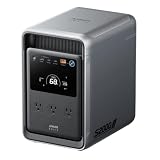
Anker SOLIX S2000
With 2,010Wh and 3,000W peak output, this unit sits in a different class from the rest of the list. It is positioned as home backup, and that ambition shows in the numbers. Owners report running refrigerators, microwaves, and space heaters from it during short outages. The LiFePO4 chemistry means it should endure far more charge cycles than NMC-based alternatives, which matters when you are buying something to sit in a garage for years. The size and weight mean it is not a backpacking companion, but that is not what it is for.
- Genuine whole-home backup capability at a fraction of what a permanent standby generator costs
- 3,000W peak handles high-surge appliances that smaller stations cannot
- Heavy and expensive; overkill for camping or desk work
Skip it unless you need to keep household essentials alive through multi-hour outages.
Daran 89.6Wh LiFePO4
At 89.6Wh, this is the smallest unit here and the cheapest, but it does not feel like a toy because it uses LiFePO4 cells rather than the older chemistry common at this price. The 100W continuous output with a 200W peak is enough for a laptop, a tablet, a phone, or a small LED lantern. The PD fast-charging port is a genuine convenience for anyone who has been stuck waiting on a slow USB-A connection. For the price, the included AC outlet gives it a versatility edge over pure USB power banks.
- LiFePO4 battery at a sub-$100 price point is rare and means longer lifespan
- PD fast charging and AC outlet in one small unit
- Capacity is genuinely tiny; it cannot run anything with a heating element or motor
Skip it if you need more than a day or two of small-device runtime.
Portable Power Station 500W (519.48Wh)
At 519.48Wh and 500W output for $179.99, this unit offers the best raw capacity-per-dollar ratio on the list. It can run a mini fridge, a power drill, or a coffee maker for short bursts. The high mAh figure listed alongside the watt-hours gives a clearer picture of internal cell voltage for anyone who wants to cross-check specs. Owner reviews note it is heavier than the marketing photos suggest, which is typical at this capacity. The build is utilitarian rather than premium.
- Best watt-hour-per-dollar value among mid-range options
- 500W output covers most small household appliances
- Generic branding and thinner documentation compared to established names
Skip it if you value polished software, a mobile app, or a long warranty track record.
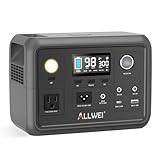
ALLWEI 300W, 256Wh
This sits close to the Jackery Explorer 300 in capacity but costs a hundred dollars less, largely because the brand carries less recognition. The 256Wh of LiFePO4 storage is a meaningful durability advantage at this price, since the chemistry tolerates full discharge cycles without the capacity fade that plagues cheaper NMC cells. Output is 300W continuous, enough for a blender or a small space heater on its lowest setting. Owners describe it as no-frills but dependable for weekend use.
- LiFePO4 chemistry at $149 delivers long-term value
- 300W output is enough for small kitchen appliances
- Charging speed and solar input handling are less refined than top brands
Skip it if you want the smoothest app experience or the fastest AC recharge.
Jackery Explorer 1000 v2
The 1,070Wh capacity and 1,500W output place this in the serious workhorse tier. It can run a full-size refrigerator, a circular saw, or a portable air compressor without strain. Owners use it for job sites, extended van trips, and emergency home backup for essentials. The “v2” designation suggests a revised internal platform, and feedback indicates improved thermal management over the original. The price is the second-highest here, and you are paying partly for the brand’s support network and accessory compatibility.
- High enough output for power tools and kitchen appliances
- Proven accessory ecosystem including multiple solar panel sizes
- $499 is a significant investment if you only need it a few times a year
Skip it if a 300Wh unit would cover your actual usage; you would be paying for capacity you never tap.
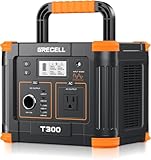
GRECELL 330W, 230.88Wh
GRECELL occupies the same slot as the ALLWEI but with slightly lower capacity and a marginal price premium. The 230.88Wh is enough for a weekend of phone and laptop charging plus a small fan or a projector for a movie night. The 330W output gives it a small headroom advantage for inductive loads like pumps or small compressors. Design is compact and light, which matters for anyone hauling gear to a campsite by hand. Owner feedback is more limited due to the brand’s smaller footprint.
- Light and compact; easy to grab for a one-night trip
- 330W covers small motors and pumps without hesitation
- Less community feedback means fewer real-world data points before buying
Skip it if you need confidence from a large owner base or a proven track record.
Anker SOLIX C300 DC
Anker built this around DC-first efficiency, which is a smart choice for camping where you run 12V gear like fridges, lights, and CPAP machines that draw more power when forced through an inverter. The 288Wh capacity and 300W output handle those loads directly, cutting conversion losses. The C300 DC also includes an AC outlet for occasional use, so it is not locked into DC-only. Owners praise the compact footprint and the fact that it runs cool under sustained load.
- DC-native design reduces wasted energy for 12V camping devices
- Runs noticeably cool, a sign of efficient power management
- 300W AC output limits what you can run through the outlet compared to surge-heavy competitors
Skip it if your primary use is AC appliances like a coffee maker or a space heater.
Buying Guide
Match Capacity to Your Actual Runtime Needs
Watt-hours are the single most important number. Multiply the wattage of your heaviest device by the hours you need it to run. A 60-watt laptop for five hours needs 300Wh. Add twenty percent for inverter inefficiency and you are looking at roughly 360Wh of usable capacity. Buying too small means frustration; buying wildly oversized means carrying dead weight and paying more than necessary.
Continuous Wattage Versus Surge Rating
Many motors and heating elements draw two or three times their rated power for a second or two at startup. A unit listed as “300W peak” may not actually run a 150W blender if the blender surges to 400W at start. Always check whether the published number is continuous or peak, and look for owner reports confirming the unit handles your specific appliance.
Battery Chemistry Determines Longevity
LiFePO4 cells typically last three to five times longer than NMC lithium cells under the same usage pattern, with some rated for over two thousand full cycles before capacity drops to eighty percent. At the price points in this roundup, LiFePO4 is appearing even under $100, so there is less reason to accept older chemistry unless weight is your absolute priority.
Our Verdict
The Jackery Explorer 1000 v2 is our top pick for anyone who needs a single unit that covers job sites, van life, and home emergency backup without compromise. For budget-conscious buyers, the ALLWEI 300W at $149 delivers LiFePO4 durability and genuine appliance-level output that no other unit under $150 matches. If your priority is strictly DC-powered camping gear, the Anker SOLIX C300 DC wins on efficiency where the others lose energy to AC conversion.
FAQ
Can a power station replace a gasoline generator?
For low to moderate loads and short outages, yes. A station like the Anker SOLIX S2000 can run household essentials for hours with zero noise and no fuel storage. For sustained high-wattage use over multiple days without recharging, a gas generator still holds the advantage because fuel is easy to store and replenish.
How do I charge a power station?
Most units accept AC wall charging and DC input from a solar panel or a 12V car outlet. Charge speeds vary widely between models, and some throttle solar input to protect the controller. Check whether the unit supports pass-through charging, meaning you can run appliances while the battery is still recharging.
Is LiFePO4 worth paying extra for?
If you plan to cycle the battery frequently, the longer lifespan pays for itself within a year or two of regular use. If the unit will sit mostly charged in a garage waiting for rare outages, the difference matters less because NMC cells are not being stress-cycled.
Can I run my refrigerator on one of these?
Most full-size refrigerators draw 100 to 250 watts running with a startup surge above 600 watts. That puts them beyond the reach of the 300W-class units here, but a 500W or higher output model can handle many compact or mid-size fridges without difficulty.

Write Your Review
No reviews yet. Be the first to share your experience!