
🛒 Best Price Today on Amazon
Prime members get fast, free shipping on everything above, plus member-only deals. New members get a 30-day free trial — cancel anytime.
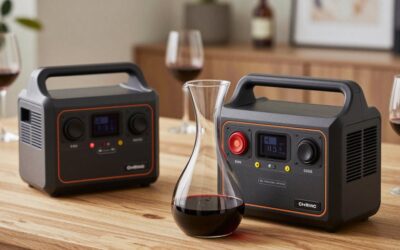
You bought a power station rated at 2,000 watts, plugged in a 1,500-watt appliance, and it shut off or refused to power it. Or you pushed DC ports and got a fraction of what you expected. Power stations have several separate limits: the inverter’s continuous rating, per-port limits, battery-state and temperature derating, and special modes. Understanding each one explains nearly every “won’t reach full wattage” complaint.
The limits that stack up
Inverter continuous vs surge
The headline number might be the continuous AC rating, or on some marketing pages a surge or “lifting” figure. Continuous is what matters for sustained loads. Read the spec sheet carefully for both.
Per-outlet and per-port caps
AC outlets share the inverter, so any one outlet can deliver up to the inverter limit, but a single 15A receptacle cannot legally exceed its own rating. DC ports are much more limited.
| Port | Typical limit | Notes |
|---|---|---|
| 12V car socket | ~120 W (10 A) | Common across brands |
| USB-A | 12-18 W per port | Some support quick charge |
| USB-C PD | 60-140 W per port | Cable must be rated |
| High-current DC (Anderson-style) | ~300-400 W | Model dependent |
| AC outlets combined | Inverter continuous rating | Shared across outlets |
Battery state of charge
At low charge, battery voltage sags under high current. Some stations reduce maximum output or shut off under heavy loads below around 10 to 20 percent.
Temperature derating
Hot conditions reduce sustained output. Cold conditions raise internal resistance, reducing available power and capacity. Stations may throttle output to protect cells.
Voltage-reduction or “lifting” modes
These let resistive loads like kettles run above the inverter rating by lowering voltage, so the appliance runs slower. Actual watts delivered are below what the appliance would draw at full voltage. Motors and electronics should not be run in this mode.
Surge is not the same as sustained power
A station might handle a 3,000-watt surge for a fraction of a second but only 1,800 watts continuously. Compressors, pumps, and power tools need both: surge to start and continuous to run. Size to continuous and confirm the surge duration fits the appliance.
Real-world sizing examples
| Appliance | Running W | Recommended continuous rating |
|---|---|---|
| Coffee maker | 800-1,200 | 1,500 W+ |
| Microwave (1,000W cooking) | 1,400-1,600 input | 1,800-2,000 W+ |
| Hair dryer (high) | 1,500-1,875 | 2,000-2,400 W+ |
| Induction burner | 1,200-1,800 | 2,000 W+ |
| Space heater (high) | 1,500 | 1,800-2,000 W+ (short runs only) |
Microwaves are a common trap: a “1,000-watt” microwave refers to cooking power; the input draw is often 1,400 to 1,600 watts. Check the appliance label for input watts.
Fixes
- Confirm the continuous rating and use AC for high-wattage loads.
- Charge above 50 percent before running heavy loads.
- Operate between roughly 50 and 85 degrees F with open vents.
- Turn off voltage-reduction mode unless the load is purely resistive.
- Use rated USB-C cables for high-wattage laptops.
- Update firmware; some brands have adjusted output behavior.
Runtime reality
Even if a station can deliver 1,800 watts, capacity limits how long. A 1,000 Wh unit running 1,500 watts lasts roughly 30 to 35 minutes after inverter losses. High wattage and long runtime together require large capacity.
Charging while running heavy loads
Another reason a station may not deliver its full rating is that it is charging at the same time. In pass-through mode, some models limit total output or prioritize charging, and heat from both processes can trigger earlier throttling. If you need maximum AC output, for example to run a microwave or induction burner, disconnect the charger or reduce the charge rate for those minutes. Similarly, when solar is feeding the station at its maximum input on a hot afternoon, internal temperature rises and sustained output may drop. Placing the station in shade with clear vents, and scheduling heavy cooking loads for cooler parts of the day, lets the inverter hold its rated continuous power longer.
FAQ
Why can my station run a kettle but not a microwave of the same label wattage?
The kettle is resistive and may run in lifting mode. The microwave’s real input is higher than its cooking rating and it needs stable voltage.
Can I combine two stations for more wattage?
Only models specifically designed to link or parallel can do this safely. Never tie two inverter outputs together with homemade cords.
Bottom line
Full wattage requires the AC outlets, a healthy state of charge, moderate temperature, and normal voltage mode. Check the continuous rating, per-port caps, and the appliance’s real input draw before blaming the station.
Write Your Review
No reviews yet. Be the first to share your experience!