
🛒 Best Price Today on Amazon
Prime members get fast, free shipping on everything above, plus member-only deals. New members get a 30-day free trial — cancel anytime.
The fastest way to make enemies at a campground is to fire up an open-frame contractor generator at 7 a.m. Quiet generators exist precisely so campers can run a fridge, fans, CPAP or a coffee maker without broadcasting it to the whole loop. This buying guide explains what makes a generator quiet enough for campgrounds, which size classes fit which camping styles, how brands like Honda, Champion, Westinghouse and EcoFlow approach the problem, and the features that separate a pleasant neighbor from a problem. Specific models change frequently, so use the criteria here and check each current spec sheet for measured noise and output.
What “quiet enough” means at a campground
Many campgrounds, including many national park campgrounds, follow a limit of about 60 dBA measured at 50 feet, and most enforce generator hours with overnight quiet periods. At 50 feet, a quality small inverter generator at light load is comfortably under that limit. A conventional open-frame generator usually is not. That is why the practical answer for campers is almost always an inverter generator or a battery power station.
Why inverter generators are quieter
Inverter generators vary engine speed with load instead of running at a constant 3,600 RPM, sit inside a muffled enclosure, and use smaller engines. At light load with eco mode on, many small inverters drop to the low 50s dBA at 7 meters.
Match the size to your camping style
| Camping style | Typical needs | Size class | Typical noise at 7 m, light load | Typical weight |
|---|---|---|---|---|
| Tent or car camping | Lights, phones, small fan, CPAP | 1,000–2,000 W inverter or 500–1,000 Wh power station | ~48–55 dBA (station: fan only) | ~20–50 lb |
| Pop-up or small trailer | Fridge, furnace fan, microwave in short bursts | 2,000–2,500 W inverter | ~50–57 dBA | ~45–60 lb |
| Travel trailer, 30A | One rooftop AC (13,500 BTU), fridge, electronics | 3,000–4,500 W inverter, or two 2,000 W units in parallel | ~55–60 dBA | ~70–120 lb |
| Large RV, 50A | Two ACs, residential fridge | Built-in RV generator or large inverter plus energy management | ~58–65 dBA | Varies widely |
How the major brands position quiet models
Honda
Honda’s EU-series inverters built the category’s reputation for quiet, reliable running and remain a benchmark, typically at premium prices. Parts and service networks are widespread.
Champion and Westinghouse
Both offer inverter lines that often undercut premium brands on price while adding features like dual-fuel capability, electric start and CO shutoff sensors. Noise ratings in their small inverter classes are frequently competitive, though measurement conditions vary, so compare carefully.
EcoFlow, Jackery, Anker SOLIX and Bluetti
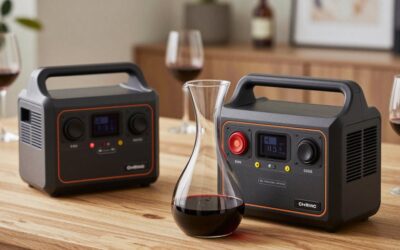
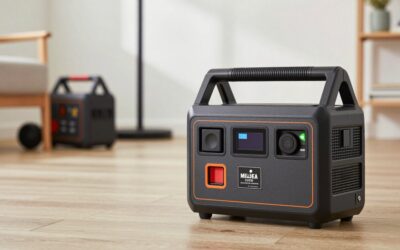
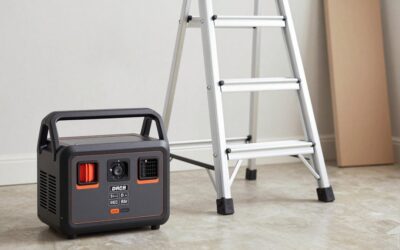
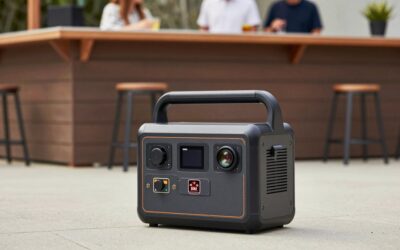
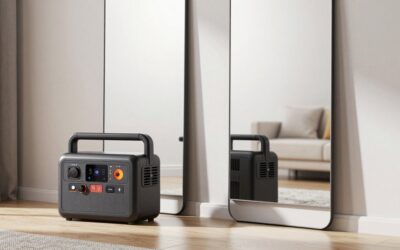
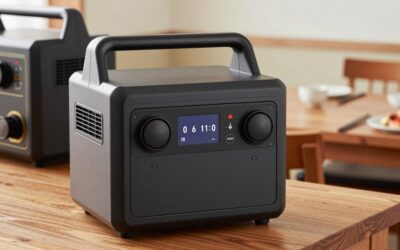
Battery power stations are the quietest option of all, making only cooling-fan noise. Paired with solar panels, they can run lights, fans, a 12V fridge and a CPAP silently for days in sunny weather. They struggle with rooftop AC or long microwave use unless you carry a large battery.
Features that make a real difference
- Eco or economy mode: lets the engine idle down at light load, the single biggest noise and fuel saver.
- Parallel capability: two small inverters linked together can power a 30A trailer and are each easier to carry. Run one alone on quiet evenings.
- CO shutoff sensors: increasingly common and worth having, especially in crowded campgrounds.
- Fuel run time at 25 percent load: a longer run time means fewer refueling interruptions and less time hovering around a hot engine.
- Weight and handles: a 50 lb unit you can lift into a truck bed is more useful than a heavier one you dread moving.
Campsite etiquette and placement
Place the generator on the side of your site away from neighbors, with the exhaust pointed toward open space rather than another camper. Keep it on level ground and away from tents, awnings and vehicle windows; carbon monoxide can drift into a tent or RV. Never run it inside a tent vestibule, under an awning or in a truck bed with a cap. Test your RV’s CO alarm before each trip. Respect posted generator hours and avoid running at all during quiet hours; a charged power station can cover overnight needs.
FAQ
Can a 2,000 watt inverter run an RV air conditioner?
Sometimes, with a soft-start device installed on the AC and a smaller rooftop unit, but it will run near its limit and get louder. A 3,000 watt-class inverter or two 2,000 watt units in parallel is more comfortable for a 13,500 BTU AC.
Is a power station better than a generator for camping?
For light loads and quiet campgrounds, yes: it is silent and needs no fuel. For air conditioning or long cloudy stretches, a small inverter generator is more practical. Many campers carry both.
Bottom line
For neighbor-friendly camping, choose an inverter generator sized to your real loads, favor models with eco mode and published noise figures measured at a stated distance and load, and consider a power station for silent overnight power. Place it thoughtfully, keep exhaust away from people and tents, and follow campground hours. Quiet is as much about how you run a generator as which one you buy.

Write Your Review
No reviews yet. Be the first to share your experience!