
🛒 Best Price Today on Amazon
Prime members get fast, free shipping on everything above, plus member-only deals. New members get a 30-day free trial — cancel anytime.
After a storm, the chainsaw and the generator often come out of the garage on the same afternoon. Trees are down, power lines are out, and you need to clear the driveway before you can go anywhere. The good news is that a chainsaw is not a demanding generator load; the catch is that the right generator depends on whether your saw is corded, battery-powered or gas, and on what else the generator is keeping alive in the house at the same time.
If your chainsaw runs on gasoline
A gas chainsaw needs no generator at all. That sounds obvious, but it matters for planning: if you own a gas saw, size the generator purely for the house, and keep separate fuel for the saw because it uses a 40:1 or 50:1 oil-gas mix, not the straight gasoline your generator burns. Mislabeling cans in a post-storm rush is a common mistake that can ruin a generator engine.
Corded electric chainsaws on a generator
A 16 to 18 inch corded saw runs at about 1,550 to 1,800 watts while cutting and spikes briefly to 2,500 to 3,000 watts at startup. A small 12 to 14 inch saw or an electric pole saw needs roughly half that. Because the load is bursty, you want a generator that can handle the start without collapsing its voltage.
| Generator class | Pole saw / 12 – 14 in corded | 16 – 18 in corded, 15 A | Corded saw + fridge + sump pump |
|---|---|---|---|
| 1,000 – 1,200 W inverter | Pole saw only | No | No |
| 2,000 – 2,500 W inverter | Yes | Yes, eco mode off | No |
| 3,000 – 4,000 W | Yes | Yes, comfortable | Marginal, stagger starts |
| 5,000 – 7,500 W | Yes | Yes | Yes |
These are practical planning ranges; check the current spec sheet of the generator for its rated running watts and of the saw for its amp rating.
Distance is the hidden problem
The generator should be at least 20 feet from the house, and the fallen tree might be another 100 feet beyond that. Long cords lose voltage. At 15 amps, a 150-foot run of 12-gauge cord drops about 6 to 7 percent; 16-gauge drops more than 15 percent, which makes the saw bog and overheat. For distant work either move the generator closer to the work area (never near open doors or windows) or use a battery saw instead.
Battery chainsaws: the generator becomes a charging station
For many homeowners, the smartest storm setup is a battery saw plus two or three packs, recharged from a generator that is already running the house. A standard charger draws 60 to 150 watts; a rapid charger can draw 300 to 600 watts. Either is a trivial addition to a generator already carrying a refrigerator. Most tool chargers include electronics, so a generator with clean inverter power, or at least a well-regulated conventional unit, is the safe choice. Some chargers flash a fault code on rough generator power.
Or skip the generator for charging
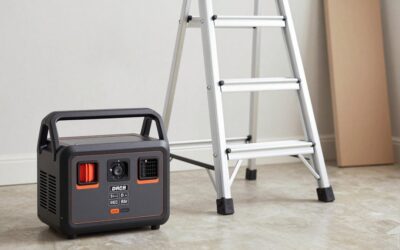
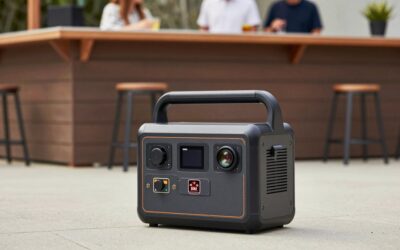
A portable power station of 500 to 1,000 watt-hours can recharge a 5 Ah 56-volt pack (about 280 watt-hours) two to three times, silently and indoors. If the outage is short, that may be all you need for the saw while the generator handles the heavy house loads.
Scenario planning for storm cleanup
Light cleanup, small property
A 2,000 to 2,500 watt inverter can run the refrigerator in the morning, then the corded saw for an hour in the afternoon, then phones and lights at night. Staggering use keeps a small generator in play.
Serious cleanup with the house running
If you want to cut while the fridge, freezer and sump pump cycle unpredictably, a 5,000 to 7,500 watt generator with a transfer switch handles everything without you watching the load meter. The saw plugs into a generator outlet on its own cord, not through the house wiring.
Fuel runtime during a cleanup day
A 3,500-watt generator running a saw for two hours of intermittent cutting plus a fridge the rest of the day averages maybe 500 to 900 watts. Most units in that class burn roughly 0.2 to 0.35 gallons per hour at that level, so 12 hours of operation uses around 3 to 4 gallons. In the days after a big storm, gas stations may be closed or rationed; storing 10 to 15 gallons of stabilized fuel before hurricane or ice season is realistic insurance.
FAQ
Can I use the generator’s GFCI outlet for a chainsaw in the rain?
Yes, and you should: most portable generators have GFCI-protected duplex outlets for exactly this reason. Keep the generator itself under a purpose-built cover or open-sided canopy, never in a garage or enclosed shed.
Why does my corded chainsaw trip the generator’s breaker?
Usually the saw starts while another motor, like a sump pump or fridge compressor, is also starting, or the cord is too long and thin. Pause other loads or move closer.
Bottom line
A 2,000 to 2,500 watt inverter runs most corded chainsaws on their own; 3,000 to 4,000 watts gives comfortable margin; and 5,000 watts or more lets the saw share the generator with a refrigerator and sump pump. If your saw is battery-powered, the generator only needs to feed a 60 to 600 watt charger, and a gas saw needs no electricity at all.








Write Your Review
No reviews yet. Be the first to share your experience!