
🛒 Best Price Today on Amazon
Prime members get fast, free shipping on everything above, plus member-only deals. New members get a 30-day free trial — cancel anytime.
A mini fridge is a common outage priority for insulin, breast milk, medications and a few days of food when the main refrigerator is too big to back up. The good news is that it needs very little running power. The catch is the compressor’s starting surge, which is what trips small inverters and power stations that look big enough on paper. Size the source around that surge and around how many hours you need to keep things cold.
Surge capacity is the real sizing constraint
A compressor mini fridge runs at 50 to 100 watts but can demand 250 to 600 watts for a moment at every start, many times a day. A source that cannot deliver that surge will either shut down or, on some small inverters, keep trying and failing, which stresses the compressor. Thermoelectric coolers have no surge and are far easier to power, though they use more energy per day.
| Power source | Continuous / surge rating | Runs a compressor mini fridge? | Approx. runtime on fridge alone |
|---|---|---|---|
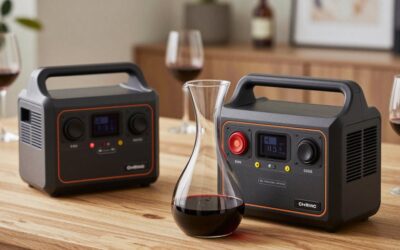
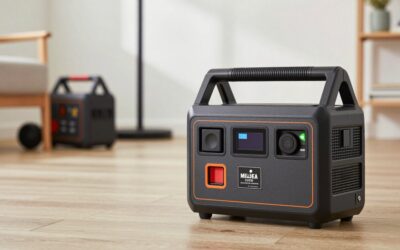
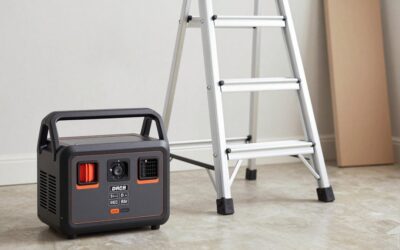
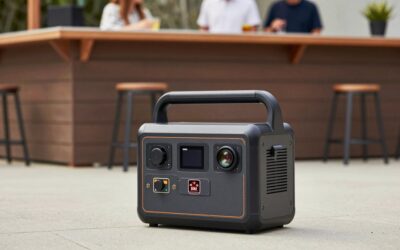
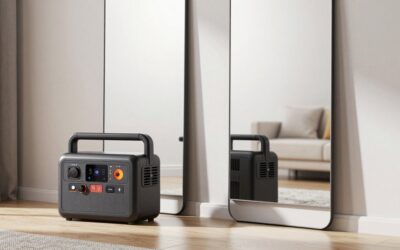
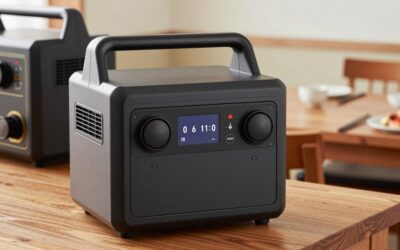
| Small power station, 250 – 300 Wh | 300 W / 600 W | Often, check surge | 8 – 14 h |
| Mid power station, 500 – 1,000 Wh | 600 – 1,000 W / 1,200 – 2,000 W | Yes | 16 – 40 h |
| Large power station, 2,000 Wh | 1,800 – 2,400 W / 3,000 W+ | Yes | 2.5 – 4 days |
| 1,000 – 1,200 W inverter generator | 900 – 1,000 W running | Yes | Fuel limited, 8 – 12 h per tank |
| 2,000 – 2,500 W inverter generator | 1,600 – 2,000 W running | Yes, plus other loads | Fuel limited, 8 – 12 h per tank |
Runtime assumes a fridge using 0.5 to 0.8 kWh per day and about 85 percent inverter efficiency. Check the current spec sheet for both the fridge’s annual kWh and the station’s surge rating.
Battery runtime math you can trust
Do not estimate runtime from running watts; use daily energy. If your fridge’s EnergyGuide label says 270 kWh per year, that is about 0.74 kWh per day. A 1,000 Wh power station delivers roughly 850 Wh of usable AC after conversion losses, so the fridge runs for about 27 hours. In a warm room, cut that by 25 to 40 percent. Also account for the station’s own idle draw when the inverter is on, often 10 to 25 watts, which alone can consume 250 to 500 Wh a day.
Why DC compressor fridges change the math
12-volt compressor coolers built for camping and vans skip the AC inverter entirely. They typically use 0.25 to 0.6 kWh a day and start with a soft-start variable-speed compressor, so even small power stations handle them easily. If medication storage during outages is your main goal, a DC compressor cooler paired with a 500 Wh station is an extremely efficient setup.
When a generator makes sense
For outages longer than two or three days, or when the mini fridge is one of several loads, a small inverter generator becomes practical. A 1,000 to 2,500 watt inverter handles the compressor surge with ease and burns roughly 0.06 to 0.12 gallons per hour at light load in eco mode. Many people run the generator a few hours morning and evening, keeping the fridge door closed in between. A well-filled mini fridge usually holds safe temperatures for 3 to 4 hours unpowered if the door stays shut.
Pairing a generator and power station
A particularly efficient approach is to run the fridge from a 1,000 Wh power station and use a small generator or solar to recharge the station once a day. The generator runs two to three hours instead of twenty-four, and the fridge gets clean power continuously.
Temperature monitoring matters more than wattage
Medications like insulin typically need to stay between about 36 and 46 degrees Fahrenheit; food safety guidance says 40 degrees or below. A cheap wireless thermometer with a min/max memory tells you whether your backup plan actually worked overnight. That data is more valuable than any wattage calculation.
FAQ
Can a 300-watt power station run a mini fridge?
Many can if the surge rating is at least 600 watts and the fridge is a small compressor model, but runtime will be only about 8 to 14 hours. Check the station’s surge rating against the fridge’s starting draw.
Is a modified sine wave inverter OK for a mini fridge?
It is not recommended. Compressor motors run hotter and noisier on modified sine wave power and may fail to start. Use a pure sine wave inverter, power station or inverter generator.
Bottom line
A compressor mini fridge needs a source with at least 600 to 1,000 watts of surge capacity, which rules out some tiny power stations. For a day or two, a 1,000 Wh station is ideal; for longer outages, add solar or a 1,000 to 2,500 watt inverter generator for recharging. For medication-critical storage, consider a 12-volt compressor cooler and track temperature with a min/max thermometer.


Write Your Review
No reviews yet. Be the first to share your experience!