
🛒 Best Price Today on Amazon
Prime members get fast, free shipping on everything above, plus member-only deals. New members get a 30-day free trial — cancel anytime.
Quick answer: Our top pick in 2026 is the Small gasoline inverter generator — our #1 rated choice. See the full ranked comparison, alternatives and buying advice below.
The Short Answer
Yes, a tri-fuel generator is worth it if you want serious backup power and have reliable access to at least two fuel types—especially gasoline plus a propane tank or a natural-gas line. If you only need to keep a refrigerator, a few lights, and phone chargers running during short outages, a smaller dual-fuel or single-fuel generator usually costs less and is easier to move.
The main advantage is flexibility, not automatically higher output. A tri-fuel model can run on gasoline, propane, or natural gas, giving you more options when one fuel is unavailable. The trade-off is a higher purchase price, more weight, more setup complexity, and typically lower output on propane and natural gas than on gasoline.
As an Amazon Associate we earn from qualifying purchases at no extra cost to you. Product prices and availability are accurate as of the date shown and are subject to change.

What You Actually Get
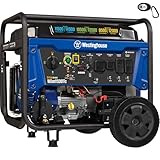
A large tri-fuel portable generator is essentially a gasoline generator with a fuel system designed to accept propane and natural gas as well. The generator still produces electricity through the same engine and alternator, but each fuel delivers a different amount of power.
For example, the Westinghouse 14500 Peak Watt Tri-Fuel Home Backup Portable Generator is listed at $1,499, while the 13500 Peak Watt version is listed at $1,249. Those peak-watt numbers describe short-duration starting capacity for motor-driven appliances—not the amount of power the generator should supply continuously. The practical running output will be lower, and it will usually drop again when switching from gasoline to propane or natural gas.
That distinction matters. A refrigerator, sump pump, furnace blower, well pump, freezer, and window air conditioner all draw extra power when starting. A generator with around 10,000 to 12,000 running watts can handle a substantial emergency load, but you still need to manage which appliances operate at the same time. A whole-home electrical panel can contain far more circuits than the generator can safely support.
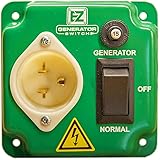
Most generators in this class include electric start, a battery, a remote-start function, multiple household outlets, and a connection point for a transfer switch or interlock. A transfer switch is the safer, more convenient way to power selected home circuits. Installation commonly adds several hundred to more than $1,000, depending on the electrician, panel layout, wiring distance, and local permit requirements.
Expect a large portable tri-fuel unit to weigh roughly 200 to 250 pounds and occupy about the footprint of a compact lawn tractor or large pressure washer. Wheels and a folding handle help, but “portable” does not mean easy for one person to lift into a vehicle. You also need outdoor operating space, several feet of clearance from walls and openings, and a dry, level surface.
Pros
- Three fuel choices: Gasoline is widely available, propane stores for long periods, and natural gas can provide an effectively continuous supply during an extended outage.
- Strong capacity: Large models in the 13,500- to 14,500-peak-watt class can support many essential circuits, including refrigerators, freezers, pumps, lighting, internet equipment, and some heating or cooling loads.
- Better emergency flexibility: If gasoline stations are closed, you can switch to propane. If gasoline and propane are difficult to obtain, a natural-gas connection may keep the generator running.
- Longer storage options: Propane does not degrade like gasoline, and natural gas avoids the need to store fuel tanks. Gasoline is still useful when maximum output is important.
- Convenient starting: Electric and remote start are valuable during storms, freezing weather, or overnight outages, when manually pulling a recoil cord is unpleasant or impractical.
- Transfer-switch readiness: The generator can become part of a more permanent backup-power setup instead of relying on extension cords throughout the house.
Cons
- High initial cost: The two example models cost $1,249 and $1,499 before fuel, taxes, delivery, accessories, and electrical installation. A complete setup can easily reach $1,800 to $3,000.
- Lower output on some fuels: Propane and natural gas commonly produce less power than gasoline. Read the running-watt ratings for each fuel, not just the headline peak number.
- Heavy and bulky: A 200-plus-pound machine is difficult to move over steps, gravel, wet grass, or uneven ground. Plan where it will be stored and how it will reach the operating area.
- Noise: Large open-frame portable generators are often much louder than inverter generators. Expect conversation and sleep disruption if the unit is close to a bedroom or neighbor.
- Fuel and connection requirements: Natural gas use may require a properly sized gas line and professional installation. Propane requires an appropriately rated hose and tank; a small grill cylinder may not support a high-demand generator well.
- Maintenance remains necessary: You still need oil changes, battery care, air-filter service, spark-plug checks, and periodic exercise. Storing gasoline incorrectly can create carburetor problems.
- It is not automatically whole-home backup: Without load management and a correctly installed transfer device, plugging in every appliance can overload the generator or create a dangerous backfeed.
Who Should Buy It
Buy a tri-fuel generator if you live in an area with frequent or lengthy outages, depend on electrically powered heating or cooling, or need to protect a sump pump, well, medical equipment, freezer, or home office. It is also a sensible choice for households that already have a natural-gas connection and want gasoline or propane as a backup.
It makes the most sense when the generator will be connected to selected home circuits through a transfer switch or interlock. That arrangement lets you use the generator’s capacity efficiently and avoids a maze of extension cords. Before buying, list the running and starting watts of every essential appliance. Leave a safety margin rather than sizing the generator exactly to your estimated load.
Choose between the two Westinghouse examples based on your load, not the larger number alone. The $1,249 13,500-peak-watt model may be the better value if it covers your essential circuits. The $1,499 14,500-peak-watt model offers more headroom, but the extra capacity is only useful if your appliances actually need it.
Who Should Skip It
Skip a large tri-fuel model if outages are rare, you live in an apartment, you cannot operate a fuel-burning engine safely outdoors, or you only need a few hundred watts of emergency power. A large generator is unnecessary for charging devices, running a modem, powering a television, or keeping a small refrigerator cold for limited periods.
It is also a poor fit if you do not have storage space, cannot handle a 200-plus-pound machine, or are unwilling to arrange maintenance and safe fuel storage. Households seeking quiet overnight operation may prefer a smaller inverter generator, battery power station, or professionally installed standby generator.
Cheaper Alternatives
| Option | Cost | Trade-off |
|---|---|---|
| Small gasoline inverter generator | $400-$900 | Quieter and easier to carry, but usually limited to about 1,800-3,500 running watts and often cannot support large pumps or central systems. |
| Mid-size dual-fuel generator | $600-$1,100 | Provides gasoline and propane flexibility at a lower price, but gives up natural-gas operation and may have less capacity. |
| Gasoline portable generator | $500-$1,000 | Often delivers strong output for the money, but gasoline is less convenient to store long term and may be unavailable during a regional emergency. |
| Battery power station | $500-$2,000 | Quiet, clean, and indoor-friendly, but runtime and high-wattage performance are limited unless paired with solar panels or extra batteries. |
| Smaller standby generator | $2,000-$5,000 installed | Offers automatic backup and convenient operation, but installation is expensive and the system is less portable. |
FAQ
Does a tri-fuel generator produce the same wattage on every fuel?
No. Gasoline generally provides the highest output, while propane and natural gas commonly produce less. Compare the manufacturer’s running- and starting-watt ratings for each fuel before deciding what the generator can operate.
Can a tri-fuel generator power an entire house?
It can power many selected home circuits, but not necessarily everything at once. A transfer switch or interlock, proper wiring, and load management are essential. Large electric water heaters, ovens, central air conditioners, and electric resistance heat can consume most of the available capacity by themselves.
Is natural gas better than propane for a portable generator?
Natural gas is convenient when the utility supply remains active and you have a properly installed connection. Propane is easier to store independently and can be useful when natural-gas service is interrupted. Keeping both options available is one of the strongest reasons to choose tri-fuel.
Is the extra cost over a dual-fuel generator worth it?
Usually, only if natural gas is a realistic backup for your home or you regularly experience long outages. If you already keep propane tanks and gasoline available, a dual-fuel generator may deliver nearly the same practical flexibility for less money. In 2026, the best choice is still the model that matches your actual load, storage space, and fuel access—not the one with the largest peak-watt number.
Ready to decide? Our #1 pick for 2026 is the Small gasoline inverter generator.
Live price & availability on Amazon.




Write Your Review
No reviews yet. Be the first to share your experience!