
🛒 Best Price Today on Amazon
Prime members get fast, free shipping on everything above, plus member-only deals. New members get a 30-day free trial — cancel anytime.
- Top Pick: WEN 4,750-Watt 120V/240V Dual Fuel Portable Generator with Wheel Kit and Electric Start (DF475T)
- Best Value: Generac 12,500 Starting Watt Tri-Fuel Portable Generator, Electric Start
- Premium Choice: Westinghouse 14500 Peak Watt Tri-Fuel Home Backup Portable Generator, Remote Electric Start, Transfer Switch Ready, Gas, Propane, and Natural Gas Powered
Choosing a generator for an electric furnace is less about the furnace’s heating output and more about its electrical input. Electric furnaces commonly use several heating elements, each drawing substantial power at 240 volts. A small portable generator may run the blower fan, refrigerator, and lights, but it usually cannot operate the furnace’s heat strips.
The Short Answer
Most whole-home electric furnaces require a generator in the 12,000- to 15,000-watt class, and even that range may only work when the furnace’s heat strips are staged or managed by an electrician. A typical 10-kilowatt electric furnace can draw about 10,000 watts while heating; a 15-kilowatt model can draw approximately 15,000 watts before adding the blower and other household loads.
As an Amazon Associate we earn from qualifying purchases at no extra cost to you. Product prices and availability are accurate as of the date shown and are subject to change.
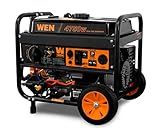

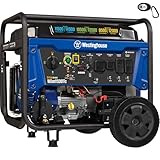

For a furnace with a single 5-kilowatt heat strip, a generator with at least 7,500 to 10,000 running watts may be practical. A 4,750-watt generator, such as the WEN DF475T, is generally suitable for the blower, controls, lights, refrigerator, and selected appliances—not the furnace’s full electric heat output.
Before buying, read the furnace data plate. Look for heat-kit kilowatts, maximum breaker size, volts, amps, and minimum circuit ampacity. The generator also needs a 120/240-volt output, a properly sized transfer switch, and enough running capacity after the furnace is connected.
Standard Sizes
The table below shows common portable generator size classes and representative physical dimensions. Dimensions are approximate published product dimensions for typical units in each class; wheels, handles, and clearance can increase the space required. Always confirm the exact model’s specification sheet before building a pad or storage area.
| Generator class | Typical rated output | Representative dimensions (L × W × H) | Metric dimensions | Typical weight | Electric-furnace suitability |
|---|---|---|---|---|---|
| Compact portable | 3,500–4,750 running watts | 27.5 × 19 × 20.5 in. | 69.9 × 48.3 × 52.1 cm | 95–115 lb | Controls and blower only; usually not heat strips |
| Large portable | 7,500–10,000 running watts | 31 × 27 × 28 in. | 78.7 × 68.6 × 71.1 cm | 180–230 lb | One small heat strip with careful load management |
| Heavy-duty portable | 12,000–13,000 running watts | 33 × 29 × 30 in. | 83.8 × 73.7 × 76.2 cm | 250–300 lb | Many 5–10 kW furnace configurations |
| High-output portable | 13,000–14,500 running watts | 34.3 × 31.5 × 35 in. | 87.1 × 80 × 88.9 cm | 300–350 lb | Best portable range for larger staged systems |
Examples in the heavy-duty class include tri-fuel generators priced around $950 to $1,200, such as 12,500- and 13,000-watt models. High-output 14,500-watt tri-fuel units commonly cost about $1,400 to $1,600. Fuel type does not eliminate the electrical load: a generator may produce different wattage on gasoline, propane, and natural gas, so use the rating for the fuel you plan to use.
How to Measure Your Space
- Measure the generator location. Record the usable length, width, and height in inches. Measure around posts, steps, doors, railings, and air-conditioning equipment.
- Add operating clearance. Do not place a portable generator directly against a wall. Follow the owner’s manual and local fire code; a common planning allowance is at least 3 feet of open space around the unit, with extra room above it for exhaust and heat.
- Check the path to the location. A 300-pound generator may fit on a pad but still be difficult to move through a 30-inch gate or over a threshold. Measure gates and doors, and account for the wheel width.
- Measure the electrical route. Note the distance from the generator inlet to the transfer switch or service equipment. A longer route may require a different cable size, which an electrician should specify.
- Read the furnace label. Find the heat-kit rating in kilowatts. Multiply kilowatts by 1,000 to estimate watts. For example, a 10-kilowatt heat kit uses approximately 10,000 watts while energized.
- List essential loads. Add the furnace, blower, refrigerator, sump pump, well pump, lighting, internet equipment, and any other circuits you want powered. Include starting watts for motors.
- Confirm voltage and connection method. A furnace normally requires a 240-volt circuit. The generator must provide 120/240 volts, and the home needs a code-compliant transfer switch or approved interlock installed by a qualified professional.
By Room or Use Case
Small electric furnace in an apartment or compact home
A small electric furnace may use a 5-kilowatt heat kit plus a low-wattage blower. With the refrigerator and a few lights turned off or managed, a 7,500- to 10,000-watt generator may be sufficient. Measure the furnace’s actual circuit rather than assuming that a small home has a small heating load. Electric baseboards and wall heaters can add significant demand.
Typical single-family home
A 10-kilowatt heat kit, blower, refrigerator, sump pump, and basic lighting can push the required capacity above 12,000 running watts. A 12,500- or 13,000-watt tri-fuel portable generator is a reasonable starting point if the furnace is controlled so that large appliances do not start at the same time. Automatic load-shedding equipment may be needed for reliable operation.
Large home or 15-kilowatt furnace
A 15-kilowatt furnace can consume nearly all the output of a 14,500-watt portable generator by itself. In this situation, a portable generator may run the furnace only when other large loads are disconnected and the heating elements operate in stages. A permanently installed standby generator or a reduced-capacity heat kit may be more practical.
Furnace plus well pump, sump pump, and refrigerator
Motor loads need extra starting power. A well pump or sump pump may briefly require several times its running wattage, potentially causing a generator to trip while the furnace is operating. For this setup, prioritize circuits, use a transfer switch with load management, and consider the generator’s running watts—not just its advertised peak or starting watts.
Blower and controls only
If you are willing to use a wood stove, space heater on a separate circuit, or another heating method, a smaller generator can power the furnace blower and controls. A 4,750-watt dual-fuel model may handle these limited loads, but do not connect electric heat strips unless the calculated load confirms adequate capacity.
Common Sizing Mistakes
- Using peak watts as the main rating. Peak watts are temporary. Size the system using continuous or running watts.
- Ignoring heat-strip ratings. Furnace blower wattage is not the same as electric heating wattage. Heat strips usually account for most of the demand.
- Assuming propane produces the same output as gasoline. Check the fuel-specific wattage chart; propane and natural gas can have lower ratings.
- Powering every household circuit. A 13,000-watt generator is not an unlimited whole-home supply. Exclude electric ranges, water heaters, dryers, hot tubs, and vehicle chargers unless the load calculation supports them.
- Connecting through a dryer outlet. This can backfeed utility lines and create a lethal hazard. Use a listed transfer switch or approved interlock installed by a licensed electrician.
- Placing the generator in a garage. Operate it outdoors, away from doors, windows, and vents, because carbon monoxide can accumulate indoors even when a garage door is open.
- Forgetting space for maintenance. Leave access to the oil fill, fuel shutoff, control panel, wheels, and exhaust area.
FAQ
Can a 5,000-watt generator run an electric furnace?
Usually not. It may run the thermostat, control board, and blower, but a typical electric heat strip can use 5,000 watts by itself. A 5,000-watt generator lacks enough reserve for reliable furnace heating and household loads.
Is a 10,000-watt generator enough for an electric furnace?
It can be enough for a small furnace with one 5-kilowatt heat strip, provided other large loads are limited. It is generally not enough for a 10- or 15-kilowatt furnace operating at full output. Have an electrician calculate the connected and starting loads.
What generator size is best for a 15-kilowatt electric furnace?
A 15,000-watt furnace needs at least 15,000 watts for heat alone, so a 14,500-watt portable generator is not a full-capacity match. Consider staged heat, automatic load management, or a larger permanently installed generator with enough reserve for the blower and essential household circuits.
Do I need a 240-volt generator?
Yes, in most installations. Electric furnaces commonly use a 240-volt, two-pole circuit. Choose a generator with a 120/240-volt receptacle and have the transfer equipment sized and installed for the furnace circuit by a qualified electrician.
Ready to decide? Our #1 pick for 2026 is the Compact portable.
Live price & availability on Amazon.



Write Your Review
No reviews yet. Be the first to share your experience!