
🛒 Best Price Today on Amazon
Prime members get fast, free shipping on everything above, plus member-only deals. New members get a 30-day free trial — cancel anytime.
- Top Pick: 20590 Furnace Air Handler Blower Motor
- Best Value: VEVOR 1/2HP Furnace Blower Motor, 1075RPM 5-Speed, 208/230V 2.7A, 48 Frame 3.4" Shaft Length, 0.5" Shaft Diameter, CW/CCW Dual Rotation, with 7.5μF/450V Capacitor and 11" Hold Hoop
- Premium Choice: VEVOR 3/4HP Furnace Blower Motor, 208/230V 3.85Amps, 1075RPM 5 Speeds, CW/CCW Rotation, 48 Frame 4.8" Shaft Length, 10μF/450V Capacitor + 11" Hold Hoop
Choosing a generator for a furnace blower is mainly a matter of accounting for two electrical demands: the blower’s normal running wattage and the short startup surge required by its motor. Most gas and oil furnace blowers do not need a massive generator by themselves, but an electric furnace or a furnace running alongside a central air conditioner can require several times more power.
The Short Answer
For a typical gas furnace with a 400- to 800-watt blower, choose a generator with at least 2,000 starting watts and 1,000 running watts. A safer all-around choice is a unit rated for 3,000 to 4,000 starting watts and 2,000 to 3,000 running watts, especially if the blower is older, the duct system is restrictive, or other household equipment will run at the same time.
As an Amazon Associate we earn from qualifying purchases at no extra cost to you. Product prices and availability are accurate as of the date shown and are subject to change.


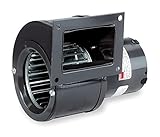
A furnace with a 1/2-horsepower blower usually fits comfortably within a 3,000- to 4,000-watt portable generator. A 3/4-horsepower blower, a blower with a high locked-rotor amperage, or a furnace sharing power with a refrigerator and sump pump may call for 5,000 to 7,500 starting watts.
Electric furnaces are different. Their heating elements can draw 10,000 to 20,000 watts or more. A standard portable generator generally cannot operate electric heat. The following guidance is primarily for gas, oil, and propane furnaces whose main electrical load is the blower, controls, igniter, and inducer motor.
To estimate the load, multiply volts by amps: watts = volts × amps. For example, a 120-volt blower drawing 6 amps uses about 720 running watts. Startup demand can be two to four times the running load, so do not size the generator using running watts alone.
Standard Sizes
The table below shows practical generator classes for furnace-blower applications. Physical dimensions are typical ranges for portable open-frame or inverter units, not guaranteed dimensions for every model. Always compare the generator’s data plate with your furnace specifications.
| Generator class | Typical rating | Approximate generator dimensions | Approximate weight | Best use |
|---|---|---|---|---|
| Compact inverter | 1,800-2,200 starting W; 1,500-1,800 running W | 20-23 in. L × 11-14 in. W × 17-19 in. H (51-58 × 28-36 × 43-48 cm) |
40-55 lb (18-25 kg) |
Small, newer furnace blower only |
| Mid-size portable | 3,000-4,000 starting W; 2,500-3,200 running W | 23-27 in. L × 17-20 in. W × 18-21 in. H (58-69 × 43-51 × 46-53 cm) |
80-115 lb (36-52 kg) |
Most gas furnaces plus controls, refrigerator, or lights |
| Large portable | 5,000-7,500 starting W; 4,000-6,000 running W | 27-32 in. L × 20-24 in. W × 21-25 in. H (69-81 × 51-61 × 53-64 cm) |
125-200 lb (57-91 kg) |
Large blower, well pump, sump pump, or several appliances |
Blower motor size provides a useful starting point, but horsepower is not the same as electrical wattage. A 1/2-horsepower, 208/230-volt replacement motor may draw only a few amps while running, yet still need substantial starting power. For reference, one common VEVOR 1/2-horsepower motor is listed at 2.7 amps, while a 3/4-horsepower version is listed at 3.85 amps. Those motors are designed for 208/230-volt systems and should not be treated as direct replacements for a 115-volt motor without checking the furnace wiring and controls.
Replacement blower motors in the examples provided range from about $95 to $140, while a smaller 115-volt draft fan is listed at about $70. These are motor prices, not generator prices. A suitable compact generator commonly costs about $400-$900, a mid-size model about $600-$1,300, and a larger dual-fuel or heavy-duty unit about $900-$2,000 or more.
How to Measure Your Space
- Read the furnace nameplate. Look for voltage, full-load amps, horsepower, and whether the unit is 115 volts or 208/230 volts. The nameplate is usually inside the access panel or near the blower compartment.
- Identify every motor that starts. A furnace may have a blower motor, inducer motor, oil-burner motor, and ignition system. Add the running wattage of each motor, then account for the largest startup surge.
- Check the blower motor label. Record the voltage and amps. A replacement motor such as a 1/2-horsepower, 1,075-RPM unit may have different electrical requirements from the original motor even if it physically fits.
- Measure the generator location. Allow room for the generator’s wheels, handles, fuel access, exhaust clearance, and maintenance. Do not place a portable generator inside a basement, garage, shed, porch, or enclosed utility area.
- Measure the path to storage. A 100-pound generator may fit its storage shelf but be difficult to move through a 30-inch doorway or over steps. Check the folded-handle width and wheel clearance.
- Calculate the combined load. Add the furnace’s running watts to anything that must operate at the same time. A 700-watt blower, 800-watt refrigerator, and 1,000-watt sump pump may total 2,500 running watts, before startup surges.
- Confirm the connection method. A transfer switch or properly installed inlet is required for connecting a furnace circuit to a portable generator. Never backfeed a home through a wall outlet.
By Room or Use Case
Gas furnace in a small home
If the furnace is the only priority load, a 2,000- to 3,000-watt generator is often adequate. This is common for a compact gas furnace with a 1/3- or 1/2-horsepower blower. Choose a 3,000- to 4,000-watt model if you also want to power a refrigerator, modem, a few lights, or a circulation fan.
Large home with a 3/4-horsepower blower
A larger blower can require more starting power, particularly in a long duct system or when the filter is clogged. A generator providing at least 3,000 running watts and 5,000 starting watts gives more margin. Have an HVAC technician check the motor’s locked-rotor amps if the generator struggles when the blower starts.
Furnace plus central air conditioner
Do not assume a generator sized for the furnace will also run the air conditioner. A central AC compressor can add a startup surge of several thousand watts. Depending on the compressor size, the combined system may require a 7,500- to 12,000-watt generator, a soft-start device, or a professionally designed standby system.
Electric furnace or heat pump
Electric resistance heat is generally too large for a portable furnace-backup setup. Some heat pumps can run on a suitably sized generator, but the outdoor compressor and supplemental heat strips must be evaluated separately. A licensed electrician or HVAC professional should size the generator and transfer equipment.
Oil or wood furnace
These systems may use a blower plus a burner, draft fan, or pump. A typical 3,000- to 5,000-watt generator is a reasonable starting range, but the individual motor labels control the final choice. A 115-volt draft fan rated around 146 CFM uses a different load profile from a large central-air blower.
Common Sizing Mistakes
- Using running watts only: The generator may overload when the blower starts even though its steady load looks acceptable.
- Confusing horsepower with watts: Motor horsepower describes mechanical output, not the exact electrical demand.
- Ignoring voltage: A 208/230-volt motor cannot automatically be substituted for a 115-volt motor.
- Adding every appliance without a priority plan: Select which loads must start together and which can remain off.
- Forgetting the inducer or burner: The blower is not always the only motor in a furnace.
- Using an undersized extension cord: Long, light-gauge cords can cause voltage drop and motor overheating. Use the cord type and gauge specified by the generator and furnace connection equipment.
- Operating indoors: Carbon monoxide can accumulate rapidly. Keep the generator outdoors, away from doors, windows, and vents, and follow the manufacturer’s clearance instructions.
FAQ
Can a 2,000-watt generator run a furnace blower?
Often, yes, if it produces enough starting watts and the furnace is a typical gas or oil unit. A 3,000-watt class generator provides a more comfortable margin and leaves capacity for small essentials.
How many watts does a furnace blower use?
Many residential blowers use roughly 400 to 1,000 running watts, but the exact figure depends on voltage, motor size, speed setting, and duct resistance. Read the motor or furnace nameplate for the most reliable number.
Will a generator run an electric furnace?
Usually not with a practical portable generator. Electric heating elements can require 10,000 watts or more, excluding startup loads from the blower and other equipment.
What size generator should I buy for a furnace in 2026?
For a gas furnace blower alone, a 3,000- to 4,000-watt portable generator is the best general-purpose range. Move to 5,000 watts or more when supporting additional motors, a larger blower, or multiple essential appliances.
Ready to decide? Our #1 pick for 2026 is the Compact inverter.
Live price & availability on Amazon.



Write Your Review
No reviews yet. Be the first to share your experience!