
🛒 Best Price Today on Amazon
Prime members get fast, free shipping on everything above, plus member-only deals. New members get a 30-day free trial — cancel anytime.
- Top Pick: VEVOR Manual Transfer Switch, 50-Amp 10-Circuit, Prewired Generator Transfer Switch Kit with CS6375 Plug Power Inlet Box, Double-Throw Switch, NEMA 3R, Mechanical Watt Meter, for 12500W Generators
- Best Value: EZ GENERATOR SWITCH – The Original, Patented, UL/CSA Approved Manual Transfer Switch – Made in the USA
- Premium Choice: MUJURUR 100A Generator Transfer Switch, 24000W Heavy Duty Double Throw Safety Switch, 120/240V Manual Transfer Switch, Stronger Stability, Enlarged NEMA 3R Enclosure for Outdoor, 10-Year Warranty
The Short Answer
Choose a transfer switch by matching three ratings: your generator’s output, the circuits you want to power, and the transfer switch’s amperage. For a typical portable generator, a 30-amp transfer switch handles up to about 7,200 watts at 240 volts, while a 50-amp switch handles up to about 12,000 watts. A large standby or commercial-style generator may require a 60-amp, 100-amp, or larger switch.
The switch must also match the generator’s voltage and connection. A 120/240-volt generator usually needs a two-pole transfer switch and a compatible inlet, such as a 30-amp L14-30 or 50-amp CS6375 connection. Do not size the switch from the generator’s advertised peak watts alone. Use its continuous or running wattage, and leave capacity for starting loads from refrigerators, pumps, furnaces, and air conditioners.
As an Amazon Associate we earn from qualifying purchases at no extra cost to you. Product prices and availability are accurate as of the date shown and are subject to change.

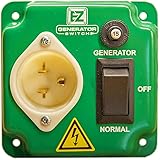
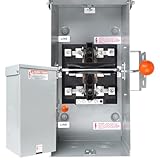
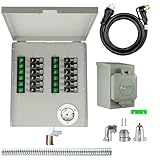
For many homes, a 30-amp, 6- to 10-circuit switch is adequate for essentials. A 50-amp, 10- to 12-circuit model is a better choice when you have a larger portable generator or want to operate several 240-volt appliances. A licensed electrician should verify the panel, wiring, grounding, inlet, and local code requirements before installation.
Standard Sizes
The following are common transfer-switch sizes. Dimensions are typical enclosure measurements, not universal standards; always confirm the manufacturer’s specification sheet before planning the installation. Wattage figures use volts multiplied by amps and assume a 120/240-volt supply.
| Switch rating | Approx. maximum at 240V | Typical circuits | Typical enclosure size | Approx. weight | Common price range |
|---|---|---|---|---|---|
| 30 amp | 7,200 watts | 6 to 10 | 12 x 8 x 4 in (30.5 x 20.3 x 10.2 cm) |
8–15 lb (3.6–6.8 kg) |
$80–$250 |
| 50 amp | 12,000 watts | 10 to 12 | 14 x 10 x 4 in (35.6 x 25.4 x 10.2 cm) |
15–30 lb (6.8–13.6 kg) |
$150–$500 |
| 60 amp | 14,400 watts | Whole-panel or multiple circuits | 16 x 12 x 6 in (40.6 x 30.5 x 15.2 cm) |
20–40 lb (9.1–18.1 kg) |
$250–$700 |
| 100 amp | 24,000 watts | Whole-panel or large subpanel | 20 x 16 x 8 in (50.8 x 40.6 x 20.3 cm) |
35–70 lb (15.9–31.8 kg) |
$75–$1,000+ |
These ratings describe the switch’s safe current capacity, not necessarily the power your generator can produce. For example, a 50-amp transfer switch can safely connect a 50-amp generator inlet, but it will not make a 7,000-watt generator produce 12,000 watts. A 100-amp switch is also unnecessary for a small portable generator unless it is part of a correctly designed system.
Expect price variation based on whether the switch is manual or automatic, indoor or outdoor rated, prewired, UL listed, and supplied with an inlet box. Basic manual products may cost roughly $80 to $150. Prewired 30-amp and 50-amp kits commonly cost $150 to $500. Automatic standby-generator equipment and larger service-rated switches can cost $500 to more than $1,000 before installation.
How to Measure Your Space
- Locate the main electrical panel. Measure the clear wall area beside or below it. A compact manual switch may be approximately 12 to 16 inches tall, 8 to 12 inches wide, and 4 to 6 inches deep.
- Check front clearance. Leave enough space to open the cover and operate the handle. A practical planning depth is at least 30 to 36 inches in front of the equipment, although local electrical rules and the electrician’s layout control.
- Measure the cable route. Note the distance from the transfer switch to the main panel and from the switch to the outdoor inlet. Longer runs may require larger conductors because of voltage drop and may increase installation cost.
- Measure the generator inlet location. The inlet box should be close enough for the generator cord without using unsafe extensions, but far enough from doors, windows, vents, and combustible materials to meet safety requirements.
- Count the circuits. List the breakers you want backed up. A 6-circuit switch may be sufficient for a refrigerator, lighting, furnace blower, sump pump, and internet equipment. A 10- or 12-circuit model offers more flexibility.
- Record breaker sizes and loads. Write down each breaker’s amperage and the appliance’s running and starting watts. The transfer switch must be compatible with the panel’s circuit arrangement, not simply large enough to fit on the wall.
- Confirm indoor or outdoor rating. Outdoor equipment generally needs a weather-resistant enclosure, such as NEMA 3R. Indoor prewired kits should not be installed outside unless the manufacturer specifically permits it.
By Room or Use Case
Essential circuits in a small home
A 30-amp, 6- or 10-circuit transfer switch is often the practical starting point for a modest portable generator. Prioritize the refrigerator, freezer, gas-furnace blower, selected lighting, internet equipment, garage-door opener, and sump pump. Keep electric ranges, electric water heaters, central air conditioners, and electric clothes dryers off the backup list unless the generator is specifically sized for them.
Kitchen and refrigerator backup
Refrigerators usually use modest running power but can draw considerably more during compressor startup. A transfer switch does not eliminate that surge. If you also want a microwave, freezer, or coffee maker, a 30-amp setup can become restrictive quickly. A 50-amp switch paired with a generator capable of at least 10,000 to 12,000 running watts provides more operating headroom, but loads still must be managed.
Basement, sump pump, and well pump
Pumps have high starting demand, so their nameplate matters more than their normal running wattage. A sump pump may use roughly 800 to 1,500 running watts, while a well pump can require more at startup. A 30-amp switch may work for one pump and a few essential circuits, but a 50-amp system is often more comfortable when a well pump, refrigerator, furnace, and lighting must operate together.
Heating and cooling
Gas furnaces usually need electricity for the blower and controls, making them easier to support than electric resistance heat. Portable air conditioners, heat pumps, and central air-conditioning systems can require substantial startup power. Check the unit’s minimum circuit ampacity, maximum fuse or breaker size, and locked-rotor or startup information. Do not assume a 50-amp transfer switch can run central air without checking the generator’s capacity.
Large home or whole-panel backup
Whole-panel applications generally use an automatic transfer switch matched to a standby generator, or a properly engineered manual service-rated switch. A 60-amp switch may suit a generator around 14,000 running watts, while a 100-amp switch can be appropriate for systems near 24,000 watts. The electrical service, generator breaker, feeder conductors, and panel rating must all be coordinated.
Common Sizing Mistakes
- Using peak watts as the normal capacity. Base planning on running watts, then reserve capacity for motor startup.
- Ignoring voltage. A 30-amp, 120/240-volt connection is not the same as a 30-amp, 120-volt connection. The theoretical capacity is 7,200 watts versus 3,600 watts.
- Counting breaker handles instead of circuits. A two-pole breaker occupies two spaces and may supply one 240-volt load. Confirm what the transfer switch actually supports.
- Choosing by enclosure size alone. A physically large box may still have the wrong amperage, pole configuration, inlet, or certification.
- Forgetting the inlet and cord. The generator inlet, cord, breaker, conductors, and transfer switch should have compatible ratings. A 50-amp switch paired with a 30-amp inlet limits the system to the smaller connection.
- Backfeeding the utility. Never connect a generator directly to a receptacle or panel without approved transfer equipment. The switch prevents dangerous utility backfeed.
- Installing without checking code. Grounding, neutral switching, bonding, clearances, and permit rules vary. Have the final design and installation reviewed by a qualified electrician.
FAQ
What size transfer switch do I need for a 7,500-watt generator?
A 30-amp, 120/240-volt transfer switch is commonly suitable if 7,500 watts is the generator’s running output and the generator has a compatible 30-amp connection. If 7,500 watts is only the peak rating, size your loads around the lower running-watt figure.
Can I use a 50-amp transfer switch with a 30-amp generator?
Yes, but the system remains limited by the generator, inlet, cord, and breaker with the lowest rating. Using a larger switch does not increase generator output. The connections must be correctly configured, and the installation should follow the manufacturer’s instructions.
How many circuits should my transfer switch have?
Choose at least one circuit for each essential breaker you intend to power. Six circuits can cover basic emergency needs; 10 to 12 circuits are better for a refrigerator, pumps, furnace, lighting, office equipment, and selected kitchen loads. Circuit quantity does not replace wattage planning.
Is an automatic transfer switch better than a manual one?
An automatic switch starts and transfers power when it detects an outage, making it convenient for standby generators. A manual switch usually costs less and works well with portable generators, but someone must start the generator, connect it safely, and move the switch. In 2026, both types remain practical; the right choice depends on generator type, budget, maintenance preferences, and installation requirements.
Ready to decide? Our #1 pick for 2026 is the 30 amp.
Live price & availability on Amazon.


Write Your Review
No reviews yet. Be the first to share your experience!