
🛒 Best Price Today on Amazon
Prime members get fast, free shipping on everything above, plus member-only deals. New members get a 30-day free trial — cancel anytime.
If your home runs on well water, the generator you choose must be able to start the pump reliably every time the pressure tank calls for water. Well pumps are heavy inductive loads with starting surges three to four times their running watts, and most run on 240V. This guide explains how to size a generator for a well pump, which outlets and connections you need, and how to handle the pump alongside the rest of your essential loads.
Generator sizing by pump horsepower
| Pump | Pump alone (starting W) | Pump + essentials | Recommended generator class |
|---|---|---|---|
| 1/2 HP | 3,000W | 5,000–6,000W | 5,500–7,000W, 240V capable |
| 3/4 HP | 4,000–4,500W | 6,500–7,500W | 7,500–8,500W |
| 1 HP | 5,000–5,500W | 7,500–9,000W | 9,000–10,000W |
| 1.5 HP | 7,000–7,500W | 9,500–11,000W | 11,000–13,000W |
| 2 HP | 9,000–9,500W | 12,000–14,000W | 14kW+ standby or large portable |
Essentials here means a refrigerator, freezer, lights, furnace blower and electronics — about 2,000–3,000W of running load.
Why well pumps need extra headroom
Submersible pumps may sit hundreds of feet down with long wire runs. Voltage drop along those wires, combined with the motor’s starting inrush, means a generator with marginal capacity may bog down, causing the pump to stall or repeatedly try to start. That stresses the motor and can trip the pump’s overload protection. Buying a generator with about 25% more starting capacity than your calculation avoids these issues.
Generator type matters
Conventional open-frame generators typically deliver strong surge capacity and good motor-starting ability for their price. Inverter generators can also start pumps well, but make sure their rated surge meets your pump’s needs; some inverters limit surge duration to a few seconds.
Connecting the pump
Because most well pumps are 240V and hardwired, you need a proper connection:
- Interlock kit with inlet box: feeds the whole panel from a 30A or 50A generator outlet; you switch off non-essential breakers.
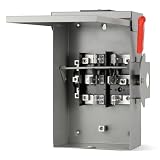
- Manual transfer switch: pre-selected circuits, including the well pump, are switched to generator power.
- Automatic transfer switch with standby: hands-free operation.
Never backfeed through a dryer outlet with a double-male cord; it is dangerous to you and utility workers.
Load strategy
A practical method is to allow the well pump to run freely while avoiding other big surges at the same time. For example, do not start the microwave, sump pump and well pump simultaneously. On a 9,000W generator with a 1 HP pump, running a fridge, freezer, lights and furnace blower alongside the pump is comfortable; add an electric water heater only while nothing else large is running.
Fuel use
The well pump itself uses little energy daily — typically 1–2 kWh — but the generator must run at a size capable of starting it. A 9,000W conventional generator idling at 25–40% load might burn roughly 0.5–0.7 gallons per hour. Over 12 hours, that is 6–8 gallons. Filling storage containers or bathtubs while the generator runs can let you shut down overnight and conserve fuel.
| Strategy | Fuel savings | Trade-off |
|---|---|---|
| Run generator 3× daily for 2 hours | 40–60% | Manage fridge and water timing |
| Fill water jugs for overnight use | Enables shutdown | Storage space needed |
| Upgrade to a larger pressure tank | Fewer starts | Plumbing cost |
Variable-speed pumps and soft starters
Constant-pressure pumps with variable-frequency drives start with minimal surge, sometimes allowing a 1 HP pump to run on a 5,000–6,000W generator. Soft-start devices designed for well pumps offer similar benefits for conventional pumps. Check pump manufacturer compatibility first.
Real-world example setup
A rural home with a 3/4 HP submersible pump at 180 feet, a gas furnace, a refrigerator, a chest freezer and a sump pump typically needs about 2,800W running for essentials and a pump starting surge around 4,000W. Choosing a 9,000W-class dual-fuel generator connected through a 30A inlet and interlock gives ample headroom and allows occasional microwave use. On propane, output drops about 10%, still leaving enough capacity to start the pump with the other loads running. The homeowner fills a few water jugs each evening and shuts the generator down overnight, stretching a 100 lb propane cylinder to roughly two days of intermittent operation.
FAQ
Can a 7,500W generator run a 1 HP well pump?
Often yes if the generator’s starting watts exceed about 5,500W and other loads are modest when the pump starts. A 9,000W+ unit provides more comfortable headroom.
Can an inverter generator run a well pump?
Yes, if it provides 240V output and adequate surge capacity. Many small inverters are 120V-only and cannot power typical submersible pumps.
Bottom line
Size your generator for the well pump’s starting surge plus all other running loads, and add about 25% headroom for deep wells and long wire runs. Make sure the generator provides 240V and connects through a proper transfer switch or interlock, and you will have reliable water through any outage.

Write Your Review
No reviews yet. Be the first to share your experience!