
🛒 Best Price Today on Amazon
Prime members get fast, free shipping on everything above, plus member-only deals. New members get a 30-day free trial — cancel anytime.
A microwave is one of the most practical appliances to run during an outage: quick meals, hot drinks and reheated leftovers with very little fuel. But its high instantaneous draw catches many generator owners by surprise, especially with small inverter models. This guide explains what size generator you need for a microwave, how to run it alongside other appliances, and how to avoid overload shutdowns.
Generator size by microwave
| Microwave (cooking power) | Input draw | Microwave alone | Microwave + fridge + lights |
|---|---|---|---|
| 600–700W compact | ~1,000–1,150W | 1,500–2,000W inverter | 2,500W |
| 800–900W | ~1,200–1,400W | 2,000W inverter | 3,000W |
| 1,000–1,100W | ~1,500–1,700W | 2,200–2,500W inverter | 3,000–3,500W |
| 1,200W+ / over-the-range | ~1,650–1,850W | 2,500–3,000W | 3,500–4,000W |
Why small inverters sometimes fail
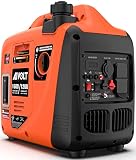
A 2,000W-class inverter generator typically provides around 1,600–1,800 running watts. A 1,000W-cooking microwave drawing 1,600W, plus its brief startup surge, can push the generator to its limit. If a refrigerator compressor starts at the same moment, the generator’s overload protection may trip. The solution is either a larger generator, a smaller microwave, or careful load management.
Parallel operation
Pairing two 2,000W-class inverters doubles available power to roughly 3,200–3,600 running watts, making a full-size microwave and refrigerator comfortable to run together.
Sizing method
- Find the microwave’s input watts (label) — not the cooking power.
- Multiply by about 1.25 to cover inrush and voltage sag.
- Add running watts for everything else on at the same time.
- Choose a generator whose running rating exceeds the total, with 10–20% margin.
Worked example
Microwave input 1,550W × 1.25 ≈ 1,940W. Fridge running 200W, lights and router 150W. Total ≈ 2,290W. A 2,500–3,000W inverter covers it with margin; a 2,000W-class inverter might trip if the fridge starts simultaneously.
Load management tips
- Turn off space heaters, hair dryers, kettles and coffee makers while microwaving.
- Start the microwave when the refrigerator compressor is already running, not during its startup.
- Use lower power settings on inverter microwaves to reduce draw.
- Put the generator’s eco mode off briefly if it has trouble responding to sudden loads.
Fuel impact
Because microwave use is brief, fuel impact is small.
| Daily microwave use | Energy | Extra fuel (2–3kW inverter) |
|---|---|---|
| 3 short reheats (3 min each) | ~0.25 kWh | ~0.03–0.05 gal |
| 3 meals cooked (6 min each) | ~0.5 kWh | ~0.06–0.1 gal |
| Heavy use (30 min total) | ~0.8 kWh | ~0.1–0.15 gal |
The main fuel consideration is the generator size you choose: a larger generator idling all day burns more fuel than a smaller one, even if the microwave itself uses little.
Power quality
Microwaves with electronic controls and inverter power supplies work best on clean power. Inverter generators typically provide under 3% THD. Conventional generators can run microwaves, but voltage fluctuations may cause uneven heating, clock resets or, in rare cases, control board issues.
Battery power alternative
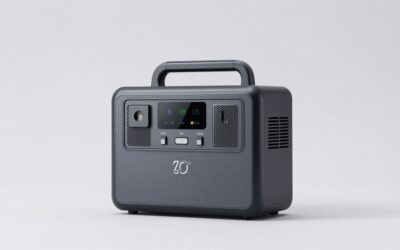
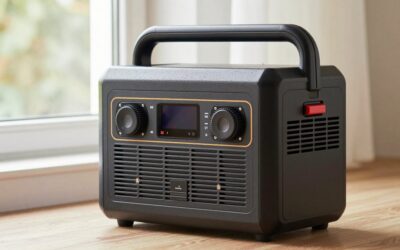
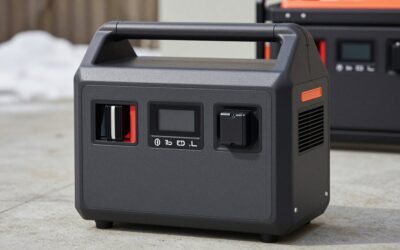
A power station with at least 1,800–2,000W continuous output can run most microwaves. A 1,000Wh station supports roughly 30 minutes of microwave use after inverter losses, enough for several meals. Recharging from solar or a generator during the day keeps it ready.
Choosing a microwave for backup power
If you often rely on generator or battery power — in an RV, cabin or outage-prone home — the microwave you buy makes a difference. An inverter microwave with genuine variable power levels draws less at lower settings and starts more gently, making it friendlier to small generators. A compact 700–900W model draws 1,000–1,400W, which fits comfortably on a 2,000W-class inverter alongside a refrigerator. Over-the-range models with vent fans and lights add load and are harder to isolate on backup circuits, so countertop units are generally easier to manage off-grid.
Using a microwave in an RV
In a 30A RV on generator power, a microwave and the rooftop AC together can reach 3,000W or more. Many RVers turn off the AC for the two or three minutes the microwave runs, which lets a 2,200–3,000W inverter handle both loads in sequence without tripping.
FAQ
Can a 2,000W generator run a 1,000W microwave?
Often yes if nothing else significant is running. A 1,000W-cooking microwave draws about 1,500–1,700W, close to a 2,000W-class inverter’s running limit, so avoid starting other loads simultaneously.
Is it better to use a microwave or a stove on a generator?
A microwave is usually better: it needs less generator capacity, runs on 120V and uses less total energy for most reheating and small meals.
Bottom line
Plan on a 2,200–3,000W generator for a full-size microwave, and 3,000–3,500W to run it alongside a refrigerator and lights. Size by the input rating, not the cooking power, and manage loads so the microwave does not start at the same time as other motors.

Write Your Review
No reviews yet. Be the first to share your experience!