
🛒 Best Price Today on Amazon
Prime members get fast, free shipping on everything above, plus member-only deals. New members get a 30-day free trial — cancel anytime.
A well pump is often the reason rural homeowners buy a generator in the first place: no pump means no water for drinking, flushing or washing. Well pump wattage varies widely based on horsepower, voltage, depth and whether the pump is a submersible, jet or constant-pressure design. This guide explains typical running and starting watts, how to read the nameplate, and how pressure-tank cycling affects daily energy use.
Typical well pump wattage
| Pump horsepower | Running watts | Starting watts | Common use |
|---|---|---|---|
| 1/2 HP | 700–1,000W | 2,100–3,000W | Shallow wells, jet pumps |
| 3/4 HP | 1,000–1,400W | 3,000–4,200W | Typical residential submersible |
| 1 HP | 1,300–1,800W | 4,000–5,500W | Deeper wells, larger homes |
| 1.5 HP | 1,800–2,500W | 5,500–7,500W | Deep wells, irrigation |
| 2 HP | 2,400–3,200W | 7,000–9,500W | Very deep wells, farms |
Starting watts for induction motors are commonly three to four times running watts. Deep submersibles with long wire runs may push toward the higher end.
Pump types and their power profiles
Submersible pumps
Installed down in the well, usually on 240V. They are efficient and quiet, but their starting surge can be large, especially 2-wire models that start without a separate control box.
3-wire submersibles
Use a control box with a start capacitor that improves starting torque and slightly reduces surge compared with 2-wire designs of the same horsepower.
Jet pumps
Mounted above ground for shallow wells (typically under 25 feet) or with a deep-well ejector. Many run on 120V or 240V selectable, and draw similar wattage to submersibles of the same horsepower.
Constant-pressure (variable-speed) pumps
These use a variable-frequency drive to ramp motor speed, eliminating most starting surge and adjusting power to demand. They can run on a much smaller generator than a conventional pump of the same horsepower.
Reading the nameplate and control box
The pump’s horsepower, voltage and service factor amps (SFA) are printed on the control box or pressure switch documentation. Multiply amps by voltage for running watts. If you cannot find the pump data, a clamp meter on the pump circuit during operation gives a direct reading. For surge, a meter with inrush capture is ideal; otherwise, use the 3–4× rule.
Daily energy use
A well pump runs only when the pressure tank drops to its cut-in pressure. A family of four using 250–400 gallons per day with a pump delivering 8–12 gallons per minute runs the pump roughly 25–50 minutes daily.
| Pump (running W) | 30 min/day | 60 min/day | Irrigation 3 hrs/day |
|---|---|---|---|
| 3/4 HP (~1,200W) | ~0.6 kWh | ~1.2 kWh | ~3.6 kWh |
| 1 HP (~1,500W) | ~0.75 kWh | ~1.5 kWh | ~4.5 kWh |
| 1.5 HP (~2,200W) | ~1.1 kWh | ~2.2 kWh | ~6.6 kWh |
Daily energy is modest; the challenge is the brief but large starting surge each time the pump cycles.
Pressure tanks and cycling
A larger pressure tank reduces the number of starts per day, which reduces wear and the number of surge events your generator must handle. A tank with a drawdown of 8–12 gallons can cut cycling significantly compared with small tanks. Check the pre-charge pressure yearly — it should be about 2 PSI below the pump’s cut-in setting.
Voltage considerations
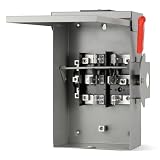
Most submersible pumps run on 240V, so they require a 240V source: a generator with an L14-30 or 14-50 outlet feeding a transfer switch, or a hardwired standby. A 120V-only generator cannot run a 240V well pump.
Signs your pump is drawing more than it should
A pump that runs longer than usual to refill the pressure tank, trips its breaker occasionally, or short-cycles every few seconds is often consuming more energy than necessary. Common causes include a waterlogged pressure tank, a leaking check valve, a clogged intake screen, a worn impeller or a falling water table. Each of these raises running time and sometimes current draw, which increases both energy use and the strain on backup power. Measuring the pump’s amperage once a year and comparing it with the control box rating is an easy way to catch problems before they leave you without water during an outage.
FAQ
How many watts does a 1 HP well pump use?
Roughly 1,300–1,800W while running and 4,000–5,500W at startup, depending on voltage, depth and whether it is a 2-wire or 3-wire design.
Do variable-speed well pumps use less power?
They use similar power at full flow but ramp up gently and often run at lower speeds, reducing both starting surge and average consumption.
Bottom line
Residential well pumps typically draw 700–2,500W running with starting surges of 2,000–7,500W. Check horsepower and voltage on the control box, measure if you can, and remember that the surge — not daily energy — is what determines your backup power requirements.

Write Your Review
No reviews yet. Be the first to share your experience!