
🛒 Best Price Today on Amazon
Prime members get fast, free shipping on everything above, plus member-only deals. New members get a 30-day free trial — cancel anytime.
- Top Picks at a Glance
- Comparison Table
- 1. Westinghouse 9500 Peak Watt Dual Fuel: Best Overall
- 2. AIVOLT 7500 Watt Dual Fuel: Best Value
- 3. Champion 8125-Watt Tri Fuel: Best for a Natural Gas Hookup
- 4. Honda EU7000iS: Best Premium Quiet Option
- 5. Generac 10,000 Starting Watt: Best for Extra Headroom
- 6. Westinghouse 7500 Peak Watt EFI Dual Fuel: Best for Easy Starts
- 7. Cummins Onan P9500df: Best for RV Plus Home Use
- Also Consider
- How We Chose
- Buying Guide
- Common Mistakes to Avoid
- Frequently Asked Questions
- Which One Should You Buy?
- Sources
If you want a 7500 watt portable generator for home backup, the Westinghouse 9500 Peak Watt dual fuel model is the safest all-round starting point: it pairs 7,500 running watts on gasoline with propane flexibility and a transfer-switch-ready outlet. The runner-up is the Generac 10,000 Starting Watt gas model, which gives you extra headroom when a well pump or air conditioner is in the mix. This guide covers the best 7500 watt generators and the nearby 7000 watt class, including dual fuel, inverter and CARB-minded choices, so you can match the machine to your panel and your budget.
A quick note on the numbers. Makers sell this class with two ratings: starting (peak) watts and running (rated) watts. A “9,500 peak” generator typically delivers 7,500 running watts on gasoline, and the propane rating is usually lower. The running figure is the one that matters for planning loads. We did not personally use these products; this guide is research-based, built from manufacturer spec sheets, retailer listing details and independent reviews, and anything we could not verify is marked “not listed”.

AIVOLT Generator 7500 Watt Dual Fuel Portable Generator with Wheels | Gas and Propane Powered, 30A RV Ready, CO Sensor, 4-Stroke OHV Air Cooled Engine, EPA-PGMA300 Compliant
Included for '7500 Watt Portable Generators: Dual Fuel, Inverter and CARB Picks' because the listing specifies Gas and Propane Powered and 30A RV Ready, details this guide uses to compare options.
View on Amazon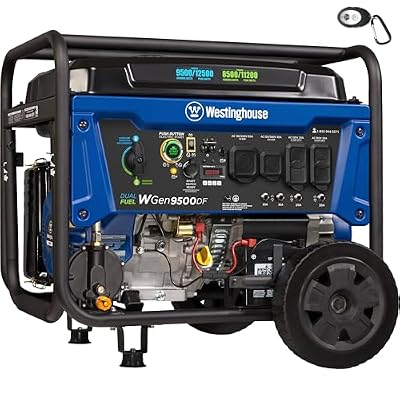
Westinghouse 12500 Watt Dual Fuel Home Backup Portable Generator, Remote Electric Start, Transfer Switch Ready, Gas and Propane Powered
Included for '7500 Watt Portable Generators: Dual Fuel, Inverter and CARB Picks' because the listing specifies Remote Electric Start and Transfer Switch Ready, details this guide uses to compare options.
View on Amazon
Westinghouse 7500 Peak Watt EFI Dual Fuel Home Backup Portable Generator, Remote Electric Start, Transfer Switch Ready, Gas and Propane Powered, CO Sensor, CARB Compliant
Included for '7500 Watt Portable Generators: Dual Fuel, Inverter and CARB Picks' because the listing specifies Remote Electric Start and Transfer Switch Ready, details this guide uses to compare options.
View on Amazon
Westinghouse 13500 Peak Watt Dual Fuel Home Backup Portable Generator, Remote Electric Start, Transfer Switch Ready, Gas and Propane Powered
Included for '7500 Watt Portable Generators: Dual Fuel, Inverter and CARB Picks' because the listing specifies Remote Electric Start and Transfer Switch Ready, details this guide uses to compare options.
View on AmazonTop Picks at a Glance
- Best Overall: Westinghouse 9500 Peak Watt Dual Fuel (gas and propane, electric start, transfer switch ready)
- Best Value: AIVOLT 7500 Watt Dual Fuel (gas and propane, 30A RV outlet, CO sensor)
- Best for Natural Gas Hookups: Champion 8125-Watt Tri Fuel (adds natural gas)
- Best Premium Quiet Option: Honda EU7000iS inverter (7,000 watts, clean power for electronics)
- Best for Extra Headroom: Generac 10,000 Starting Watt (8,000 running watts, COsense)
- Best for Easy Starts: Westinghouse 7500 Peak Watt EFI Dual Fuel
- Best for RV Plus Home Use: Cummins Onan P9500df (7,500 running watts on gasoline)
Comparison Table
| Product | Best for | Key specs (as listed) | Watch for | Price tier |
|---|---|---|---|---|
| Westinghouse 9500 Peak Watt Dual Fuel | All-round home backup | 9,500 peak watts, dual fuel, electric start, transfer switch ready | Heavy open-frame unit; propane output is lower than gas | Mid-range |
| AIVOLT 7500 Watt Dual Fuel | Lowest cost dual fuel | 7,500 watts, dual fuel, wheels, 30A RV outlet, CO sensor | Newer brand; confirm warranty and service network | Budget |
| Champion 8125-Watt Tri Fuel | Natural gas hookup at home | 8,125 watts, gas / propane / natural gas, electric start | Output differs by fuel | Mid-range |
| Honda EU7000iS | Quiet, clean power | 7,000 watts, 120/240V inverter, gasoline | High cost, gasoline only | Premium |
| Generac 10,000 Starting Watt | Larger loads | 10,000 starting, 8,000 running watts, electric start, COsense | Gasoline only; bigger and heavier | Mid-range |
| Westinghouse 7500 Peak Watt EFI Dual Fuel | Fuel-injected, remote start | 7,500 peak watts, EFI, remote electric start, dual fuel | Peak rating, so running watts are lower than the name | Mid-range |
| Cummins Onan P9500df | RV plus house use | 9,500 peak, 7,500 running on gas, RV-ready 30A, dual fuel | Propane running watts not listed here | Premium |
1. Westinghouse 9500 Peak Watt Dual Fuel: Best Overall
- 9,500 peak watts, with 7,500 running watts on gasoline per Westinghouse’s WGen7500DF specifications
- Dual fuel: gasoline or propane (propane output is lower, about 6,750 running watts per the maker)
- Electric start with a transfer-switch-ready 120/240V twist-lock outlet
- 420cc engine; the gasoline sibling lists up to 11 hours on its 6.6 gallon tank
- Carbon monoxide sensor: check the exact listing for your version
Best for: homeowners who want a single machine for a transfer switch or interlock setup, plus the option to store propane long-term. Skip if: you need a quiet unit for a campsite or need guaranteed California compliance.
This is the class benchmark. A 7,500 running watt rating covers a typical essentials circuit set: refrigerator, furnace blower, sump pump, lights, internet gear and a few outlets. Dual fuel matters in practice because gasoline goes stale in storage while propane keeps. Many owners run on propane during a storm when gas stations have lines and keep gasoline as a backup.
On the specs that trip buyers up: Westinghouse’s own pages for the WGen7500 family list the CARB status as “No”, although some retailers show otherwise. The sensible step is to read the emissions label on the exact unit, or ask the seller, before ordering for California or another CARB state.
Pros: strong running wattage for the price class; propane option; transfer-switch-ready outlet; electric start; broad parts and accessory availability. Cons: heavy at about 200 lbs for the gasoline model per the maker; loud open-frame design; propane derating.
2. AIVOLT 7500 Watt Dual Fuel: Best Value
- 7,500 watts, gas and propane
- Wheels included
- 30A RV-ready outlet
- Carbon monoxide sensor, per the listing
- Running versus peak split: not listed in the short title, so confirm before you size loads
Best for: budget-minded homeowners who want dual fuel and an RV outlet. Skip if: you want a long-established service network or proven parts supply.
The price gap against the big names is the point of this pick. The thing to verify is whether the 7,500 figure is a peak or a running rating. If it is peak, plan around roughly 6,000 running watts instead. That is still enough for essentials, but not for central air plus a well pump at the same time. Ask the seller for the running watt figure for both fuels and the warranty length.
It also pays to look at the practical extras: a wheel kit saves your back, a 30A outlet means an RV cord plugs straight in, and a built-in CO sensor adds a shutoff layer. None of that replaces placing the generator well away from the house.
Pros: low cost for a dual fuel unit; wheel kit and 30A outlet; CO sensor. Cons: less brand history; specs sit mostly in the listing; support quality unknown to us.
3. Champion 8125-Watt Tri Fuel: Best for a Natural Gas Hookup
- 8,125 watts, tri fuel: gasoline, propane or natural gas
- Electric start
- LPG hose included, per the listing
- Running watts on each fuel: not listed in the short title
- Transfer-switch-ready and CO features: check the full listing
Best for: homes with a natural gas line where you want unlimited runtime without refueling. Skip if: you never plan to connect to natural gas, because a dual fuel model costs less.
Natural gas is the calmest fuel decision you can make for outages. Supply is steady during multi-day events, and there is no gasoline to carry. The trade-off is that natural gas typically gives lower output than gasoline, so look at the per-fuel table on the manufacturer’s sheet and size your loads to the lowest figure. Hook-up should be done by a licensed professional following local code.
Pros: three fuels; electric start; strong brand support in the US. Cons: more complex fuel setup; output varies by fuel; heavier than basic gas units.
4. Honda EU7000iS: Best Premium Quiet Option
- 7,000 watts, 120/240V
- Inverter design, gas powered
- Electric start (the “iS” model), per the listing
- Marketed as super quiet for camping and job sites
- Exact dB and run-time figures: not listed here, see the Honda spec sheet
Best for: buyers who care about noise and clean power for sensitive electronics. Skip if: price is the main driver or you want propane.
Inverter generators produce a smooth sine wave, which helps with laptops, modern furnaces and similar electronics. They also throttle the engine to the load, which usually makes them calmer in a quiet neighborhood. Honda lists this at 7,000 watts rather than 7,500, so it sits in the same planning band but with a little less headroom. It is also the most expensive pick here by a wide margin.
Pros: quiet operation; clean power; well-regarded reliability reputation. Cons: premium cost; gasoline only; fewer outlets than some open-frame machines.
5. Generac 10,000 Starting Watt: Best for Extra Headroom
- 10,000 starting watts and 8,000 running watts
- Electric start
- PowerRush technology to help with starting motors
- COsense carbon monoxide shutoff, per the listing
- Gasoline only
Best for: households with a well pump, a larger air conditioner or a shop. Skip if: you want to run on propane or keep weight down.
At 8,000 running watts this is above the strict 7500 watt class, which is exactly why it appeals. Starting surge is the quiet problem with generators: a 3-ton air conditioner or a deep well pump can ask for several times its running load for a second or two. PowerRush is Generac’s feature designed to help with that, though you should still add up your starting loads before trusting any single number.
Pros: extra running watts; CO shutoff; recognized brand and service network. Cons: gasoline only; larger footprint; higher fuel use at heavy loads.
6. Westinghouse 7500 Peak Watt EFI Dual Fuel: Best for Easy Starts
- 7,500 peak watts (running watts: not listed in the title, expect lower)
- EFI, or electronic fuel injection, with remote electric start
- Dual fuel and transfer switch ready
- CO and CARB details: check the exact listing
Best for: owners who dislike carburetors. Skip if: you need a true 7,500 running watts, because this model is rated by peak.
Carburetor problems from stale fuel are one of the most common reasons generators fail to start after storage. EFI engines handle that better because the fuel system self-adjusts. The catch is the name: “7500 Peak” means the sustained output is lower. This is a good machine for essentials, but it is a step down in capacity from the 9500 peak model above.
Pros: EFI convenience; remote start; dual fuel. Cons: peak rating confuses buyers; lower continuous capacity; EFI repairs are less DIY-friendly.
7. Cummins Onan P9500df: Best for RV Plus Home Use
- 9,500 watts peak, 7,500 running watts on gasoline
- Dual fuel with electric start
- RV-ready 30A outlet
- Propane running watts: not listed here, check the maker sheet
Best for: people who drive an RV or trailer and also want house backup. Skip if: you want the lowest price.
The Cummins Onan name has a long RV-generator history. The 30A outlet lets you plug a travel trailer shore cord directly, and the same machine can feed a home inlet. The labelling is also clear about running watts on gasoline, which is the honest number to plan around.
Pros: clearly stated running watts; RV-ready; dual fuel. Cons: premium cost; weight; limited detail in the short listing for propane.
Also Consider
- Efurden 7000 Watt Inverter Generator: a lower-cost inverter alternative with ECO mode and a 30A RV outlet. Brand support is unproven, so read the warranty.
- Powerhorse 7,000 Watt Portable Generator: a basic electric-start unit for backup and job sites. Fewer extras but straightforward.
- Westinghouse 6500 Watt Dual Fuel: a step smaller, with 30A outlets for RV and transfer switch. Good if 7,500 is more than you need.
- Champion 9375-Watt Dual Fuel with CO Shield: a bigger dual fuel option with Champion’s CO shutoff. Check running watts per fuel.
How We Chose
We compared manufacturer spec sheets, retailer listing details and independent generator reviews, and we looked for models that really sell in the 7,000 to 8,000 running watt band, with a mix of gas, dual fuel, tri fuel and inverter designs. We did not personally use these products. Where the listing showed only a peak rating or omitted a figure, we said so instead of filling the gap. Brand limits kept the list varied: no more than two models from one brand.
Buying Guide
Running watts versus peak watts
Plan around running watts. Add the running watts of everything you want to power at once, then add the single largest starting surge. If the total is 6,500 and your generator is rated 7,500 running, you are fine; if you land at 7,400, step up a size. Staying below about 80 percent of the running rating is a common rule of thumb for sustained loads.
A worked sizing example
Suppose you want a refrigerator (about 700 running watts, 2,100 starting), a furnace blower (about 800 running), a sump pump (about 1,000 running, 2,000 starting), lights and electronics (about 600) and a small microwave (about 1,000). The running total is roughly 4,100 watts. Add the largest extra starting surge (about 1,400 above the sump pump’s running load) and you need about 5,500 watts at the worst moment. A 7,500 running watt unit covers that with room. Add a 3-ton central air conditioner and the picture changes, so ask an electrician about soft starters or load management. These appliance figures are typical examples, not your numbers: read the labels on your own equipment.
Fuel type
| Fuel | Strength | Trade-off |
|---|---|---|
| Gasoline | Highest output, easy to find | Ages in storage, needs stabilizer |
| Propane | Stores for years, cleaner burn | Lower output than gasoline |
| Natural gas | No refueling during long outages | Needs a plumbed connection by a licensed professional, lower output |
Outlets and transfer switch
Look for a 120/240V 30A twist-lock outlet if you plan to connect through a transfer switch or interlock. Have a licensed electrician install it. Never backfeed a house panel through a wall outlet. A 30A RV outlet is useful for trailers, and a 50A outlet may be needed for large rigs, so check the outlet list.
CARB and emissions rules
California and a few other states restrict generators that are not CARB certified. Compliance can differ between versions of the same model name, as the Westinghouse WGen7500 family shows, so check the emissions label on the exact unit. When in doubt, ask the seller to confirm in writing.
Noise, weight and safety
Open-frame generators in this class are loud and weigh roughly 170 to 230 pounds, so wheels matter. Inverter models are quieter but cost more. Always run a generator outdoors, well away from windows, doors and vents, because carbon monoxide can build up indoors even with doors open. Install battery-powered CO alarms in the house. Models with CO shutoff add a layer of protection but do not replace good placement.
Common Mistakes to Avoid
- Reading a peak rating as running capacity.
- Ignoring the propane derate and then finding the load too heavy.
- Buying for California without checking the emissions label.
- Skipping a transfer switch or interlock and running extension cords through a window.
- Storing gasoline untreated for many months.
- Forgetting break-in and oil changes: follow the owner’s manual for the first oil change and the maintenance schedule.
Frequently Asked Questions
How many watts do I really need for home backup?
Most homes with a fridge, furnace blower, sump pump and lights need 4,000 to 6,000 running watts, so a 7,500 watt generator gives a margin. Add up your own appliance running and starting watts, and ask an electrician for sizing help.
Can a 7500 watt generator run a whole house?
Not usually all at once. It can run essentials and sometimes one central air unit, but electric ranges, dryers and multiple air conditioners together will exceed it. Use a transfer switch with selected circuits.
Is dual fuel better than gas only?
For most people, yes, because propane stores well and gives a second fuel source in an outage. The trade-off is a lower output on propane, which you should check in the spec sheet.
What does CARB compliant mean for portable generators?
It means the engine meets California Air Resources Board emissions rules, which some states follow. Compliance can vary by model version, so check the label on the unit you buy.
Are 7000 watt and 7500 watt generators very different?
The difference is small. Ratings are set differently by each maker, so compare running watts rather than the marketing number. Inverter models rated 7,000 can be quieter and cleaner than open-frame 7,500 models.
Where should I run a portable generator?
Outdoors only, on a flat dry surface, well away from windows, doors and vents. Never run it in a garage or enclosed space, and use battery-powered CO alarms inside.
Do I need an electrician?
If you plan to connect to your home’s wiring, yes. A transfer switch or interlock installed by a licensed electrician prevents dangerous backfeeding and protects utility workers.
Which One Should You Buy?
Choose the Westinghouse 9500 Peak Watt dual fuel if you want the most balanced mix of power, fuel flexibility and support. Pick the AIVOLT if cost is first and you will check the warranty carefully. Choose the Champion tri fuel if you have natural gas, the Generac if loads are heavy, and the Honda EU7000iS if quiet and clean power are worth a premium. For RV and house use together, the Cummins Onan is the tidy answer. Whatever you choose, size it from your own running and starting watts, install the connection through a licensed electrician, and keep carbon monoxide alarms working.
Sources
- Westinghouse Outdoor Power Equipment product pages (WGen7500, WGen7500DF, WGen7500c)
- Generac portable generator product information
- Champion Power Equipment product specifications
- Honda Power Equipment EU7000iS specifications
- Cummins Onan portable generator information
- Independent generator reviews from Generator Mechanics and RightGenerator
Last updated: October 2026



Write Your Review
No reviews yet. Be the first to share your experience!