
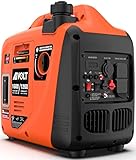
- Top Pick: AIVOLT 1600W Super Quiet Inverter Generator 28lbs Portable for Camping
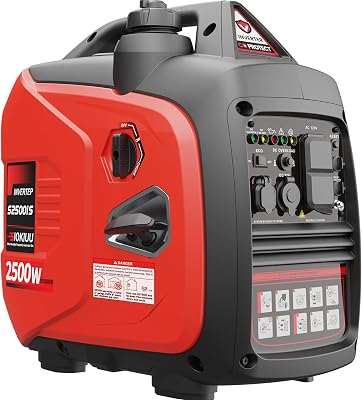
- Best Value: SIOKIUU 2500W Portable Generator Super Quiet Inverter Generator Ultra Lightweight for Home Backup Outdoor Camping, CO Sensor Protect, EPA, ECO Mode
- Premium Choice: Oxseryn Power Equipment 4400 Watts Inverter Generator Gas Powered, Portable Open Frame Generator, Low Noise with ECO Mode, RV Ready, Emergency Home Backup
There is nothing quite like the silence of a campsite at dusk, and nothing that ruins it faster than a cheap contractor generator roaring away two tents over. If you camp, tailgate, or live the RV life in 2026, the game has completely changed. Modern inverter generators and solar power stations now deliver clean, stable electricity at noise levels quiet enough to hold a conversation next to, which is why “quiet” has become the single most searched-for feature among portable power buyers this year. Campground rules are also getting stricter, with many U.S. sites now enforcing a hard 60-decibel limit at 50 feet and quiet hours after 10 p.m.
- Comparison Table: Best Quiet Camping Generators for 2026
- Honda EU2200i: The Gold Standard for Quiet Reliability
- Jackery & EcoFlow: Silent Solar Power Stations
- Champion & Westinghouse: Dual-Fuel Value Picks
- WEN 56225i: The Best Budget Inverter
- Verdict: Which Quiet Generator Should You Buy?
- Related Guides
- Frequently Asked Questions
- Related Articles
- Related Guides
But “quiet” is not a single number. A generator that whispers at quarter load can bark at full throttle, and a solar generator that is silent forever still can’t run your RV air conditioner for eight hours without a big battery and a lot of sun. Choosing well means balancing four things at once: decibel rating, usable wattage, runtime, and weight. Fuel-powered inverter units like the Honda EU2200i give you unlimited runtime as long as you can buy gas, while battery-and-solar stations from Jackery and EcoFlow give you true zero-emission, zero-noise operation that you can run inside a tent vestibule or an enclosed trailer.
As an Amazon Associate we earn from qualifying purchases at no extra cost to you. Product prices and availability are accurate as of the date shown and are subject to change.


Editor's Pick
WEN Quiet and Lightweight 4800-Watt RV-Ready Portable Inverter Generator with Fuel Shut Off (56477i)


Dropped $9.98
Below we compare five of the best quiet portable generators for camping in 2026 across every spec that matters, then break down who each one is actually for. Whether you want the bombproof reliability of a Honda, the silent solar freedom of a Jackery, or the best value from WEN and Westinghouse, there is a right pick here for your rig and your budget.
As an Amazon Associate we earn from qualifying purchases…
🛒 Best Price Today on Amazon
Prime members get fast, free shipping on everything above, plus member-only deals. New members get a 30-day free trial — cancel anytime.
Comparison Table: Best Quiet Camping Generators for 2026
| Generator | Power (W) | Noise (dB) | Best For | Approx Price |
|---|---|---|---|---|
| Honda EU2200i | 2200W surge / 1800W rated | 48–57 dB | Reliability & resale value | $1,199 |
| Jackery Explorer 2000 Plus (Solar) | 3000W surge / 2000W rated | ~30 dB (near silent) | Tent camping & zero emissions | $1,499 |
| EcoFlow Delta 2 Max (Solar) | 2400W (2048Wh battery) | ~30 dB (near silent) | Fast recharge & RV backup | $1,399 |
| Champion 2500-Watt Dual Fuel | 2500W surge / 1850W rated | 53 dB | Propane/gas flexibility | $629 |
| WEN 56225i | 2250W surge / 1800W rated | 51 dB | Budget & light weight | $399 |
Honda EU2200i: The Gold Standard for Quiet Reliability
If you ask any veteran camper or RV owner to name one generator, they will say the Honda EU2200i. At 48 decibels at quarter load and 57 at full output, it is among the quietest gas inverters ever made, and its 121cc GX engine simply refuses to die. You get 2200 watts of surge power and 1800 running watts, enough for a 13,500 BTU RV air conditioner when paired with Honda’s soft-start-friendly design. Runtime lands between 4 and 9.6 hours on a single 0.95-gallon tank depending on load, and the unit sips fuel thanks to its Eco-Throttle system that idles the engine down when demand drops.
The EU2200i is fully parallel-capable, so two of them linked together deliver up to 4400 watts to run even a larger 15,000 BTU air conditioner. At 47 pounds it is not the lightest option here, but the build quality justifies every ounce. The only real downside is price: at around $1,199 it costs three times what a budget inverter does. For serious full-timers, that premium buys near-legendary reliability and the best resale value in the category. See how it stacks up in our full Honda inverter generator reviews.
Jackery & EcoFlow: Silent Solar Power Stations
For the quietest possible experience, nothing beats a battery-based solar generator because there is no engine at all. The Jackery Explorer 2000 Plus pairs a 2042Wh LiFePO4 battery with a 3000W inverter and produces only the faint hum of its cooling fan, roughly 30 decibels, quiet enough to run inside your tent. It recharges from foldable solar panels in as little as 2 hours of strong sun, or from a wall outlet before you leave home. Because it emits zero carbon monoxide, it is the only category safe to operate in an enclosed space, a genuine life-safety advantage over any gas unit.
The EcoFlow Delta 2 Max is its closest rival, with a 2048Wh capacity, blistering X-Stream fast charging that hits 80% in under an hour from AC, and an app that monitors every watt from your phone. The catch with all solar generators is finite runtime: once the battery is drained, you need sun or a wall outlet to refill, so they suit weekend trips and light loads far better than powering an AC unit all night. To decide between them, read our deep dive on solar generators versus gas inverters.
Champion & Westinghouse: Dual-Fuel Value Picks
The Champion 2500-Watt inverter earns its spot with dual-fuel versatility, running on either gasoline or clean-burning propane. Propane is a camper’s secret weapon: it stores indefinitely, never gums up a carburetor, and burns quieter and cleaner. At 53 decibels the Champion is impressively hushed, and its “Quiet Technology” plus economy mode keep it neighborly. Westinghouse’s iGen2500 and iGen4500 lines are worth a look too, offering push-button and remote-key start, higher wattage for RV air conditioners, and an excellent warranty at a mid-tier price. Both brands are parallel-ready for future expansion.
These value units are ideal for the camper who wants gas-generator runtime without Honda money, and the propane option is a big plus for anyone who already carries LP tanks for a grill or RV stove. For a broader look at fuel choices, our guide to dual-fuel camping generators breaks down the real-world cost per hour.
WEN 56225i: The Best Budget Inverter
At roughly $399, the WEN 56225i proves you do not need to spend four figures for a quiet, capable camping generator. It delivers 2250 surge and 1800 running watts at a measured 51 decibels, weighs a manageable 39 pounds, and includes a fuel-shutoff feature that runs the carburetor dry to prevent clogs during storage. It is parallel-capable with WEN’s connection kit, letting you double up as your needs grow. It will not match a Honda’s decade-long lifespan, but for occasional weekend campers it is the smartest dollar-for-watt buy on this list.
Verdict: Which Quiet Generator Should You Buy?
For most campers, the choice comes down to lifestyle. Pick the Honda EU2200i if you camp often and want a generator that will outlast your vehicle, and pair two for RV air conditioning. Choose the Jackery 2000 Plus or EcoFlow Delta 2 Max if silence and clean air matter most, you camp near others, or you want to run power safely inside a tent. Grab the Champion dual-fuel for propane flexibility and strong mid-range value, and the WEN 56225i if you are on a budget or camp only a few weekends a year. Every unit here clears typical campground noise limits, so you truly cannot go wrong, only better-matched. For more picks, browse our roundup of the best RV generators for 2026.
Frequently Asked Questions
How many decibels is considered quiet for a camping generator?
Anything at or below 60 decibels at 50 feet is considered quiet and meets most U.S. campground rules. Premium inverters like the Honda EU2200i run 48–57 dB, while solar generators are near-silent at around 30 dB since they have no engine, only a small cooling fan.
Can a portable generator run an RV air conditioner?
A single 2000-watt inverter can start a 13,500 BTU air conditioner if it has a soft-start feature, but a larger 15,000 BTU unit usually needs two generators run in parallel for 4000+ watts. Solar stations can run an AC too, but only for a limited time before the battery drains.
Are solar generators better than gas generators for camping?
Solar generators are quieter, emit zero carbon monoxide, and are safe to run inside a tent, making them ideal for weekend trips and light loads. Gas inverters offer unlimited runtime as long as you have fuel, so they are better for extended stays or heavy loads like air conditioning all night.
What does parallel capability mean and why does it matter?
Parallel capability lets you link two identical generators together with a connection kit to combine their output, for example two Honda EU2200i units producing 4400 watts. It matters because it lets you start small and cheap, then add a second unit later when you need to power bigger appliances.
Top picks from this guide
 JackeryJackery Explorer 300 Portable Power Station,292Wh$289 \xc2\xb7 99/100AIVOLTAIVOLT 1600W Super Quiet Inverter Generator 28lbs Portable for Camping$329 \xc2\xb7 99/100
 WENWEN Quiet and Lightweight 4800-Watt RV-Ready Portable Inverter Generator with…$635 \xc2\xb7 98/100
 SIOKIUUSIOKIUU 2500W Portable Generator Super Quiet Inverter Generator Ultra Lightweight…$308 \xc2\xb7 97/100
Write Your Review
No reviews yet. Be the first to share your experience!