
🛒 Best Price Today on Amazon
Prime members get fast, free shipping on everything above, plus member-only deals. New members get a 30-day free trial — cancel anytime.
For CPAP users, a power outage is not an inconvenience; it is a night without therapy. A 2000Wh power station is one of the most capable home solutions for that problem. Depending on your pressure and humidifier settings, a 2kWh-class battery can usually run a CPAP for somewhere between about three and a dozen or more nights. The spread is that large because the heated humidifier, not the blower, is what eats most of the energy. Here is how to find your own number and set things up so the machine keeps running without anyone having to wake up and fiddle with it.
Where CPAP energy actually goes
The blower motor in a modern CPAP is efficient. At typical pressures it often draws something like 10 to 30 watts. Turn on the heated humidifier and a heated tube, and total draw commonly climbs to 50 to 100 watts or more, especially in a cold, dry bedroom. Check your machine’s power supply label and manual for its maximum rating, but remember that maximum is a worst case; average use over a night is usually well below it.
| Setup (8-hour night) | Typical average draw | Energy per night | Nights on ~1,700Wh usable |
|---|---|---|---|
| Blower only, DC cable | 10 to 20W | 80 to 160Wh | about 10 to 20 nights |
| Blower only, AC adapter | 15 to 30W | 120 to 240Wh | about 7 to 14 nights |
| Humidifier on low | 35 to 60W | 280 to 480Wh | about 3.5 to 6 nights |
| Humidifier plus heated tube, cold room | 70 to 110W | 560 to 880Wh | about 2 to 3 nights |
These are estimates for planning. Your own machine, pressure and room conditions will set the real figure, so do a test night before you depend on it.
DC versus AC: the easiest efficiency win
Most CPAP machines run internally on low-voltage DC. When you plug the machine’s power brick into a station’s AC outlet, the station converts DC to AC, and the brick converts it straight back to DC. Each conversion wastes energy, and the station’s inverter also has its own standby draw that can be a noticeable share of a small load. Many CPAP makers sell an approved DC power cord that plugs into a 12V car-style socket. Running from the station’s 12V port can add several nights of runtime. Only use the DC cable your CPAP manufacturer approves for your model.
Test night checklist
Measure at home before an outage
Charge the station to 100 percent, plug in the CPAP exactly how you would during an outage, and sleep normally. In the morning, note the remaining percentage. If you used 12 percent, a full battery gives you roughly eight nights at those settings.
Check the settings that silently cost power
Humidity level, tube temperature and ramp settings all matter. If your clinician approves it, a lower humidity level during an outage can double your runtime. Never change prescribed pressure settings on your own.
Disable auto-off
Some stations switch off AC or DC ports after a period of low draw to save energy. A CPAP between breaths may look like a low load. Find the auto-off setting in the app or menu and disable it for the port you use.
Pass-through and UPS features
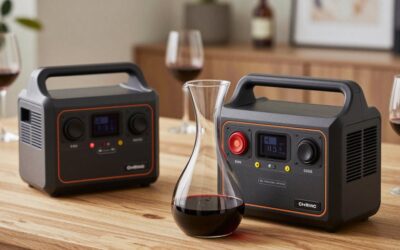
Many 2kWh-class stations can stay plugged into the wall with the CPAP running from the station. When grid power drops, the station takes over. Stations advertise switchover times; a true UPS-style switchover of around 10 to 30 milliseconds is generally fast enough for CPAP, but check both the station spec and your CPAP manual. This setup means an outage at 3 a.m. does not wake you up. Leaving a station on pass-through indefinitely does add some wear, so follow the maker’s guidance.
Keeping the rest of the night safe
Place the station on a hard, stable surface with ventilation around it, not on carpet or under a blanket. If you plan to recharge it from a fuel generator during a long outage, that generator must run outside, at least 20 feet from the house, never in a garage or on a porch, with exhaust directed away from windows. CO alarms on each floor, including near bedrooms, are essential, and a sleeping person will not notice early CO symptoms. Also ask your utility whether it runs a medical-needs registry; some prioritize restoration or send outage notices to registered users.
Is 2000Wh more than you need?
For CPAP alone, 2000Wh is generous. A 500 to 1,000Wh station covers one to several nights for many users and weighs much less. The 2kWh class makes sense when you want to run the CPAP plus other essentials, such as a phone, a fan, a small fridge or a router, or when you want a full week of therapy without recharging. Expect a 2kWh LiFePO4 station to weigh roughly 40 to 60 pounds, which matters if the person who needs the CPAP will be moving it.
FAQ
Will a power station void my CPAP warranty?
Using a power source that meets the machine’s input specification is normally fine, but warranty terms vary. Use the manufacturer’s approved DC cord or the original AC power supply, and check your CPAP manual or supplier if you are unsure.
Can I run two CPAP machines from one 2000Wh station?
Yes, the inverter can easily handle two, but the runtime roughly halves. Two users with humidifiers on may get only one to three nights, so consider reducing humidity or using DC connections where approved.
Bottom line
A 2000Wh station can typically keep a CPAP running for around 3 to 6 nights with the humidifier on, and 10 nights or more on the blower alone through an approved DC cord. Test a full night at home, turn off auto-off, place the unit where it can breathe, and always confirm the current spec sheet for capacity and switchover time before you buy.
Write Your Review
No reviews yet. Be the first to share your experience!