
🛒 Best Price Today on Amazon
Prime members get fast, free shipping on everything above, plus member-only deals. New members get a 30-day free trial — cancel anytime.
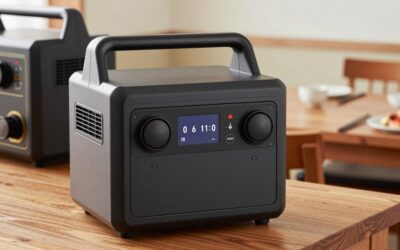
Ice storms and blizzards knock out power at the worst possible moment: when heat is a safety issue, not a comfort issue. A battery cannot heat a house the way a furnace does, but it can keep a gas furnace’s blower and controls alive, which keeps the whole house warm. The Jackery HomePower 3600 Plus is one of the few 120V power stations with enough capacity headroom, through expansion packs, to do that for more than a single day.
What winter asks of a battery
Winter loads are long rather than large. A furnace blower cycling on and off all night might average 300 to 500 W but run 18 hours a day in deep cold. That adds up fast. The HomePower 3600 Plus starts at about 3,584 Wh of LiFePO4 storage with roughly 3,600 W of 120V output, and Jackery states it expands to about 21.5 kWh with five add-on packs. Two linked units can provide 240V. Check the current spec sheet for exact figures.
Furnace runtime estimates
| Outside temperature | Blower duty cycle | Approx. daily furnace energy | Base unit | Base + 2 packs |
|---|---|---|---|---|
| 35°F | 30–40% | 2.0–3.0 kWh | about 1–1.5 days | 3–4.5 days |
| 20°F | 50–60% | 3.5–4.5 kWh | under 1 day | 2–2.5 days |
| 5°F | 70–85% | 5.0–6.5 kWh | about half a day | 1.5 days |
Estimates assume a 400 to 600 W blower and a gas-fired furnace; ECM variable-speed blowers can use noticeably less. The takeaway is that expansion packs matter far more in winter than in summer.
Connecting the furnace
Nearly all furnaces are hardwired. Have a licensed electrician install a manual transfer switch or a furnace-specific inlet and switch. Never use a double-male cord or plug into a dryer outlet to backfeed; that is how houses catch fire and how line workers get hurt.
Other winter essentials
- Sump pump: thaws after a storm can flood basements. A 1/2 HP pump running 10 minutes an hour uses roughly 150 to 250 Wh per hour of heavy inflow.
- Heat tape on pipes: 5 to 9 W per foot; 30 feet running overnight is about 1.5 to 2.5 kWh.
- Electric blankets: far better value than space heaters, at 50 to 100 W per bed.
- Space heaters: at 1,500 W, one would drain the base unit in about two hours. Use only for brief warm-ups.
Cold and the battery itself
Jackery advertises that the expansion packs can operate in cold conditions down to around -4°F, but LiFePO4 cells in general charge poorly or not at all near freezing, and usable capacity shrinks in the cold. Keep the main unit and packs inside the heated envelope of the house, ideally in a room that stays above 50°F. A basement mechanical room near the furnace is often ideal.
Recharging in a gray week
A winter storm usually means several cloudy days. Solar input of roughly 1,000 W might yield only 1,000 to 2,000 Wh per day in December, and zero with snow on the panels. Wall charging at up to about 1,800 W makes a generator the realistic backup: a 2,000 to 3,500 W inverter generator can refill a large portion of the battery in two or three hours. Set the generator at least 20 feet from the home, never inside a garage, shed, porch or under a deck, and keep snow drifts away from the exhaust. Install battery CO alarms outside every sleeping area; CO poisonings spike during winter outages.
Sample routine for a two-day ice storm
Keep the thermostat at 62 to 64°F, let the house drift lower overnight with everyone on electric blankets, run the fridge (or move food to a cold porch cooler), and use the generator for a morning and evening recharge. With two expansion packs, many homes can ride out a two-day event on battery alone in moderate cold.
FAQ
Can it power an electric furnace or heat pump?
Not realistically. Electric furnaces draw 10 kW or more, and most heat pumps need 240V with high start-up current. This platform is designed for gas furnace blowers and essential 120V circuits.
Should I keep it plugged in all winter?
Keeping it on wall power is fine and ensures it is full when the storm hits. Check the app periodically and follow Jackery’s storage guidance.
Bottom line
The HomePower 3600 Plus is good for winter storm outages if you have a gas furnace and add at least one or two expansion packs. It keeps heat circulating, pipes protected and a sump pump running, silently and without fumes. Add a properly placed generator for long cloudy stretches, and have an electrician handle every connection to house wiring.

Write Your Review
No reviews yet. Be the first to share your experience!