
🛒 Best Price Today on Amazon
Prime members get fast, free shipping on everything above, plus member-only deals. New members get a 30-day free trial — cancel anytime.
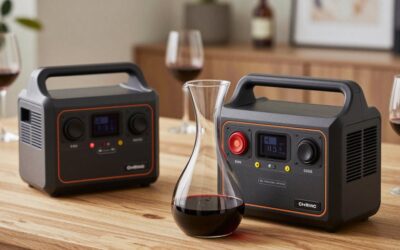
The station said 1,000 Wh on the box, yet it ran your fridge for half a day instead of the two days you pictured. Or the percentage plunges faster than the math suggests. Runtime that falls short almost always comes from overlooked losses and loads: inverter efficiency, idle draw, compressor duty cycles, surge, temperature, and aging. This guide shows how to calculate realistic runtime and squeeze more out of every charge.
The runtime formula most people skip
Realistic runtime ≈ (rated Wh × efficiency factor) ÷ average watts. For AC loads, a factor of about 0.80 to 0.90 accounts for inverter losses. For DC loads, the factor is higher, often 0.90 to 0.95. Also account for any discharge limit you set.
Where the energy really goes
| Energy drain | Typical size | Impact on a 1,000 Wh station |
|---|---|---|
| Inverter conversion loss | 10-20% of AC load | 100-200 Wh lost |
| Inverter idle draw (AC on) | 10-30 W | 240-720 Wh per day |
| Fans during heavy use | Few watts | Minor |
| Cold (near freezing) | 10-30% less usable | 100-300 Wh |
| Aging (older NMC unit) | 10-30% capacity loss | 100-300 Wh |
Idle draw is the sneaky one. Leaving the AC inverter on overnight to power a 10-watt device can double actual consumption.
Know your appliances’ real consumption
Label wattage and actual consumption differ. A refrigerator rated at 150 watts running might consume 1 to 2 kWh per day depending on size, age, and how often it is opened, because the compressor cycles and defrost heaters kick in. Measure with a plug-in energy meter over 24 hours.
| Device | Typical daily use | Runtime on 1,000 Wh (≈850 usable AC) |
|---|---|---|
| Full-size fridge | 1.0-2.0 kWh | ~10-20 hours |
| Chest freezer (efficient) | 0.4-0.9 kWh | ~1-2 days |
| CPAP without humidifier (8 hrs) | 0.25-0.5 kWh | ~2-3 nights |
| Wi-Fi router + modem (24 hrs) | 0.2-0.5 kWh | ~2-4 days |
| LED lights (4 x 10 W, 6 hrs) | 0.24 kWh | ~3.5 days |
How to extend runtime
- Use DC where you can. Power CPAPs with DC adapters, laptops with USB-C PD, and 12V fridges via DC ports. Skipping the inverter saves 10 to 20 percent.
- Turn AC off when unused. Group AC use into blocks.
- Keep the fridge closed. Every opening adds compressor time.
- Disable CPAP humidifiers or heated hoses if acceptable; they can triple consumption.
- Keep the station warm. Inside heated rooms during winter outages.
- Enable eco settings that auto-shut the inverter when load is below a threshold.
When fast drain means a fault
Do a controlled test: fully charge, run a steady 200-watt load verified with a watt meter, and time it. Multiply watts by hours. If the result is below about 70 percent of the rated Wh on a unit less than a couple of years old, contact support. Also check for rising temperature at idle, erratic percentage jumps, or swelling, which point to hardware problems.
Plan capacity for outages
Add up the daily Wh of what you need, divide by about 0.85, and add 20 percent reserve. A household wanting fridge, router, lights, and phones for a day typically lands in the 2 to 3 kWh range. Add solar panels or a generator for multi-day outages.
A one-day energy audit
If you are unsure where energy goes, do a simple audit. Charge the station to 100 percent in the morning and note the time. Plug in your normal outage loads through a plug-in energy meter where possible. Every few hours, write down the percentage and what was running. At the end of the day you will see which periods drained fastest. Often the surprises are a CPAP humidifier, a fridge opened frequently while cooking, or a TV and streaming box left on standby. Compare the station’s total delivered Wh with the meters’ totals; the difference is roughly inverter loss and idle draw. With that data, you can trim the worst offenders and decide whether you need more capacity.
FAQ
Why does my station lose 10 percent overnight with nothing plugged in?
The AC inverter or DC outputs are likely left on. Idle draw of 10 to 30 watts easily adds up to 10 percent or more overnight on a mid-size unit.
Does charging and discharging at the same time waste energy?
Pass-through is convenient but adds conversion loss and heat. It is fine for backup use but not the most efficient path.
Bottom line
Runtime is rated Wh times about 0.85 divided by real average watts, minus idle draw. Measure your appliances, favor DC, switch off the inverter when idle, keep the unit warm, and test capacity with a steady load if drain seems abnormal.
Write Your Review
No reviews yet. Be the first to share your experience!