
🛒 Best Price Today on Amazon
Prime members get fast, free shipping on everything above, plus member-only deals. New members get a 30-day free trial — cancel anytime.
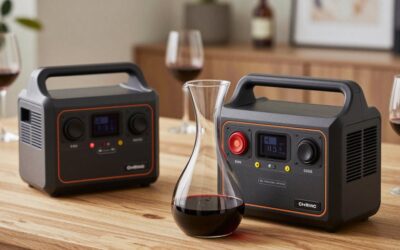
You charged your power station to 100 percent, set it in the closet for a few weeks, and it now reads 60 percent. Or it charges to full but runs out far sooner than it used to. “Won’t hold a charge” covers two very different problems with a power station: losing charge while sitting idle, and having less usable capacity than it should. The first is usually a settings or storage issue. The second can be calibration, age, or a failing cell group.
Problem 1: losing charge while idle
Standby draw from active outputs
If the AC inverter is left on, it draws power even with nothing plugged in, commonly in the 10 to 30 watt range depending on size. On a 1,000 Wh station, 20 watts of idle draw empties the battery in about two days. Wireless modules, screens set to always-on, and DC ports left enabled also nibble away.
Normal self-discharge
With everything off, a healthy lithium station typically loses only a few percent per month. If yours drops 10 to 30 percent in a week while fully off, something is still drawing power or a cell has an internal fault.
| Idle draw source | Typical draw | Drain time on 1,000 Wh |
|---|---|---|
| AC inverter on, no load | 10-30 W | ~1.5-4 days |
| Wi-Fi/Bluetooth module active | 1-3 W | ~2-6 weeks |
| Screen always on | 1-2 W | ~3-6 weeks |
| Fully off (self-discharge) | well under 1 W equivalent | many months |
Problem 2: runs out too fast after a full charge
Calibration drift
The percentage display is an estimate. LFP batteries have a very flat voltage curve, so the BMS relies on counting energy in and out. After months of partial cycles, the estimate drifts and the unit may shut off at “15 percent” or jump from 40 to 10. A full calibration cycle usually fixes this: charge to 100 percent, let it sit an hour, discharge with a steady load to automatic shutoff, then recharge to 100 percent without interruption.
Real capacity is less than the label
The rated Wh is the battery’s stored energy, not what reaches your outlet. Inverter losses mean AC output usually delivers about 80 to 90 percent of rated Wh. A 1,000 Wh station running a 100-watt load typically lasts around 8 to 9 hours, not 10.
Aging and cycle count
LFP stations are often rated for thousands of cycles to around 70 to 80 percent capacity, while NMC units are commonly rated in the several-hundred to low-thousands range. Heat speeds up aging. A three-year-old NMC station stored hot may legitimately hold 20 to 30 percent less.
How to test real capacity
- Charge to 100 percent and let it rest for an hour.
- Plug in a steady, known load such as a 100 to 200 watt incandescent-style lamp or a space heater on low, verified with a plug-in watt meter.
- Time how long until shutoff. Multiply watts by hours.
- Compare to 85 percent of the rated Wh. Much lower than about 70 percent of that figure on a newer unit suggests a warranty issue.
Storage habits that preserve capacity
- Store at roughly 50 to 80 percent charge if you will not use it for months, unless the manual recommends keeping it plugged in.
- Keep it indoors between about 50 and 77 degrees F. Avoid attics, garages in summer, and car trunks.
- Turn off AC, DC, and wireless outputs when stored.
- Top up every three months; set a calendar reminder.
When to contact support
Drop of more than 10 percent per week while completely off, a percentage that jumps erratically even after calibration, a unit that shuts off under light loads, or any swelling or heat at rest are signs of a hardware problem. Many brands offer 2 to 5 year warranties, and cell faults are typically covered.
FAQ
Is it OK to leave a power station plugged in all the time?
Many modern models support it and include a charge limit or UPS mode. If yours allows setting a maximum charge, 80 to 90 percent reduces long-term wear.
Does cold weather make a power station lose charge?
Cold temporarily reduces available capacity and the display may drop. Warming it up usually restores most of it. Do not charge below freezing unless the unit has built-in battery heating.
Bottom line
Turn off idle outputs, calibrate with one full cycle, and measure real capacity with a known load. If it still loses charge while fully off or falls well short of about 85 percent of rated Wh, the battery needs warranty service.

Write Your Review
No reviews yet. Be the first to share your experience!