
🛒 Best Price Today on Amazon
Prime members get fast, free shipping on everything above, plus member-only deals. New members get a 30-day free trial — cancel anytime.
People spend weeks choosing a generator and thirty seconds grabbing an extension cord, which is backwards. The cord is where heat, voltage drop and fire risk concentrate. An undersized 16-gauge cord feeding a refrigerator from 100 feet away can run warm, starve the compressor of voltage and shorten its life. This buyer’s guide explains what makes a good generator cord, how to choose gauge and length, when a power distribution box is worth buying, and which features to look for. It uses general specs rather than specific product names because what matters is the rating, not the brand on the jacket.
The three numbers on every cord
Gauge (AWG)
Lower numbers mean thicker copper. Thicker wire carries more current with less heat and less voltage drop. For generator use, 12 AWG is the practical minimum for anything that runs a motor at distance, and 10 AWG is better for long runs or 30 amp loads.
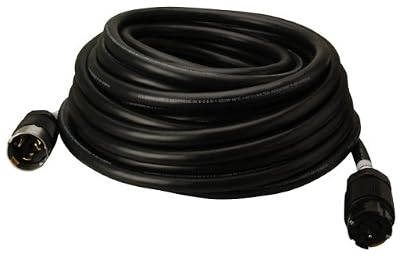
Southwire Power Distribution Extension Cord - Splits 50-Amp Service into Dual Feeds - Flexible Jacket - Oil & Moisture Resistant - WC596 Grade - 6/3 & 8/1 STOW - 50 Foot
Included for 'Best Generator Extension Cords and Power Distribution Boxes' because the listing specifies Splits 50-Amp Service into Dual Feeds and Flexible Jacket, details this guide uses to compare options.
View on Amazon
Champion Power Equipment Pro Grade OSHA Compliant Power Distribution Box, 50-Amp Twist Lock Inlet, Six 120V GFCI Duplexes, One 120/240V 30A Locking Outlet, 30A and 50A RV Adapters
Included for 'Best Generator Extension Cords and Power Distribution Boxes' because the listing specifies 50-Amp Twist Lock Inlet and Six 120V GFCI Duplexes, details this guide uses to compare options.
View on Amazon
OPL5 30 Amp Generator Cord 25 Feet and Pre-Drilled Power Inlet Box, 30A Generator Extension Cord NEMA L14-30P/L14-30R, STW 10 AWG with Twist Lock Connector, ETL Listed
Included for 'Best Generator Extension Cords and Power Distribution Boxes' because the listing specifies 30A Generator Extension Cord NEMA L14-30P/L14-30R and STW 10 AWG with Twist Lock Connector, details this guide uses to compare options.
View on Amazon
VEVOR 50 Amp Generator Cord and Power Inlet Box Kit, 25FT Generator Extension Cord NEMA 14-50P/SS2-50R STW 6/3+8/1 AWG with Twist Lock Connector, Pre-Drilled Inlet Box, ETL Listed
Included for 'Best Generator Extension Cords and Power Distribution Boxes' because the listing specifies Pre-Drilled Inlet Box and ETL Listed, details this guide uses to compare options.
View on AmazonAmp rating
Check that the cord’s rated amps meet or exceed the load. A 15 amp cord on a 20 amp circuit is a weak link.
Jacket rating
Look for outdoor ratings such as SJTW, SJOOW or STW. The “W” means weather-rated; the “OO” means oil-resistant insulation and jacket. Rubber-type SJOOW jackets stay flexible in cold weather better than cheap vinyl.
Choosing gauge by length and load
The table gives conservative recommendations for 120-volt loads, aiming to keep voltage drop to roughly 3 to 5 percent. Long runs of thin cord are the most common mistake, and the generator’s required 20-foot distance from the house means most people need at least 25 feet anyway.
| Load | Up to 25 ft | 50 ft | 100 ft |
|---|---|---|---|
| Up to ~10 A (~1,200 W): lights, TV, chargers | 14 AWG | 14 AWG | 12 AWG |
| ~10–15 A (~1,800 W): fridge, freezer, fan | 14 AWG | 12 AWG | 10 AWG |
| ~15–20 A (~2,400 W): window AC, microwave | 12 AWG | 12 AWG | 10 AWG |
| 30 A, 120/240 V (L14-30, ~7,200 W max) | 10 AWG 4-wire | 10 AWG 4-wire | 8 AWG 4-wire |
| 50 A, 120/240 V (14-50, ~12,000 W max) | 6 AWG 4-wire | 6 AWG 4-wire | 4–6 AWG 4-wire |
What to look for in a generator cord
- Lighted ends: a small indicator at the female end confirms power is flowing, handy when troubleshooting in the dark.
- Locking or molded connectors: twist-lock plugs on 30 and 50 amp cords stay put; molded 15/20 amp ends resist moisture better than assembled ones.
- Multi-outlet ends: a triple-tap end on a 12 AWG cord lets you run several small loads, but the total still cannot exceed the cord’s rating.
- Cold flexibility: rubber-jacketed cords coil and uncoil in freezing weather; stiff vinyl can crack.
- Bright jacket color: orange, yellow or green cords are easier to see and less likely to be tripped over or cut by a mower.
Power distribution boxes: when they make sense
A power distribution box, sometimes called a spider box or temporary power box, takes one heavy input such as an L14-30 or 14-50 and splits it into several protected 20 amp outlets. Each outlet or pair of outlets has its own breaker and usually GFCI protection. Instead of running four separate cords from the generator, you run one heavy cord to a central point near your loads and branch out from there.
Who benefits
- Households without a transfer switch that need to run several appliances spread across rooms.
- Job sites, events and campgrounds with multiple users.
- Anyone who wants each load circuit-protected rather than relying only on the generator’s outlet breakers.
Features to check
Look for an input that matches your generator’s largest outlet, individually breakered 20 amp outlets, GFCI protection, a rugged weather-resistant housing, and a UL or ETL listing. Expect roughly $150 to $500 depending on capacity and build quality.
Safe routing habits
Run cords to the house through a proper path, such as a cord pass-through port or an inlet installed by an electrician, rather than through a window cracked open, which lets carbon monoxide in. Keep the generator at least 20 feet away with exhaust pointed away from the home and never in a garage or on a porch. Keep connections off wet ground, fully uncoil cords under load to avoid heat buildup, and never daisy-chain multiple cords. Inspect for cuts, crushed sections and warm spots before each use.
Cords do not replace a transfer switch
Extension cords power individual appliances. To power hardwired loads like a furnace, well pump or ceiling lights, you need a transfer switch or interlock kit with an inlet box installed by a licensed electrician. Never use a double-male cord to backfeed an outlet.
FAQ
Can I use a regular orange extension cord with a generator?
Yes, if it is outdoor-rated and the gauge matches the load and distance. Many cheap orange cords are 16 AWG, which is fine for a lamp but too thin for a fridge at 50 feet. Check the gauge printed on the jacket.
Are GFCI outlets necessary on a generator setup?
For outdoor and damp locations, GFCI protection is strongly recommended, and many newer generators include it. A distribution box with GFCI outlets adds protection when the generator does not have it.
Bottom line
Buy cords by gauge, length and jacket rating, not by price. Use 12 AWG as a practical minimum for motor loads, step up to 10 AWG for 100-foot runs, and match 30 and 50 amp cords to your generator’s twist-lock outlet. If you are running several loads without a transfer switch, a GFCI-protected distribution box keeps the setup tidy and safer. Good cords cost more once and prevent problems for years.


Write Your Review
No reviews yet. Be the first to share your experience!