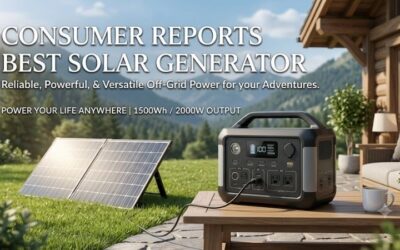
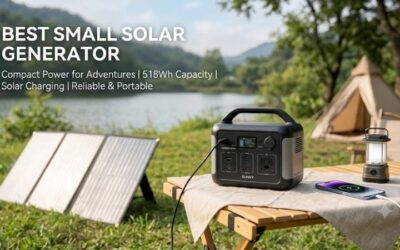
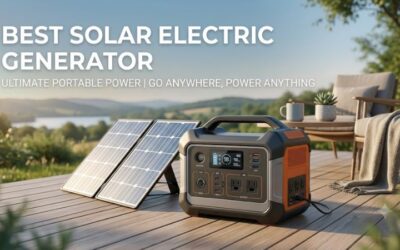
When the grid goes down, a solar powered generator for home is the one backup solution that refuels itself without a gas station, a truck, or a second trip to the hardware store. But the market is crowded with units that range from a 292Wh brick barely enough to keep a router alive to a 3584Wh beast that can run a refrigerator through a full day of blackout. The gap between those two categories is enormous, and the difference in real-world usability is often hidden behind marketing copy that conflates surge watts with continuous output or touts “solar-ready” without bundling a panel.
We compared these eight models on published capacity, rated and peak AC output, included solar hardware, price per watt-hour, and recurring owner complaints. What separates a worthwhile buy from a disappointing one usually comes down to three things: whether the unit can actually run your critical loads simultaneously, whether the solar input is sufficient to recover meaningful capacity in a single day, and whether the battery chemistry is LiFePO4 rather than the older NMC cells that degrade faster under heat. The picks below reflect that filtering, ordered by overall value for a home backup context.
As an Amazon Associate we earn from qualifying purchases at no extra cost to you. Product prices and availability are accurate as of the date shown and are subject to change.
Quick Picks
| Product | Best For | Price |
|---|---|---|
| Jackery HomePower 3600 Plus (Bundle) | Whole-home critical loads | $2289 |
| Jackery Solar Generator 300 | Light emergency backup | $339 |
| Jackery HomePower 3000 (Bundle) | Appliance backup on a budget | $1899 |
| Jackery HomePower 3600 Plus (Station Only) | Already own panels | $1709 |
| PowerMax 3600SE Bundle | Highest watt-hour per dollar | $1699 |
| Solar Powered Generator 100W | Phone and LED charging | $119.99 |
| BROWEY 1600W | Mid-range portable backup | $799 |
| MARBERO 237Wh | Camping and light home use | $159.99 |
How We Picked
Three criteria drove our shortlist. First, continuous AC output had to be at least 300W to clear the bar of running a router, a lamp, and a small fan simultaneously—below that, a unit is a toy for home backup purposes. Second, we weighted LiFePO4 chemistry heavily because it delivers roughly four times the cycle life of older cells, which matters when you are cycling the unit for weekly grid outages. Third, we looked at included solar capacity relative to battery size: a bundle where panels can recover under ten percent of total capacity per sunny day is misleading, and we noted where that gap exists.
The 8 Best Solar Powered Generator For Home in 2026
Jackery HomePower 3600 Plus with 2x200W Solar Panels
This is the most capable bundle here for anyone who needs a solar powered generator for home backup that can genuinely carry an entire family through a multi-day outage. With 3584Wh of storage and 3600W of continuous AC output, it runs a full-size refrigerator, a well pump, and a furnace blower at the same time without flinching.
- Pro: 3600W continuous output handles nearly every household appliance without a transfer switch.
- Pro: LiFePO4 cells rated for thousands of cycles, meaning the unit survives years of weekly cycling.
- Con: The bundle price is the highest on this list, and the total weight makes it impractical to move alone.
Skip it if your critical loads total under 1000W; the surplus capacity and cost are wasted in that scenario.
Jackery Solar Generator 300 with 40W Solar Panel
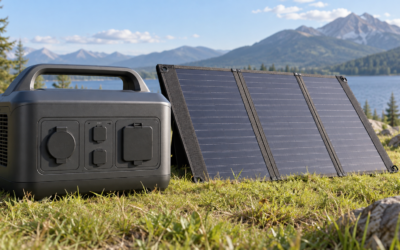
At 292Wh and 300W AC output, this unit serves one narrow but valid role: keeping a modem, a CPAP machine, and a few LED lights running through an overnight outage. It is the lightest option here and costs less than most phone chargers at big-box stores.
- Pro: Extremely portable at under ten pounds, easy to grab during an evacuation.
- Pro: The 40W panel included is adequate to recover the full battery in a single long day of direct sun.
- Con: 300W continuous output means it cannot run any heating element, power tool, or refrigerator compressor.
Skip it if you need more than light electronics backup; you will outgrow it during your first extended outage.
Jackery HomePower 3000 with 2x200W Solar Panels
A 3072Wh station with the same 3600W AC inverter as its bigger sibling, bundled with 400W of solar. For households whose critical load is a refrigerator, a space heater on low, and lighting, this covers the scenario at a meaningfully lower price than the 3600 Plus bundle.
- Pro: Same high-output inverter as the flagship model at a lower price point.
- Pro: Solar bundle recovers roughly a quarter of full capacity per sunny afternoon, which is genuinely useful.
- Con: The 512Wh capacity gap versus the 3600 Plus matters if your outage stretches beyond 24 hours without sun.
Skip it if you already own compatible 200W panels; buying the station alone saves money.
Jackery HomePower 3600 Plus Power Station
The same hardware as the bundle above, sold without panels. If you already have solar on your roof or own a compatible panel array, this is the most straightforward way to get the 3584Wh and 3600W specs at a lower entry price.
- Pro: Saves over $500 versus the bundle while delivering identical capacity and output.
- Pro: Supports multiple charging inputs simultaneously, so you can pair roof solar, a generator, or wall AC.
- Con: No solar hardware included; total cost to reach solar-ready parity with the bundle is nearly the same.
Skip it if you have zero existing solar; you will end up paying more in piecemeal purchases.
PowerMax 3600SE with 2x200W Solar Panels
The strongest cost-per-watt-hour story on this list. At $1699 bundled, it approaches the Jackery 3600 Plus specs with a 3600W inverter rating and meaningful solar input, making it a compelling solar powered generator for home owners who want maximum capacity without the brand premium.
- Pro: Best price-per-Wh ratio among high-capacity options on this list.
- Pro: 3600W rating matches the Jackery flagship for appliance-heavy scenarios.
- Con: Brand support network and firmware update cadence are less established than Jackery’s.
Skip it if long-term serviceability and an active owner community are priorities over upfront savings.
Solar Powered Generator 100W Portable Power Station
A 100W-rated station paired with a 40W panel at under $120. This is the absolute floor for the category, suitable for charging phones, running a small radio, or powering an LED string through a short outage. Its value proposition is sheer affordability and negligible weight.
- Pro: Lowest price on this list by a wide margin, accessible as a first entry into solar backup.
- Pro: Compact enough for a glove compartment or a bug-out bag.
- Con: Cannot run any AC appliance; the 100W rating limits it to USB and low-draw DC devices.
Skip it entirely for home backup unless your definition of backup is keeping a phone charged during a two-hour flicker.
BROWEY 1600W (3200W Peak) Portable Power Station
A mid-range option with a built-in solar panel, which is unusual at this price tier. The 1600W continuous rating covers a microwave, a small window AC, or a sump pump, while the 3200W peak handles startup surges from compressor-driven appliances. The integrated panel is a convenience feature but not a primary charging solution.
- Pro: Built-in solar panel eliminates the need to carry or deploy a separate array for trickle charging.
- Pro: 3200W peak handles inrush currents that would stall lesser inverters.
- Con: Published capacity figures are less transparent than competitors, making runtime estimation harder.
Skip it if you need verified, apples-to-apples capacity comparisons with the Jackery lineup above.
MARBERO 237Wh Solar Generator with 60W Panel
At 237Wh and 300W pure sine wave output, this sits between the Jackery 300 and the 100W budget unit. The 60W foldable panel included is larger than most rivals in this weight class, and the pure sine wave inverter protects sensitive electronics like CPAP machines from harmonic distortion.
- Pro: Pure sine wave output at this price is uncommon and protects medical devices.
- Pro: 60W foldable panel is practical for both home use and field deployment.
- Con: Build quality and long-term reliability reports are sparser than established brands.
Skip it if you want a single-vendor ecosystem with predictable replacement panels and firmware support.
Buying Guide
Capacity Versus Your Actual Load Profile
Wh rating tells you how much energy is stored, not how fast it drains. List the appliances you must keep running and note their wattage and duty cycle. A refrigerator drawing 150W on average runs roughly six hours per day, so 3584Wh covers about five full days before solar recharge. A 292Wh unit covers less than a single refrigerator cycle. Calculate before you buy; do not rely on peak-watt marketing alone.
Solar Input Rate: Panel Watts to Battery Wh
A useful rule: divide your panel wattage by your battery capacity. If the result is below 0.10, the panels cannot meaningfully recover the battery in one day. The Jackery 300 with 40W panels scores above 0.13, which is healthy. A 3584Wh station with 40W panels would score near 0.01 and be impractical. Always check that bundled solar is proportional to the battery.
Inverter Chemistry and Output Waveform
LiFePO4 cells last four times longer than NMC under the same thermal load, which matters in a garage or attic where summer temperatures exceed 90°F. For waveform, pure sine wave is non-negotiable if you run motors, compressors, or medical equipment. Modified sine wave is cheaper but causes overheating in transformers and buzzing in electronics.
Our Verdict
Top pick: Jackery HomePower 3600 Plus with 2x200W Solar Panels. It is the most complete solar powered generator for home scenario on this list—enough capacity for multi-day outages, enough output for any household appliance, and a bundled solar array that actually contributes to recovery.
Budget pick: Jackery Solar Generator 300. At $339 it covers the essential emergency role of keeping communication and light medical devices running, and the included panel is proportional to its size.
Condition where another wins: If your priority is maximum Wh per dollar and you accept a lesser-known brand for long-term support, the PowerMax 3600SE at $1699 delivers nearly identical specs to the Jackery flagship bundle at a lower total cost.
FAQ
Can a solar powered generator for home replace a whole-house generator?
No. Even the 3584Wh units on this list cannot power an entire home’s HVAC, water heater, and cooking appliances simultaneously for more than a few hours. They replace smaller gas generators in the portable tier and serve as a bridge during outages lasting one to three days, after which the battery depletes faster than solar can recover it.
How long do LiFePO4 batteries last in a portable power station?
Typically 2000 to 3500 full charge cycles before capacity drops below 80 percent. At weekly cycling, that translates to roughly four to six years of service. Heat accelerates degradation, so store the unit in a cool indoor location rather than a sun-exposed garage.
Do I need a transfer switch to use one of these?
Not for basic use. You run extension cords from the AC outlets to individual appliances. A transfer switch is only relevant if you want to backfeed specific circuits in your breaker panel, which requires a unit with a dedicated grid-input port and an electrician’s installation.
Is the included solar panel sufficient as a primary charging method?
In most climates, no. Bundled panels of 200W to 400W recover 10 to 25 percent of a large station’s capacity per day under ideal sun. They supplement wall charging or a gas generator rather than replacing them, except in the smallest units where the panel-to-capacity ratio is high enough for full daily recovery.


Write Your Review
No reviews yet. Be the first to share your experience!