
🛒 Best Price Today on Amazon
Prime members get fast, free shipping on everything above, plus member-only deals. New members get a 30-day free trial — cancel anytime.
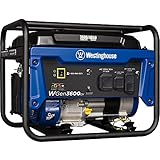
- Top Pick: Westinghouse 4650 Peak Watt Portable Generator, RV Ready 30A Outlet, Gas Powered, CO Sensor
- Best Value: Westinghouse 6500 Watt Dual Fuel Home Backup Portable Generator, Transfer Switch Ready 30A Outlet, RV Ready 30A Outlet, CO Sensor
- Premium Choice: Genkins 4500W Inverter Generator for Home, RV Ready 30A Outlet, Gas Powered
The Short Answer
For most RVs with a 30-amp electrical connection, choose a generator rated for at least 3,500 running watts and 4,000 to 4,500 starting watts. This gives you enough capacity for an air conditioner, refrigerator, lights, battery charger, and small appliances without operating the generator at its limit.
A 30-amp RV connection is rated for 120 volts and 30 amps, which equals a maximum of 3,600 watts:
As an Amazon Associate we earn from qualifying purchases at no extra cost to you.


120 volts × 30 amps = 3,600 watts
That does not mean every 30-amp RV needs a 3,600-watt generator. Appliances have different starting and running demands. An RV air conditioner, for example, may run at about 1,200 to 1,800 watts but briefly need 2,500 to 4,000 starting watts. A generator with 4,000 to 4,500 peak watts provides useful headroom.
For occasional camping, a 4,000- to 4,650-watt portable generator is usually the best size. For heavier use, multiple appliances, or home backup, consider a 6,000- to 6,500-watt model. A larger generator will not force more power into the RV; the RV draws only what its appliances require. However, larger units are generally heavier, louder, and less convenient to transport.
Standard Sizes
The table below shows practical generator sizes for a 30-amp RV. Dimensions and weights are representative of current portable models in each category; check the manufacturer’s specification sheet before buying because frame design, wheel kits, and fuel type can change the final measurements.
| Generator class | Typical running/peak output | Approximate dimensions (L × W × H) | Approximate dimensions (cm) | Typical weight | Best use |
|---|---|---|---|---|---|
| Compact inverter | 2,000 / 2,500 watts | 23 × 14 × 19 in | 58 × 36 × 48 cm | 45–65 lb | Small loads, charging, no large AC |
| Mid-size inverter | 3,000 / 3,500 watts | 26 × 18 × 21 in | 66 × 46 × 53 cm | 70–100 lb | Light-duty RV use and some soft-start AC units |
| Standard RV generator | 3,600–3,800 / 4,200–4,650 watts | 27 × 26 × 26 in | 69 × 66 × 66 cm | 95–125 lb | Most 30-amp RVs and one rooftop AC |
| Large portable | 5,000–5,500 / 6,000–6,500 watts | 28 × 27 × 26 in | 71 × 69 × 66 cm | 125–170 lb | Multiple appliances or home backup |
A standard RV-ready generator should have a TT-30R, or 30-amp, 120-volt receptacle. Do not judge compatibility by wattage alone. A generator can have plenty of power but still require the correct outlet, adapter, or cord.
Common examples include 4,650-peak-watt portable generators priced around $349 to $399, a 4,500-watt inverter generator around under $300, and a 6,500-watt dual-fuel unit around $579. Gas-only models often weigh less, while dual-fuel models add propane flexibility but may be larger or heavier.
How to Measure Your Space
- Measure the storage opening. Measure the narrowest part of the RV basement compartment, truck bed, garage door, or shed opening. Record width, height, and depth in inches.
- Measure the generator footprint. Use the manufacturer’s listed length, width, and height. Include wheels, handles, propane regulators, and removable or fixed control panels.
- Add handling clearance. Leave at least 2 inches of clearance around the sides for lifting and positioning. A 27-inch-wide generator may need a 31-inch-wide practical space.
- Plan for ventilation. Never run a gasoline or propane generator inside an RV, garage, basement, storage compartment, or enclosed porch. During operation, place it outdoors in an open area away from doors, windows, and vents.
- Check the cord distance. A 25-foot 30-amp RV cord is common, but measure from the intended generator location to the RV inlet. Keep the cord fully uncoiled and protected from vehicles and foot traffic.
- Check the lifting weight. A 100- to 170-pound generator is difficult for one person to load. Wheels and a folding handle help, but they do not eliminate the need for safe lifting.
By Room or Use Case
Rooftop air conditioner
For an RV with one 13,500-BTU air conditioner, target at least 3,500 running watts and 4,000 peak watts. A 15,000-BTU unit may have a higher starting demand, so a 4,500- to 5,000-peak-watt generator is a safer choice. A soft-start device can reduce compressor startup demand, but it does not turn a small generator into a high-capacity model.
Kitchen appliances
A microwave may use about 1,000 to 1,500 watts while operating. A coffee maker can use roughly 800 to 1,200 watts, and an electric skillet or toaster may use 1,000 to 1,500 watts. With the refrigerator and converter running, a 3,500-watt generator can become overloaded if the air conditioner starts at the same time. Choose 4,000 to 4,650 peak watts and manage which appliances run together.
Refrigerator, lights, and battery charging
These lighter loads usually do not require a large generator. A 2,000- to 3,000-watt unit may handle the refrigerator, LED lights, television, device chargers, and battery converter. It may not reliably start a rooftop air conditioner. This size is suitable when quiet operation and easy lifting matter more than full-RV capacity.
Home backup from the driveway
If the generator will also power selected home appliances, step up to roughly 5,000 to 6,500 watts. A 6,500-watt dual-fuel model can support a 30-amp RV while also offering useful capacity for a refrigerator, freezer, sump pump, lights, or furnace blower. Use a properly installed transfer switch or approved interlock; never backfeed a home through an RV outlet or wall receptacle.
Quiet camping and nighttime use
Inverter generators generally provide cleaner power and can throttle down when demand is low. Look for an economy mode, a listed noise rating, and a 30-amp RV receptacle. Conventional open-frame generators may deliver similar wattage for less money, but they are often heavier and louder. Do not rely on a low advertised decibel number without checking the testing conditions.
Common Sizing Mistakes
- Confusing peak watts with running watts. Peak watts are temporary starting capacity. Running watts determine how much equipment the generator can continuously support.
- Buying exactly 3,600 watts. That matches the theoretical limit of a 30-amp connection but leaves little room for motor startup or normal load fluctuations.
- Adding every appliance rating together. In real use, you may not run the microwave, coffee maker, air conditioner, and electric heater simultaneously. Make a realistic operating list instead.
- Ignoring startup loads. Compressors, pumps, and motors can briefly use two or more times their running wattage.
- Using a 50-amp generator for a 30-amp RV without understanding the limit. A 50-amp RV system is substantially larger. An adapter does not increase the capacity of a 30-amp RV or generator.
- Choosing by physical size alone. A compact generator may fit perfectly but lack the starting watts needed for the air conditioner.
- Operating indoors or too close to the RV. Carbon monoxide can accumulate rapidly. Keep the generator outdoors, follow the clearance instructions, and use working carbon-monoxide alarms.
FAQ
Can a 3,000-watt generator run a 30-amp RV?
It can run basic loads such as lights, charging, a refrigerator, and small electronics. It may run an air conditioner only if the unit has a low starting demand or a soft-start system, and other appliances may need to be turned off during startup.
Is a 4,500-watt generator enough for a 30-amp RV?
Yes, a generator with about 4,000 to 4,650 peak watts and at least 3,500 running watts is a strong all-purpose choice for one 30-amp RV. It can typically handle one rooftop air conditioner plus moderate appliance use, provided the total running load stays within its rating.
What size generator is best for a 30-amp RV with two air conditioners?
Most 30-amp RVs are not designed to run two air conditioners at full output simultaneously. A larger generator will not remove the RV’s 30-amp electrical limit. Use a power-management system, run one AC at a time, or consult the RV manufacturer before changing the electrical service.
Should I buy a dual-fuel generator?
Dual-fuel models are useful if you want gasoline for maximum output and propane for longer-term storage or fuel availability. Compare the running watts on both fuels, not just the headline peak rating. For basic camping, a gas-only generator may be lighter and less expensive; for emergency preparedness, the added flexibility may justify the higher price.
Top picks from this guide
 WestinghouseWestinghouse 4650 Peak Watt Portable Generator, RV Ready 30A Outlet,…$349 \xc2\xb7 97/100
 GenkinsGenkins 4500W Inverter Generator for Home, RV Ready 30A Outlet,…$290 \xc2\xb7 95/100
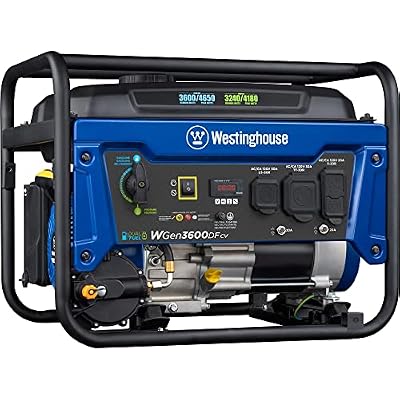 WestinghouseWestinghouse 4650 Peak Watt Dual Fuel Portable Generator, RV Ready…$399 \xc2\xb7 94/100
 WestinghouseWestinghouse 6500 Watt Dual Fuel Home Backup Portable Generator, Transfer…$579 \xc2\xb7 94/100

Write Your Review
No reviews yet. Be the first to share your experience!