
🛒 Best Price Today on Amazon
Prime members get fast, free shipping on everything above, plus member-only deals. New members get a 30-day free trial — cancel anytime.
At the top end of portable generators, machines like the Westinghouse WGen9500DF begin to compete with standby systems. It sits in the roughly 9,500-running-watt class on gasoline with a peak rating well above that, dual-fuel capability, electric start, and a 50A outlet suited to transfer switches. This review asks whether a large portable is worth buying instead of a standby generator for near-whole-home backup, and what it takes to run one well through a long outage.
What this class can run
With roughly 9,500 running watts on gasoline and somewhat less on propane, this class runs a full essentials list plus comfort loads: fridge, freezer, well or sump pump, furnace, lights, electronics, a microwave, and often a 2 to 3-ton central AC with a soft-start. Confirm current specs on the label.
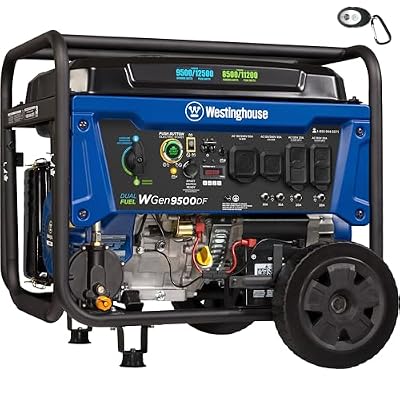
Westinghouse 12500 Watt Dual Fuel Home Backup Portable Generator, Remote Electric Start, Transfer Switch Ready, Gas and Propane Powered
Included for 'Westinghouse WGen9500DF Review: Is It Worth Buying in 2026?' because the listing specifies Remote Electric Start and Transfer Switch Ready, details this guide uses to compare options.
View on Amazon
Westinghouse 12500 Watt Dual Fuel Home Backup Portable Generator, Remote Electric Start, Transfer Switch Ready + Westinghouse 120/240 Volt, 200 Amp Automatic Portable Generator Transfer Switch
Included for 'Westinghouse WGen9500DF Review: Is It Worth Buying in 2026?' because the listing specifies Remote Electric Start and Transfer Switch Ready + Westinghouse 120/240 Volt, details this guide uses to compare options.
View on AmazonNear-whole-home load plan
| Load | Running watts | Starting watts |
|---|---|---|
| Central AC, 3-ton, with soft-start | 3,000-3,800W | 5,000-7,000W (lower with soft-start) |
| Refrigerator + chest freezer | 1,200-1,500W | 2,500-3,500W |
| 1/2 hp well pump | 1,000-1,300W | 2,500-3,500W |
| Furnace blower | 500-800W | 1,000-1,600W |
| Lights, router, TVs | 500-800W | None |
| Microwave, rotated | 1,000-1,200W | None |
| Total running | ~7,200-9,400W | Stagger starts |
The list fits, but with little margin. Owners typically avoid running the microwave while the AC and well pump are active.
Portable versus standby at this size
| Factor | Large portable (~9,500W) | 20kW standby |
|---|---|---|
| Installed cost | ~$1,600-$3,500 incl. inlet/interlock | ~$9,000-$17,000 |
| Startup | Manual; you wheel it out | Automatic in seconds |
| Fuel | Gasoline/propane you store | Natural gas or large propane tank |
| Runtime per fill | ~8-12 hours at half load | Continuous on natural gas |
| Weight | ~200-240 lbs on wheels | Permanently installed |
| Noise | ~72-76 dBA | ~60-70 dBA |
The portable wins decisively on cost. The standby wins on convenience, noise, and endurance. If someone is always home during storms and can safely operate it, the large portable delivers most of the benefit.
Fuel planning for long outages
A big generator consumes fuel quickly. At half load, expect roughly 0.7 to 0.9 gallons of gasoline per hour, or about 17 to 22 gallons per 24 hours. On propane, consumption is higher by volume; plan roughly 1 to 1.3 gallons per hour, which empties a 20-pound cylinder in about 4 hours. For multi-day outages, many owners connect to a 100-pound cylinder or run intermittently, 4 hours on and 2 off, to stretch fuel.
Transfer switch connection
The 50A outlet pairs with a 50A inlet and transfer switch or interlock, installed by a licensed electrician. This lets you power hardwired loads including the AC condenser and well pump. Expect $600 to $2,000 for the installation. Never connect through a backfed outlet.
Moving and storing a 200-pound machine
Wheels and folding handles help, but this is a two-person job on uneven ground or steps. Store it where you can roll it directly to its operating spot on a hard surface. Consider a permanent operating location with a concrete pad 20 feet from the house and a cord run to the inlet.
Carbon monoxide and placement
Large generators produce large amounts of CO. Operate it outdoors, at least 20 feet from the house, exhaust directed away from doors, windows, and vents, never in a garage. Models with built-in CO shutdown sensors add a safety layer, but they do not replace CO alarms inside the home.
Maintenance
Change oil after break-in and then every 50 to 100 hours; during a long outage, that can mean an oil change every 4 days of continuous running. Keep extra oil and a funnel with your fuel. Exercise it monthly.
Cords and inlet sizing
A large generator is only as good as its connection. A 50A inlet requires a matching 50A generator cord, typically 6-gauge, and cords longer than 25 to 30 feet add voltage drop and cost. Measure the distance from your safe operating spot, at least 20 feet from the house, to the inlet location before buying the cord. If your panel is on the far side of the house, the electrician can place the inlet on the near wall and run the conductors inside. A properly sized cord keeps the AC and well pump starting cleanly instead of dimming lights and straining motors.
FAQ
Can the WGen9500DF run central air conditioning?
Often, for 2 to 3-ton systems, especially with a soft-start kit. Run it without other large motor loads starting simultaneously.
How much fuel does it need for a 3-day outage?
Running 16 hours a day at half load, plan roughly 35 to 50 gallons of gasoline, or equivalent propane. Intermittent running can reduce that.
Bottom line
The Westinghouse WGen9500DF is worth buying for homeowners who want near-whole-home backup, including a well pump and central AC, at a fraction of standby cost, and who can safely manage fuel and setup. If you want automatic operation or are often away during storms, a standby system is the better investment.

Write Your Review
No reviews yet. Be the first to share your experience!