
🛒 Best Price Today on Amazon
Prime members get fast, free shipping on everything above, plus member-only deals. New members get a 30-day free trial — cancel anytime.
Keeping a 55-inch TV running during an outage is less about raw wattage and more about protecting sensitive electronics and choosing a power source that makes sense for a load under 200 watts. Almost any generator can push that much power, but not every generator produces power a modern TV and its streaming hardware should see, and a large generator idling for a movie night wastes fuel and patience.
How much capacity you actually need
A 55-inch LED TV usually runs at 50 to 120 watts, an OLED at 70 to 250 watts depending on content. Add a streaming device, a Wi-Fi router, a soundbar and maybe a game console and the entertainment load is typically 150 to 450 watts. In an outage you might add the refrigerator, lights and phone chargers, bringing the realistic total to 600 to 1,200 watts running with a fridge compressor start of 1,000 to 1,500 watts on top.
| Setup | Running watts | Peak with surges | Suitable source |
|---|---|---|---|
| TV + streaming stick | 60 – 130 W | under 250 W | 300 – 500 Wh power station |
| TV + router + soundbar | 100 – 230 W | under 400 W | 500 – 1,000 Wh station or 1,000 W inverter |
| TV + console + soundbar + router | 250 – 450 W | under 600 W | 1,000 – 2,000 Wh station or 1,000 – 2,000 W inverter |
| Entertainment + fridge + lights | 600 – 1,200 W | 1,800 – 2,500 W | 2,500 – 3,500 W inverter generator |
These ranges cover typical household gear; check the current spec sheet of your TV for its maximum power and of any generator for its rated running watts.
Clean power: why inverter generators are the default
TVs, streaming boxes and routers use switch-mode power supplies that are fairly tolerant, but they are designed for utility power with low total harmonic distortion. Conventional open-frame generators often produce 10 to 25 percent THD, and their voltage and frequency drift as the load changes. Most modern electronics survive it, but the risk of glitching, buzzing audio, or shortened power supply life is real, and the fix is simple: use an inverter generator, which typically keeps THD under 3 percent, or a power station with a pure sine wave inverter.
Protect against voltage swings anyway
Even with good power, plug the TV setup into a quality surge protector. When a large motor on the same generator, like a well pump or air conditioner, shuts off suddenly, the voltage can briefly overshoot. A surge protector with a joule rating in the 1,000 to 3,000 range adds a cheap layer of insurance. Avoid plugging the TV into the same cord as a refrigerator or space heater.
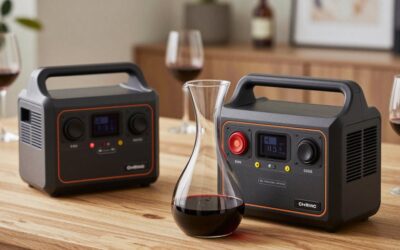
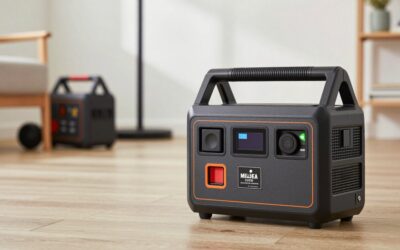
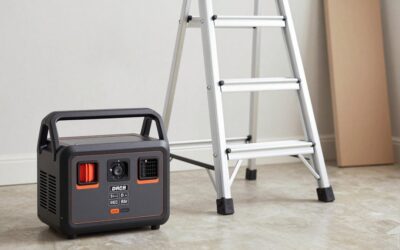
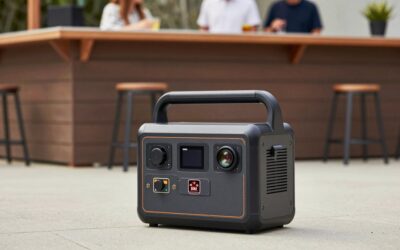
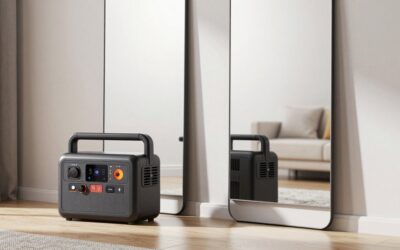
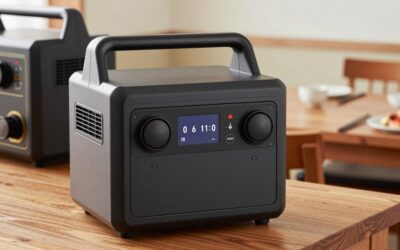
Power stations are often the best fit
For a TV-centered load, a portable power station makes a strong case. It is silent, safe indoors and outputs pure sine wave AC. Runtime math: capacity in watt-hours times about 0.85, divided by load. A 1,000 Wh station running a 100-watt TV and a 10-watt streaming stick delivers roughly 7.5 hours, enough for three or four movies. A 2,000 Wh unit with a 300-watt console setup gives about 5.5 hours of gaming.
Reducing the load stretches runtime
Switch the TV to its eco picture mode, lower backlight to 50 to 60 percent, and skip the soundbar in favor of the TV speakers. These changes can cut the entertainment load by 30 to 50 percent. Download shows ahead of an expected storm so the router and modem can stay off.
When a generator makes more sense
If the outage stretches beyond a day and you also need refrigeration and lighting, a 2,500 to 3,500 watt inverter generator becomes the practical backbone. Run it in eco mode during the evening to power the TV along with the fridge; at 30 to 40 percent load many units in this class burn roughly 0.15 to 0.25 gallons per hour. Some households run the generator in the evening while also recharging a power station, then switch the generator off and use the station overnight.
FAQ
Can a conventional generator damage a TV?
It is uncommon, but voltage spikes and distorted waveforms can stress power supplies over time. If you only own a conventional generator, keep a larger steady load on it, use a surge protector and consider a small UPS or power station as a buffer.
Will a 300-watt power station run a 55-inch TV?
Most LED 55-inch TVs yes, since they draw well under 150 watts in eco mode. Runtime from a 300 Wh unit would be roughly two to three hours. A bright HDR OLED scene may approach the output limit, so check the station’s continuous rating.
Bottom line
A 55-inch TV needs only 50 to 250 watts, so a 500 to 1,000 Wh power station or a 1,000 to 2,000 watt inverter generator is plenty for the entertainment setup alone. Step up to 2,500 to 3,500 watts only when the refrigerator and other essentials share the source. Whatever you choose, clean inverter power and a surge protector matter more than extra wattage.



Write Your Review
No reviews yet. Be the first to share your experience!