
🛒 Best Price Today on Amazon
Prime members get fast, free shipping on everything above, plus member-only deals. New members get a 30-day free trial — cancel anytime.
Powering a home theater from a generator is really a question of power quality and dynamic headroom. The average load is modest, often under a kilowatt, but the equipment is expensive and sensitive, and its demand jumps in milliseconds when the soundtrack gets loud. A generator that is fine for a refrigerator can make a receiver buzz, a projector shut off, or a subwoofer’s amplifier clip on every explosion.
Size for peaks, not averages
A typical system averages 350 to 900 watts during a movie. Loud scenes push amplifiers and subwoofers into brief peaks that can take the total to 1,000 to 1,500 watts. Generators respond to sudden load steps with a short voltage dip, and if the peak brushes the generator’s limit, the dip becomes audible distortion or a protection shutdown. Size the generator so the system’s peaks sit around half of its running rating.
| System | Average during film | Peaks | Recommended inverter generator (running) | Power station option |
|---|---|---|---|---|
| 55 – 65 in TV + soundbar + sub | 150 – 300 W | 400 – 600 W | 1,600 – 2,000 W | 1,000 Wh, 1,000 W output |
| 75 in TV + 5.1 receiver + 1 sub | 300 – 550 W | 800 – 1,100 W | 2,500 – 3,000 W | 2,000 Wh, 1,800 W output |
| Projector + 7.2 receiver + 2 subs | 500 – 900 W | 1,200 – 1,500 W | 3,000 – 4,000 W | 3,000 Wh+, 2,400 W output |
| Theater + fridge + lights during outage | 900 – 1,500 W | 2,500 – 3,000 W | 4,000 – 5,500 W | Not practical long term |
These are planning ranges; check the current spec sheet for your equipment’s rated consumption and for the generator’s rated running watts and THD figure.
Why inverter generators are essential here
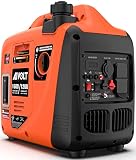
Audio amplifiers and projector power supplies are more sensitive to waveform quality than most household loads. Conventional open-frame generators can produce harmonic distortion of 10 to 25 percent, and their frequency drifts slightly as load changes. The results range from audible hum through the speakers to projectors refusing to strike or shutting down. Inverter generators typically keep THD under 3 percent and hold frequency steady, which is what this equipment expects. Look for a published THD specification rather than a vague “clean power” claim.
Eco mode and dynamic audio
Eco mode lowers engine speed at light load, and a quiet dialogue scene is light load. When a loud scene arrives, the engine has to spin up, and for a moment voltage sags. Some systems handle it; others clip or trigger receiver protection. Turning eco mode off costs a little fuel but keeps voltage stable.
Protect the equipment chain
Place a quality surge protector or line conditioner between the generator and the rack, and consider a pure sine wave UPS for the projector so it can cool down properly if the generator stops or runs out of fuel. Projectors that lose power without a cooling cycle can suffer shortened lamp or light-source life. Power up the generator and let it stabilize before switching on the system, and shut the equipment down before stopping the generator.
Keep big motors off the same generator
If the generator also runs a well pump, air conditioner or compressor, those motors cause voltage dips when they start and overshoots when they stop. Either put the theater on its own small inverter generator or accept that you should not watch a film while the well pump is cycling.
Power stations for quiet movie nights
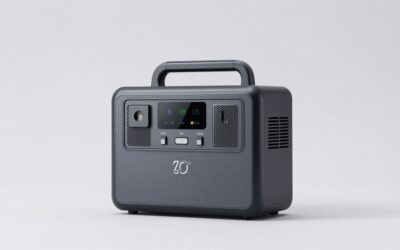
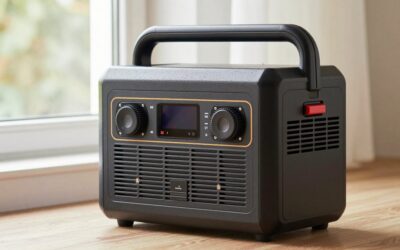
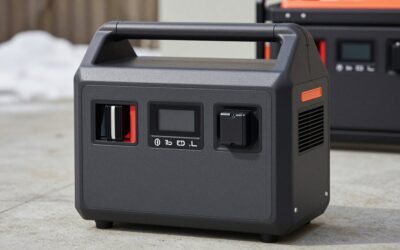
A generator’s noise, even from a quiet inverter at 50 to 60 dB, intrudes on a film. A power station with 2,000 to 3,000 Wh and 1,800 to 2,400 watts of pure sine output can run a mid-size system silently for about three to five hours. Recharge it from the generator during the day or from solar. For outage entertainment, this hybrid approach is often the most satisfying.
Fuel for a movie night
A 3,000-watt inverter running a 600-watt average theater load with eco off typically burns around 0.2 to 0.3 gallons per hour, so a two-and-a-half-hour film uses roughly half a gallon or a bit more. If the generator is already running the fridge and lights, the extra fuel for the movie is modest.
FAQ
Will a conventional generator damage my AV receiver?
Damage is unlikely with a well-regulated unit, but hum, protection shutdowns and projector faults are common. Use an inverter generator or at least a line conditioner and a UPS for the projector.
Can a 2,000-watt inverter run a full surround system?
A modest 5.1 system with a 55 to 65 inch TV, yes. Larger setups with multiple subwoofers and a projector should have 3,000 watts or more to keep peaks well below the limit.
Bottom line
Most home theater systems run well on a 2,500 to 4,000 watt inverter generator with eco mode off, sized so that bass peaks stay near half of the rated output. Clean, low-THD power, surge protection and a UPS for the projector matter more than raw capacity, and a large power station is the quietest way to watch during an outage.

Write Your Review
No reviews yet. Be the first to share your experience!