
🛒 Best Price Today on Amazon
Prime members get fast, free shipping on everything above, plus member-only deals. New members get a 30-day free trial — cancel anytime.
A generator and an air compressor are a classic pairing on job sites, farms and roadside repair calls, and they are also one of the most common mismatches. Compressors cycle on unpredictably, they start with a heavy motor surge, and they sometimes start while the generator is already carrying another load. The generator has to handle the worst possible moment, not the average.
Sizing for the worst-case start
The key number is the compressor’s starting draw, not its running watts. Induction-motor compressors can demand four to six times their running current for a moment. The generator must provide that surge while also supporting whatever else is running when the pressure switch kicks in. On a job site that might be a saw mid-cut, a work light and a radio.
| Compressor | Running watts | Starting watts | Generator alone (starting / running) | Generator with saw sharing |
|---|---|---|---|---|
| Pancake 3 – 6 gal, 120 V | 900 – 1,500 W | 1,800 – 3,000 W | 3,000 / 2,500 W | 5,000 / 4,000 W |
| Twin-stack 8 – 10 gal, 120 V | 1,400 – 1,800 W | 2,800 – 4,500 W | 4,500 / 3,500 W | 6,500 / 5,500 W |
| Vertical 20 – 30 gal, 120 V | 1,500 – 1,900 W | 3,500 – 5,500 W | 5,500 / 4,500 W | 7,500 / 6,000 W |
| Stationary 60 gal, 240 V | 3,000 – 4,000 W | 8,000 – 12,000 W | 12,000 / 9,500 W with 240 V | Dedicated generator advised |
| Stationary 80 gal 5 hp, 240 V | 4,000 – 5,500 W | 11,000 – 16,000 W | 15,000 W+ with 240 V | Dedicated generator advised |
These are planning ranges. Motor condition, cold oil and a sticking unloader can push starting draw higher; check the current spec sheet for your compressor’s amps and the generator’s rated output.
Why conventional generators often start compressors better
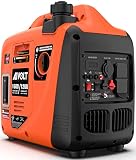
Motor starting depends on how well the generator holds voltage during the surge. Large open-frame generators with heavy alternators and rotating mass tend to ride through induction-motor starts better than lightweight inverters with the same headline rating. Inverter generators are electronically current-limited; when the surge exceeds their limit, they shut down or drop voltage sharply. For jobsite compressors, a well-built conventional generator with a genuine surge rating is often the more reliable choice, while inverters excel for electronics and quiet operation.
Eco mode is the enemy of compressors
On any inverter generator, idle-down or eco mode drops engine speed at light load. When the compressor’s pressure switch closes, the engine needs a moment to rev up, and in that moment the voltage sags and the motor may stall. Turn eco mode off whenever a compressor is connected.
Practical tricks to reduce surge
Keep the compressor on the shortest, heaviest cord possible, ideally 10 or 12 gauge and under 25 feet, and run longer air hose instead. Make sure the unloader valve is venting at each shutoff. In cold weather, oil-lubricated pumps start harder; letting the compressor warm up in a sheltered spot helps. Some compressors have a manual unloader or tank drain you can open briefly to start unloaded. Where a generator is borderline, fill the tank on the generator before other tools are running, then let the compressor cycle only as needed.
Fuel and runtime planning
A 5,000 to 7,500 watt open-frame generator running a pancake or twin-stack compressor intermittently along with a saw and lights might average 1,500 to 2,500 watts. Most units in this class burn roughly 0.4 to 0.6 gallons per hour at that load, so an eight-hour day uses 3 to 5 gallons. Running a 60-gallon compressor for continuous air tools pushes load and fuel use much higher; plan for 8 to 12 gallons a day on a larger 240-volt generator.
Engine-drive compressors for serious field use
For crews that need high air volume far from power, gas or diesel engine-driven compressors that deliver 14 to 20+ SCFM skip the generator altogether and avoid double conversion losses. Some truck-mounted units combine compressor, generator and welder in one package.
FAQ
Can a 2,000-watt inverter generator run a pancake compressor?
Some small oil-free pancakes will start on a 2,000-watt inverter with eco mode off and nothing else connected, but it is marginal. A 3,000-watt or larger generator is the reliable minimum.
Why does my compressor start fine on house power but stall on the generator?
The generator is dropping voltage during the surge. Try eco mode off, a shorter heavier cord and no other loads at start. If it still stalls, the generator is undersized for that motor.
Bottom line
Plan on a generator with 3,000 to 4,500 starting watts for a pancake or small twin-stack compressor, 5,500 watts or more for a 20 to 30 gallon 120-volt unit, and 12,000 watts or more with a 240-volt outlet for stationary 60 to 80 gallon compressors. Size for the moment the compressor starts while other tools are running, and keep eco mode off.

Write Your Review
No reviews yet. Be the first to share your experience!