
🛒 Best Price Today on Amazon
Prime members get fast, free shipping on everything above, plus member-only deals. New members get a 30-day free trial — cancel anytime.
- Top Pick: SoftStartRV Soft Start for RV Air Conditioner, RV AC Soft Start Kit for Air Conditioner, Easy Start Even with a Small Generator, 100% Waterproof, Trailer Camper, Motorhome HVAC -NetworkRV
- Best Value: MICRO-AIR EasyStart Flex 398 Soft Start Kit for Home & RV Air Conditioner
- Premium Choice: Spartan Power SpartanStart – Soft Start Kit for RV Air Conditioner, A/C Unit, up to 20K BTU, 120v Softstart Aid, Battery Saving Softstartup System for RV, Van, or Camper Air Conditioning Systems
Choosing the right generator for an RV air conditioner is mainly a startup-wattage question. A running air conditioner may use 1,200 to 1,800 watts, but its compressor can briefly demand 2,800 to 4,500 watts when it starts. That short surge is why a generator that appears large enough on paper may overload or shut down.
For most RVs, a 3,000- to 3,500-watt inverter generator is the practical starting point for one 13,500-BTU air conditioner. A 15,000-BTU unit usually needs a 3,500- to 4,500-watt generator unless it has a soft-start kit. Two air conditioners generally require a 6,000- to 8,000-watt setup, often using parallel-connected generators or a permanently installed RV generator.
As an Amazon Associate we earn from qualifying purchases at no extra cost to you. Product prices and availability are accurate as of the date shown and are subject to change.


The Short Answer
| RV air conditioner | Typical running watts | Estimated startup watts | Recommended generator |
|---|---|---|---|
| 9,000-10,000 BTU | 900-1,300 watts | 2,000-3,000 watts | 2,500-3,000 watts |
| 13,500 BTU | 1,300-1,700 watts | 2,800-4,000 watts | 3,000-3,500 watts |
| 15,000 BTU | 1,500-2,000 watts | 3,500-4,500 watts | 3,500-4,500 watts |
| 18,000 BTU | 1,800-2,400 watts | 4,000-5,500 watts | 4,500-6,000 watts |
| Two 13,500-15,000 BTU units | 2,600-4,000 watts | 5,600-9,000 watts | 6,000-8,000 watts |
These are planning figures, not a substitute for the amperage label on your specific air conditioner. Heat, altitude, extension-cord length, refrigerator operation, battery charging, and microwave use can all reduce the generator’s available capacity. For a comfortable margin, choose a generator with at least 10% to 20% more continuous capacity than your expected running load.
Standard Sizes
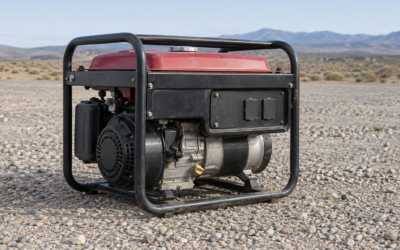
Portable inverter generators are commonly grouped by their continuous output. The physical measurements below are representative dimensions for current enclosed inverter-generator designs; exact dimensions vary by manufacturer, fuel tank size, wheel kit, and handle position. The dimensions exclude optional wheel assemblies unless noted.
| Generator class | Continuous output | Typical physical size | Approximate weight | Best RV use |
|---|---|---|---|---|
| 2,000-2,200 watts | 1,600-1,800 watts | 20.0-24.0 × 11.0-14.0 × 17.0-20.0 in (50.8-61.0 × 27.9-35.6 × 43.2-50.8 cm) |
40-55 lb (18-25 kg) |
Small AC with limited onboard loads |
| 3,000-3,500 watts | 2,800-3,200 watts | 25.0-30.0 × 16.0-20.0 × 19.0-24.0 in (63.5-76.2 × 40.6-50.8 × 48.3-61.0 cm) |
65-95 lb (29-43 kg) |
One 13,500-BTU AC |
| 4,000-5,000 watts | 3,500-4,500 watts | 28.0-34.0 × 18.0-24.0 × 22.0-27.0 in (71.1-86.4 × 45.7-61.0 × 55.9-68.6 cm) |
90-140 lb (41-64 kg) |
One 15,000-18,000-BTU AC |
| 6,000-8,000 watts | 5,500-7,000 watts | 30.0-36.0 × 22.0-28.0 × 25.0-32.0 in (76.2-91.4 × 55.9-71.1 × 63.5-81.3 cm) |
140-220 lb (64-100 kg) |
Two AC units and larger coach loads |
Pay attention to continuous, or rated, watts rather than the larger “peak” number printed in advertisements. A generator labeled 3,500 starting watts but only 3,000 running watts should be treated as a 3,000-watt generator for air-conditioner planning.
A soft-start device can reduce the compressor’s initial demand. Examples include the SoftStartRV kit, priced around $295, MICRO-AIR EasyStart Flex 398 at about $399, and Spartan Power SpartanStart at approximately $189. These products are installed inside or near the air-conditioner electrical system, so installation should follow the manufacturer’s instructions or be handled by a qualified technician. A soft start does not reduce the air conditioner’s normal running wattage; it primarily makes startup easier for a smaller generator.
How to Measure Your Space
- Read the air-conditioner data plate. Find the rated amps, voltage, locked-rotor amps, and BTU capacity. Most RV rooftop units use 120 volts. If the label lists 13.3 amps, the approximate running load is 1,596 watts: 13.3 × 120.
- Measure the generator compartment. Measure usable width, depth, and height in inches, then subtract at least 1 inch from each dimension for clearance. Convert inches to centimeters by multiplying by 2.54.
- Check access dimensions. A generator may fit inside a compartment but fail to pass through its door. Measure the narrowest opening, including hinges, trim, and latch hardware.
- Allow ventilation space. Do not operate a portable gasoline or propane generator in an enclosed storage bay. Outdoor operation requires clear airflow, protection from rain, and separation from doors, windows, and vents to prevent exhaust entering the RV.
- Add the other loads. Include the refrigerator, converter or battery charger, television, lights, water heater, coffee maker, and microwave. A microwave can draw 1,000-1,500 watts by itself.
- Plan for altitude and heat. Gasoline engines generally lose available power as elevation rises and air gets hotter. If you camp at high elevations, select the next generator size or verify the manufacturer’s derating information.
By Room or Use Case
Small camper or teardrop trailer
A 9,000- or 10,000-BTU air conditioner may work with a quality 2,500- to 3,000-watt generator, provided the refrigerator and other high-draw appliances are off during startup. Compact generators often weigh 40 to 55 pounds, making them easier to carry, but their limited fuel tanks may require frequent refueling.
Travel trailer with one 13,500-BTU unit
This is the most common RV air-conditioning setup. Choose a 3,000- to 3,500-watt inverter generator with at least 2,800 watts of continuous output. A 3,500-watt model offers more flexibility for battery charging and small kitchen appliances. With a properly installed soft-start kit, some owners can use a generator near the lower end of this range.
Large fifth wheel or motorhome
A 15,000-BTU unit normally pairs better with a 4,000- to 5,000-watt generator. An 18,000-BTU replacement, such as the Furrion Chill Cube 18K, can require even more starting capacity. Check its electrical specifications rather than sizing from BTU alone. Large generators may weigh more than 100 pounds, so wheels, a lift, or a permanent compartment installation can be important.
RV with two air conditioners
Two rooftop units can exceed the capacity of a typical portable generator, especially when the refrigerator, converter, or microwave is operating. Plan on 6,000 to 8,000 watts, or use two compatible inverter generators with a manufacturer-approved parallel kit. Make sure the RV’s shore-power connection and transfer equipment are rated for the combined output.
Quiet campground use
Inverter generators are usually preferable because they adjust engine speed to the load and provide stable power for sensitive electronics. However, sound ratings are measured under different conditions, so compare the rated decibel figure, fuel runtime, and campground rules. Never place a running generator beneath the RV, inside a pickup bed with a cap closed, or in a storage compartment.
Common Sizing Mistakes
- Using running watts only: The compressor’s startup surge is often the reason a generator trips.
- Confusing peak and continuous ratings: Base your decision on continuous watts, not the biggest number on the box.
- Ignoring other appliances: A generator sized for the AC alone may overload when the microwave or electric water heater turns on.
- Assuming every 15,000-BTU unit is identical: Efficiency, compressor design, age, voltage, and locked-rotor amps vary.
- Overlooking cord loss: Long, undersized extension cords can cause voltage drop. Use a heavy-duty cord rated for the generator and load.
- Installing a soft start incorrectly: Incorrect wiring can damage equipment or create a shock and fire hazard.
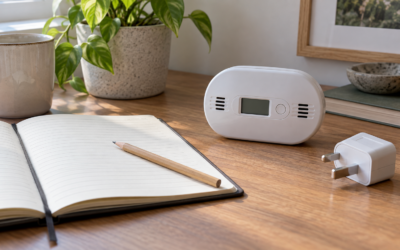
- Skipping carbon-monoxide protection: Run the generator outdoors, far from openings, and use working carbon-monoxide alarms inside the RV.
FAQ
Can a 2,000-watt generator run an RV air conditioner?
Sometimes, but it is not a dependable choice for most 13,500-BTU units. A small air conditioner with low startup demand may run on a 2,000-watt generator, particularly with a soft-start device, but there may be little capacity left for other appliances. A 3,000- to 3,500-watt generator is a safer general recommendation.
Is a 3,500-watt generator enough for a 15,000-BTU RV AC?
It can be, if the air conditioner has modest startup demand, the generator produces close to 3,500 continuous watts, and other loads are managed. For more consistent operation, especially in hot weather or at elevation, a 4,000- to 5,000-watt generator provides a better margin.
Does a soft-start kit let me use a smaller generator?
It may reduce startup demand enough to make a smaller generator practical, but it does not guarantee compatibility. Confirm the air conditioner’s running watts, generator output, and soft-start manufacturer requirements. The kit also does not allow unlimited simultaneous appliance use.
How much does an RV generator setup cost?
Portable inverter generators commonly cost about $700 to $2,500, depending on output and fuel type. A parallel kit may add roughly $100 to $300. Soft-start kits generally range from about $189 to $399, while installation can add to the total. Permanent RV generator systems often cost $3,000 to $6,000 or more, including installation.


Write Your Review
No reviews yet. Be the first to share your experience!