
🛒 Best Price Today on Amazon
Prime members get fast, free shipping on everything above, plus member-only deals. New members get a 30-day free trial — cancel anytime.
The Short Answer
Yes—if your generator has an electric-start battery and may sit unused for weeks or months. A small 6V/12V smart charger or battery maintainer can keep that battery ready without the hassle of removing it for charging. If your generator starts only with a recoil cord, however, you do not need a generator battery charger.
There is one important condition: buy a charger that matches your generator battery’s voltage and chemistry. Most portable generators use a 12V lead-acid, AGM, or similar starting battery, but some models use different batteries or have a built-in charging system. Check the generator manual and the label on the battery before connecting anything.
As an Amazon Associate we earn from qualifying purchases at no extra cost to you.
A charger will not make a weak battery healthy again, and it will not replace gasoline, oil changes, or routine generator testing. Its main job is preventing an electric-start battery from slowly discharging while the generator is stored.
What You Actually Get
A generator battery charger is usually a compact low-output device that plugs into a standard wall outlet and connects to the battery with clamps or ring terminals. Common portable models deliver about 0.8 to 1 amp, while larger automotive-style chargers may provide several amps or include a higher-amp starting mode.
For generator storage, a low-output smart charger is generally the better choice. It charges the battery gradually, then reduces or pauses the current when the battery is full. Many models also monitor voltage and resume charging as needed. That is different from an old-fashioned “dumb” trickle charger, which can continue pushing current into a full battery and eventually cause overheating, fluid loss, or battery damage.
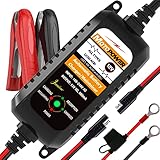
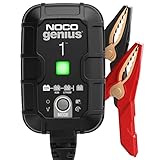
The MOTOPOWER MP00205A is a basic 12V automatic charger, maintainer, and desulfator rated at 800mA. It is listed at about $15, making it one of the least expensive ways to maintain a compatible 12V battery. The NOCO GENIUS1 is a 1-amp smart charger for 6V and 12V batteries and is listed at about $25. Its broader voltage compatibility is useful if you maintain more than one type of battery.
Neither product is a substitute for a generator’s starter battery. They are maintenance tools. A 1-amp charger may need several hours—or overnight—to recharge a significantly depleted battery. A rough estimate is that replacing 10 amp-hours of lost capacity can take around 10 to 14 hours after accounting for charging inefficiency. A totally dead or damaged battery may not accept a normal charge at all.
Expect a small charger to weigh roughly 1 to 3 pounds and occupy about the space of a paperback book or smaller, although exact dimensions vary. Electricity use is modest: a low-output charger might draw only a few watts while actively charging and much less when maintaining. The outlet, cable routing, and weather protection matter more than raw wattage.
Pros
- Improves starting readiness. A fully charged battery gives an electric-start generator its best chance of starting when the power goes out.
- Inexpensive insurance. Basic maintainers typically cost about $15 to $35, far less than replacing a starting battery or dealing with a failed emergency start.
- Useful during long storage. Generators often sit untouched for several months. A smart maintainer helps counter the battery’s normal self-discharge.
- Simple to install. Ring-terminal leads can remain attached to the battery, while a quick-connect plug makes it easy to connect the charger.
- Low energy consumption. A small maintainer uses little electricity compared with a heater, refrigerator, or even a continuously running generator.
- Can extend battery service life. Keeping a lead-acid battery near full charge is generally better than allowing it to remain deeply discharged.
- Some models support multiple batteries. A 6V/12V charger can be useful for lawn equipment, motorcycles, backup batteries, and other seasonal machines.
Cons
- It requires a nearby outlet. A charger cannot help if the generator is stored in a shed, enclosure, or garage without safe access to power.
- It does not repair a failed battery. Sulfation, an internal short, corrosion, or a battery that will not hold voltage still requires replacement.
- It is unnecessary for recoil-start generators. If there is no starting battery, there is nothing for this type of charger to maintain.
- Compatibility matters. A 12V lead-acid charger is not automatically suitable for lithium batteries or unusual battery packs.
- Small chargers are slow. An 800mA or 1A unit is designed for maintenance, not rapid recovery after repeated failed starts.
- Outdoor use can be complicated. Even if the charger is advertised as weather-resistant, the outlet and connection point must be protected from rain, standing water, and physical damage.
- Improper connection can be dangerous. Reversed polarity, damaged cables, or charging a frozen or visibly damaged battery can create safety problems.
Who Should Buy It
Buy a generator battery charger if your unit has electric start and is used mainly as emergency backup. This is especially worthwhile when the generator spends most of the year idle, when you live in an area with frequent storms or winter outages, or when the generator is difficult to access for monthly charging.
It is also a sensible purchase if you have already experienced the familiar problem: the generator has fuel, the oil is fresh, and the engine is mechanically sound, but the starter only clicks. A maintainer can reduce that particular failure point.
Choose an automatic or smart model rather than a continuously charging basic trickle charger. For a single 12V generator battery, an 800mA to 1A maintainer is usually adequate. The MOTOPOWER MP00205A is the budget-oriented option at approximately $15. The NOCO GENIUS1 costs approximately $25 and adds 6V/12V flexibility, which may justify the higher price if you maintain several types of equipment.
Consider a charger with ring terminals if you want a semi-permanent connection. Clamps are convenient for occasional use, but ring terminals are less likely to slip off and can make routine maintenance easier.
Who Should Skip It
Skip the purchase if your generator has recoil start only, or if its battery is charged automatically whenever the generator runs and is used frequently enough to stay healthy. You may also skip it if the generator is stored where no safe electrical outlet is available.
Do not use a generic charger without checking the battery type. If the battery is swollen, cracked, leaking, frozen, or hot, disconnect it and replace or inspect it rather than trying to revive it. Likewise, a charger will not solve an electrical fault that is draining the battery unusually fast. In that situation, the generator needs diagnosis.
Cheaper Alternatives
| Option | Cost | Trade-off |
|---|---|---|
| Manual charging every few weeks | $0 if you already own a compatible charger | Requires remembering to remove, charge, and reinstall the battery; easier to neglect. |
| Use the generator’s built-in charging port | $0 additional cost | Usually charges only while the generator is running, so it does not maintain the battery during storage. |
| Disconnect the negative cable | $0 | Can reduce parasitic drain, but the battery still self-discharges and the generator may not be ready immediately. |
| 12V solar maintainer | About $20-$60 | Useful without an outlet, but performance depends on sunlight, panel placement, weather, and charge-controller quality. |
| MOTOPOWER MP00205A, 12V/800mA | About $15 | Low-cost choice for a compatible 12V battery; not intended as a fast charger or universal battery solution. |
| NOCO GENIUS1, 6V/12V/1A | About $25 | Costs more, but supports both 6V and 12V batteries and provides smart charging and maintenance. |
FAQ
Can I leave a battery charger connected to my generator?
Usually, yes, if it is an automatic smart charger designed for continuous maintenance and the battery is compatible. Keep the charger and connections dry, provide ventilation around a lead-acid battery, and follow the generator and charger instructions. Do not leave a damaged charger or frayed cable connected unattended.
How long should I charge a generator battery?
It depends on the battery’s capacity and how deeply it is discharged. A small 12V starting battery may need several hours after a light discharge, while a nearly empty battery can take overnight or longer with a 0.8A to 1A maintainer. Stop relying on charging alone if the battery repeatedly loses charge or cannot hold voltage.
Can I use a car battery charger on a generator battery?
Only if its output and charging mode match the generator battery. A smart charger with a suitable 12V setting can work, but high-output automotive chargers may be excessive for a small battery. Never assume that a charger intended for lead-acid batteries is suitable for lithium or another chemistry.
Should I charge the battery before testing the generator?
Yes. Charge or maintain the battery first, then test the generator under the procedure in its manual. Run it long enough to circulate fluids and confirm that the electric starter works, but do not test indoors or in an enclosed garage because generator exhaust contains dangerous carbon monoxide. A charger helps keep the battery ready; regular testing confirms that the entire generator is ready.

Write Your Review
No reviews yet. Be the first to share your experience!