
🛒 Best Price Today on Amazon
Prime members get fast, free shipping on everything above, plus member-only deals. New members get a 30-day free trial — cancel anytime.
Whole-house generators and portable generators answer different questions. A whole-house unit is designed to power essentially everything in your home — central air, electric range, water heater, well pump — automatically. A portable generator is designed to power a selected set of essential circuits that you choose and manage. The decision comes down to how much of your home you need to run, how often outages happen, and how much you want to spend. This guide focuses on coverage: sizing each option for real homes and understanding what you give up with a portable.
Calculating whole-home demand
Whole-house sizing starts with the largest simultaneous loads. The biggest single factor is central air conditioning, followed by electric heat, electric water heaters and ranges.

Oxseryn Power Equipment 4400 Watts Inverter Generator Gas Powered, Portable Open Frame Generator, Low Noise with ECO Mode, RV Ready, Emergency Home Backup
Included for 'Whole-House Generator vs Portable Generator: Which Is Right for You?' because the listing specifies Portable Open Frame Generator and Low Noise with ECO Mode, details this guide uses to compare options.
View on Amazon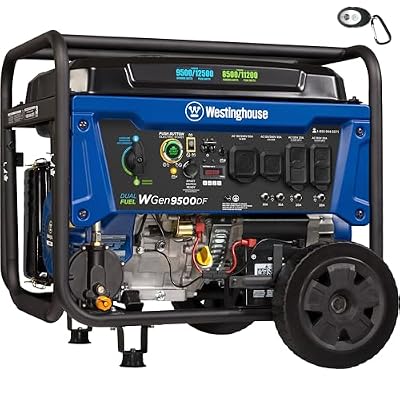
Westinghouse 12500 Watt Dual Fuel Home Backup Portable Generator, Remote Electric Start, Transfer Switch Ready, Gas and Propane Powered
Included for 'Whole-House Generator vs Portable Generator: Which Is Right for You?' because the listing specifies Remote Electric Start and Transfer Switch Ready, details this guide uses to compare options.
View on Amazon| Appliance | Running watts | Starting watts |
|---|---|---|
| Central AC, 3-ton | 3,500–4,500 | 10,000–15,000 (less with soft start) |
| Electric water heater | 4,000–4,500 | 4,000–4,500 |
| Electric range (per large burner) | 1,500–2,500 | Same |
| Well pump, 1 HP | 1,000–1,500 | 3,000–4,000 |
| Refrigerator + freezer | 400–1,200 | 2,000–3,500 |
| Lighting, electronics | 800–1,500 | Same |
Adding common simultaneous loads in a mid-size home with central AC easily reaches 12,000–18,000 running watts, which is why whole-house units are typically 18–26kW.
What a portable can realistically cover
A 7,000–10,000W portable connected through a 30A or 50A inlet can cover refrigeration, a gas furnace blower, sump or well pump, lighting, internet and a microwave, with load rotation for bigger items. It usually cannot run central AC and an electric water heater at the same time.
| Coverage tier | Typical loads | Portable size |
|---|---|---|
| Essentials | Fridge, freezer, lights, router, furnace blower | 3,500–5,000W |
| Essentials + water | Add sump or 1 HP well pump | 7,000–9,000W |
| Comfort | Add window AC or electric water heater in rotation | 9,000–12,000W with 50A |
| Whole house | Central AC, range, dryer, everything | Standby 18–26kW |
Cost per level of coverage
An essentials-level portable setup, including interlock installation, typically costs $1,200–3,000. A whole-house standby system usually costs $8,000–20,000 installed. The question is whether full coverage is worth an extra $7,000–17,000 for your household.
Load management narrows the gap
Smart load management modules on standby systems, and soft-start kits on AC compressors, can reduce required generator size by several kilowatts. A 3-ton AC with a soft starter may need only 5,000–7,000 starting watts instead of 12,000+, making it feasible for larger portables in some cases.
Living with each option
With a whole-house unit, an outage is barely noticeable: lights flicker, the generator starts, life continues. With a portable, you schedule usage — run the water heater for an hour, then the dryer, keep the AC off — and refuel twice a day. For a two-day outage once a year, that is a mild inconvenience. For a week-long hurricane outage in August, it can be exhausting.
Decision guide
- Whole-house: frequent or long outages, medical needs, central AC in hot climates, all-electric homes, or homeowners who travel.
- Portable: occasional outages, gas heat and cooking, tighter budgets, and households comfortable with manual operation.
A middle path: large portable with a transfer switch
Many homeowners land between the two options. A 9,000–12,000W dual-fuel portable connected through a 50A inlet and an interlock can run a surprising amount: refrigerator, freezer, gas furnace, well pump, lights, internet, microwave, and either a window AC or an electric water heater in rotation. Add a soft starter to a 2–3-ton central AC and some homes can even cycle the central air for a few hours in the afternoon. The all-in cost is typically $2,500–4,500 — a third or less of a standby system — while covering perhaps 70–80% of daily needs. The trade-off remains manual operation and refueling, but for households with outages a few times a year, this middle path often delivers the best value.
Resale and home value
Standby systems are often cited as adding appeal at resale in outage-prone regions, while a portable goes with you when you move.
FAQ
What size generator runs a whole house?
Most average homes with central air need 18–22kW; large or all-electric homes may need 24–26kW or load management. Homes without central AC may manage with 12–16kW.
Can two portable generators run a whole house?
Paralleling two inverters increases output but is usually limited to 30A connections. It rarely matches whole-house capacity and adds complexity.
Bottom line
A whole-house generator delivers seamless, full coverage at a premium price. A portable covers essentials affordably with hands-on management. Calculate your simultaneous loads, decide which comforts you truly need during an outage, and choose the tier that matches.
Write Your Review
No reviews yet. Be the first to share your experience!