
🛒 Best Price Today on Amazon
Prime members get fast, free shipping on everything above, plus member-only deals. New members get a 30-day free trial — cancel anytime.
A 20-inch box fan is one of the lightest loads you’ll ever put on a generator. Most draw between 50 and 110 watts, so almost any generator on the market can run one. That makes the real question more interesting: which generator runs a fan all night without waking the neighborhood or burning a tank of fuel for 75 watts of cooling? For summer outages, when a moving fan may be the only relief in a hot bedroom, the answer shapes whether you actually sleep.
How much a fan really draws
| Fan type | Low speed | High speed | Overnight (8 hr) energy on medium |
|---|---|---|---|
| 20 in. box fan (standard motor) | 45-60W | 75-110W | ~0.5-0.7 kWh |
| 20 in. box fan (high-efficiency / DC) | 10-20W | 35-55W | ~0.2-0.3 kWh |
| Pedestal / stand fan | 30-45W | 50-70W | ~0.3-0.5 kWh |
| Tower fan | 25-35W | 40-60W | ~0.3-0.4 kWh |
| Air circulator (12 in.) | 20-30W | 40-60W | ~0.3 kWh |
Startup surge is small, typically under 200W for a shaded-pole or PSC fan motor, so nearly any generator will start one.
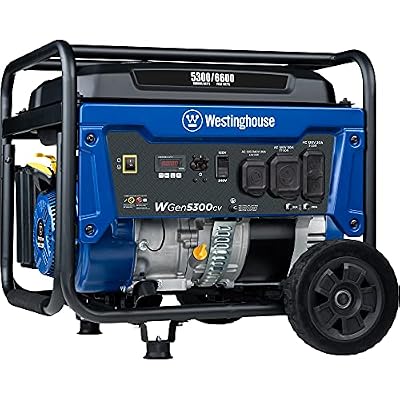
Westinghouse 6600 Peak Watt Home Backup Portable Generator, Transfer Switch Ready 30A Outlet, RV Ready 30A Outlet, Gas Powered, CO Sensor
Included for 'Best Generator for Running a Box Fan' because the listing specifies Transfer Switch Ready 30A Outlet and RV Ready 30A Outlet, details this guide uses to compare options.
View on Amazon
Oxseryn 5000W Inverter Generator Gas Powered, Portable Open Frame Generator
Included for 'Best Generator for Running a Box Fan' because the listing specifies Portable Open Frame Generator, details this guide uses to compare options.
View on AmazonThe case for a small inverter
Best fuel-burning pick: 1,000-2,300W inverter with eco mode
A small inverter generator throttles its engine down to match light loads. Running one or two box fans plus a phone charger, a 2,000W-class inverter in eco mode may use as little as 0.08-0.12 gallons per hour, which can mean 8-12 hours on a single tank. At 7 meters (23 feet), these units typically run in the low-to-mid 50s dBA, roughly the sound of a quiet conversation. That’s the difference between sleeping and lying awake. A big open-frame generator can burn 0.3-0.4 gallons per hour at the same tiny load, at 65-72 dBA.
Best overall for bedroom fans: a battery power station
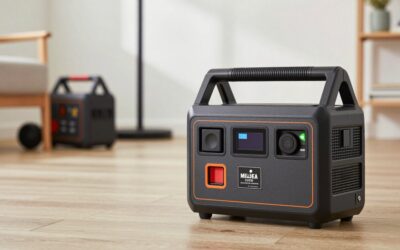
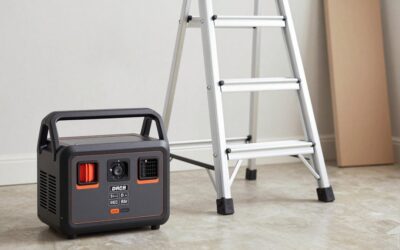
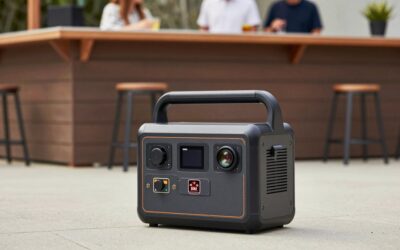
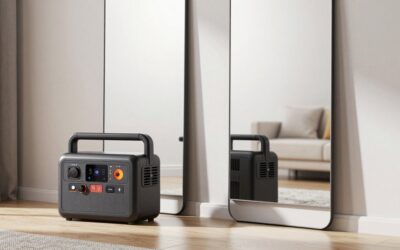
For fans alone, a 500-1,000Wh portable power station is honestly the better tool. It’s silent, safe to use inside the bedroom, and needs no fuel. A 1,000Wh station running a 60W box fan through its AC inverter delivers roughly 12-14 hours of runtime, allowing for inverter losses and idle draw. Efficient DC-motor fans stretch that to 20-plus hours. Recharge it during the day from the generator or solar panels.
Combining a generator and a battery
A smart outage setup runs the generator during the day to keep the refrigerator cold and charge a power station, then shuts the generator off at night. The station runs fans, a CPAP, and phone chargers silently until morning. You get quiet nights, lower fuel use, and no generator running unattended while everyone sleeps, which is when CO risks are highest.
Fans help most with a cross-draft
A box fan doesn’t lower room temperature. It moves air across skin, making it feel roughly 4-6°F cooler. In the evening, when outdoor air is cooler than indoor air, place one fan facing out of a window on the downwind side of the house and open a window on the upwind side. This exhausts hot air and pulls in cooler air, which does far more than a fan pointed at the bed. It’s the most fuel-efficient cooling strategy available during an outage.
Safety for overnight generator use
If a generator does run overnight, placement is non-negotiable. Keep it at least 20 feet from the house, with the exhaust facing away from the open windows your fans are pulling air through. A window fan drawing air inward can pull generator exhaust straight into a bedroom. Keep CO alarms, with battery backup, in every sleeping area. Never run a generator in a garage, shed, or crawl space, and never on a porch under an open window.
Battery care for summer use
Lithium power stations dislike heat. Keep them out of direct sun and out of hot cars. Most specify discharge up to around 104°F (40°C) and charging to a lower limit. For storage, LiFePO4 units prefer roughly 50-60% charge, topped up every few months. Sodium-ion stations handle temperature extremes somewhat better, but still follow the manufacturer’s stated operating range.
FAQ
How long can a 1,000Wh power station run a box fan?
About 12-14 hours for a typical 60W box fan on medium through the AC outlet, and longer on low. High-efficiency DC fans can exceed 20 hours.
Is a 1,000-watt generator enough for a box fan?
Yes. A 1,000W-class inverter can run several box fans plus lights and chargers. The only reasons to go larger are other loads, such as a refrigerator or microwave.
Bottom line
For box fans, the best generator is the quietest and most frugal one you can find: a 1,000-2,300W inverter in eco mode. Better still, pair it with a battery power station that carries the fans silently at night. Keep any running generator well away from the windows your fans are breathing through.




Write Your Review
No reviews yet. Be the first to share your experience!